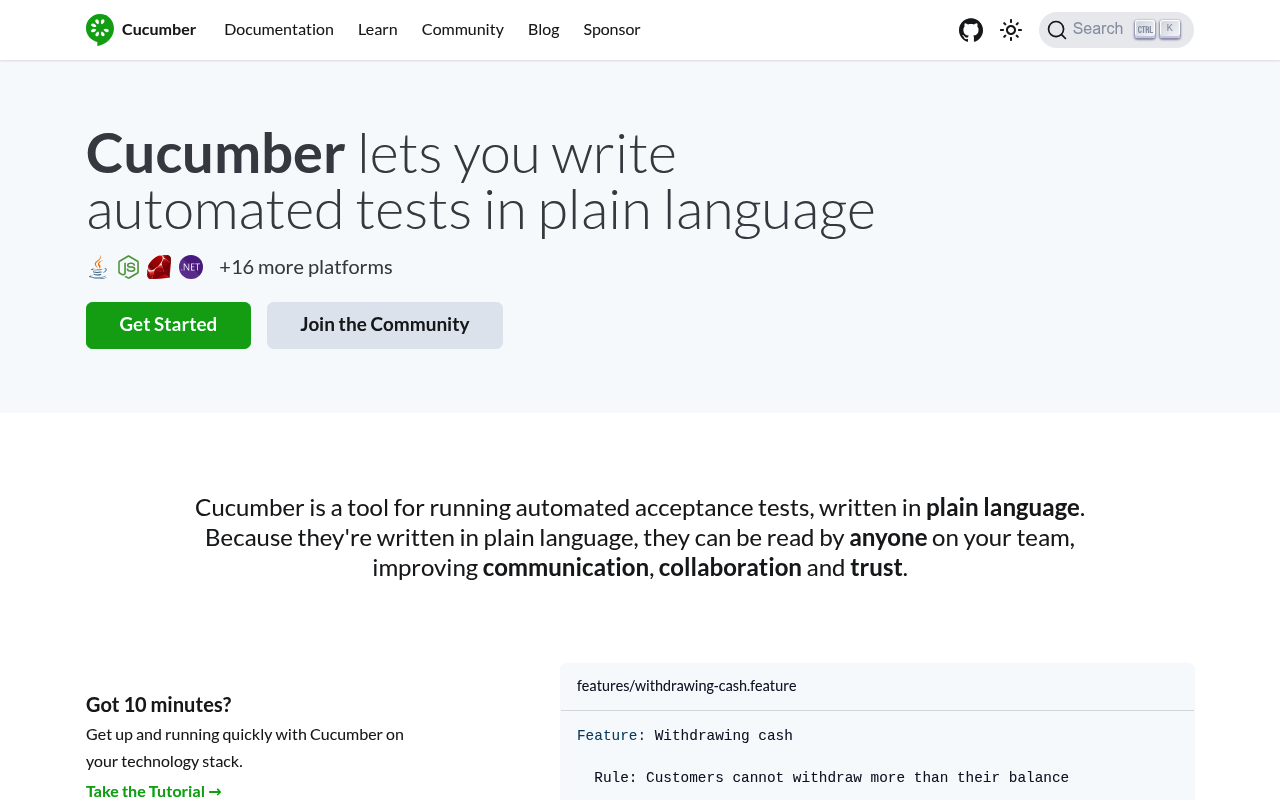
Cucumber website screenshot

Cucumber

Cucumber is an open-source Behavior Driven Development (BDD) tool for running automated tests written in plain language using the Gherkin syntax. It enables collaboration between technical and non-technical team members by expressing executable specifications as Given/When/Then scenarios. Cucumber has implementations for many languages (JVM, JavaScript, Ruby, .NET, Python, Go, Rust) and a shared message protocol that connects parsers, runners, and reporters.

Cucumber publishes 5 APIs on the APIs.io network. Tagged areas include Automation, BDD, Behavior-Driven Development, Gherkin, and Open-Source.

The Cucumber catalog on APIs.io includes 1 JSON-LD context and 1 Spectral governance ruleset.

Cucumber’s developer surface includes documentation, tooling, YouTube channel, engineering blog, and 15 more developer resources.

29.4/100 thin ▬ flat Agent 3/100 human only self hosted · MIT Full breakdown ↓
scored 2026-09-08 · rubric v0.20.0
AccessFreemium
5 APIs
AutomationBDDBehavior-Driven DevelopmentGherkinOpen-SourceQuality AssuranceTest FrameworkTesting

Kin Score

Kin Score Kin Score How this is scored →
scored 2026-09-08 · rubric v0.20.0
Open Source Surface applies to this provider. This product is open source and we read its repository directly, so Open Source Surface carries 10 points of the composite. It is scored from what the repository actually publishes — a security policy, a contribution guide, a release history, a code of conduct — read live from the provider rather than inferred from our own catalog pointers. This facet adds; nothing was taken away to make room for it. An open-source project is not excused from the commercial facets, because exemption would strip it of the points it does earn. If we have the wrong repository, or this product is not open source, say so on your provider repo and we will drop the facet rather than have you publish against it.
Create-or-Update Ergonomics could not be measured. We hold no machine-readable contract for this provider to read, so there is nothing to measure a write surface against. Excluded rather than scored zero: never-measured and measured-empty are different facts. Publishing an OpenAPI is what makes this facet — and several others — scorable at all.
The six quality facets above are damped to 90 points between them, because the conditional facet above carries the other 10. That is why each facet's contribution is shown against a damped maximum: raising a quality facet moves the composite by 90% of its nominal weight, not 100%. The full arithmetic is at apis.io/rating/.
Improve this rating by publishing the missing artifacts — every area above can be raised, and the full rubric is at apis.io/rating/. Every facet and dimension name above is a link: it opens that measurement's own page — what it means, the exact checks that feed it, how the whole catalog distributes on it, and the providers at the top of it. This rating is computed from github.com/api-evangelist/cucumber: open an issue to ask a question, or submit a pull request to add artifacts. Submit an artifact on GitHub — free → Manage your own listing — the Influence plan, $499/mo →

APIs 5

Individual APIs this provider publishes, each with its own machine-readable definition.

Cucumber JVM

Java/JVM implementation of Cucumber supporting Java, Kotlin, Scala, and other JVM languages. Distributed via Maven Central under the io.cucumber group.

Cucumber.js

JavaScript/Node.js implementation of Cucumber for running BDD tests in Node and the browser. Distributed as @cucumber/cucumber on npm.

Cucumber Ruby

Ruby implementation of Cucumber, the original Cucumber project. Distributed as the cucumber gem on RubyGems.

Gherkin

Gherkin is the language used to write Cucumber feature files. Parsers are published per language and emit Cucumber Messages that downstream tools consume.

Cucumber Messages

Protocol-buffer / JSON Schema specification of the messages exchanged between Cucumber components (parsers, runners, formatters). Implemented across all language ports for consi...

Pricing Plans 1

Published pricing tiers and plan structures.

Rate Limits 1

Documented rate limits and quota policies.

Cucumber Rate Limits

5 limits

RATE LIMITS

FinOps 1

Cost, billing, and metering signals for API financial operations.

Semantic Vocabularies 1

JSON-LD contexts and semantic vocabularies used across these APIs.

Cucumber Context

23 classes · 2 properties

JSON-LD

Spectral Rules 1

Spectral governance rulesets for linting and validating these APIs.

Cucumber API Rules

5 rules · 3 warnings 2 info

SPECTRAL

JSON Schema 1

Standalone JSON Schema definitions for this provider's data models.

CucumberMessage

11 properties

JSON SCHEMA

Security Posture 1

Authentication, domain security, vulnerability disclosure, and trust-center signals.

Cucumber Domain Security

TLSv1.3 · DMARC

SECURITY

Resources

Documentation 4

Reference material describing how the API behaves

Design & Contract 2

Pagination, idempotency, versioning, errors, and events

Build 3

SDKs, sample code, and the tooling you integrate with

Access & Security 1

Authentication, authorization, and security posture

Learn 1

Tutorials, courses, talks, and written guidance

Operate 3

Status, limits, changes, and where to get help

Commercial 1

Pricing, plans, and the legal terms of use

Company 2

The organization behind the API

Other 2

Properties that don't map to a standard resource type

Source (apis.yml)

apis.yml Raw ↑
aid: cucumber
url: https://raw.githubusercontent.com/api-evangelist/cucumber/refs/heads/main/apis.yml
kind: opensource
name: Cucumber
description: Cucumber is an open-source Behavior Driven Development (BDD) tool for running automated tests written in plain
  language using the Gherkin syntax. It enables collaboration between technical and non-technical team members by expressing
  executable specifications as Given/When/Then scenarios. Cucumber has implementations for many languages (JVM, JavaScript,
  Ruby, .NET, Python, Go, Rust) and a shared message protocol that connects parsers, runners, and reporters.
deliveryModel:
  model: self-hosted
  license: MIT
  open_source: true
  commercial: false
  callable_host: false
  label: Self-hosted open source · you run it yourself
  confidence: high
  source:
  - license
  generated: '2026-08-28'
  method: derived
accessModel:
  pricing: freemium
  onboarding: unknown
  trial: false
  try_now: false
  public: false
  label: Freemium
  confidence: medium
  source:
  - plans
  generated: '2026-07-22'
  method: derived
image: https://kinlane-images.s3.amazonaws.com/shared/apis-json/icons/cucumber.png
tags:
- Automation
- BDD
- Behavior-Driven Development
- Gherkin
- Open-Source
- Quality Assurance
- Test Framework
- Testing
tags_raw:
- Automation
- BDD
- Behavior Driven Development
- Gherkin
- Open Source
- Quality Assurance
- Test Framework
- Testing
type: Index
specificationVersion: '0.23'
created: '2024-01-01'
modified: '2026-04-28'
apis:
- aid: cucumber:cucumber-jvm
  name: Cucumber JVM
  description: Java/JVM implementation of Cucumber supporting Java, Kotlin, Scala, and other JVM languages. Distributed via
    Maven Central under the io.cucumber group.
  humanURL: https://github.com/cucumber/cucumber-jvm
  baseURL: https://github.com/cucumber/cucumber-jvm
  tags:
  - BDD
  - Java
  - JVM
  - Kotlin
  - Scala
  - Testing
  properties:
  - type: GitHubRepository
    url: https://github.com/cucumber/cucumber-jvm
  - type: Documentation
    url: https://cucumber.io/docs/cucumber/
  - type: PackageIndex
    url: https://search.maven.org/search?q=g:io.cucumber
- aid: cucumber:cucumber-js
  name: Cucumber.js
  description: JavaScript/Node.js implementation of Cucumber for running BDD tests in Node and the browser. Distributed as
    @cucumber/cucumber on npm.
  humanURL: https://github.com/cucumber/cucumber-js
  baseURL: https://github.com/cucumber/cucumber-js
  tags:
  - BDD
  - JavaScript
  - Node.js
  - Testing
  properties:
  - type: GitHubRepository
    url: https://github.com/cucumber/cucumber-js
  - type: Documentation
    url: https://github.com/cucumber/cucumber-js/blob/main/docs/
  - type: PackageIndex
    url: https://www.npmjs.com/package/@cucumber/cucumber
- aid: cucumber:cucumber-ruby
  name: Cucumber Ruby
  description: Ruby implementation of Cucumber, the original Cucumber project. Distributed as the cucumber gem on RubyGems.
  humanURL: https://github.com/cucumber/cucumber-ruby
  baseURL: https://github.com/cucumber/cucumber-ruby
  tags:
  - BDD
  - Ruby
  - Testing
  properties:
  - type: GitHubRepository
    url: https://github.com/cucumber/cucumber-ruby
  - type: Documentation
    url: https://cucumber.io/docs/cucumber/
  - type: PackageIndex
    url: https://rubygems.org/gems/cucumber
- aid: cucumber:gherkin
  name: Gherkin
  description: Gherkin is the language used to write Cucumber feature files. Parsers are published per language and emit Cucumber
    Messages that downstream tools consume.
  humanURL: https://github.com/cucumber/gherkin
  tags:
  - DSL
  - Gherkin
  - Parser
  properties:
  - type: GitHubRepository
    url: https://github.com/cucumber/gherkin
  - type: Reference
    url: https://cucumber.io/docs/gherkin/reference/
- aid: cucumber:cucumber-messages
  name: Cucumber Messages
  description: Protocol-buffer / JSON Schema specification of the messages exchanged between Cucumber components (parsers,
    runners, formatters). Implemented across all language ports for consistent reporting.
  humanURL: https://github.com/cucumber/messages
  tags:
  - Protocol
  - JSON-Schema
  - Message
  tags_raw:
  - Protocol
  - JSON Schema
  - Messages
  properties:
  - type: GitHubRepository
    url: https://github.com/cucumber/messages
  - type: JSONSchema
    url: json-schema/cucumber-message-schema.json
features:
- name: Plain-Language Specifications
  description: Tests written in Gherkin (Given/When/Then) readable by non-engineers.
- name: Multi-Language Implementations
  description: First-class implementations for JVM, JavaScript, Ruby, .NET, Python, Go, and Rust.
- name: Step Definitions and Cucumber Expressions
  description: Pattern-matched code bindings for Gherkin steps via regex or Cucumber Expressions.
- name: Hooks and Tags
  description: Before/After hooks plus tag-driven scenario selection and configuration.
- name: Cucumber Messages Protocol
  description: Shared message format for parsers, runners, and formatters across implementations.
- name: Pluggable Formatters
  description: Built-in pretty, JSON, JUnit, and HTML reporters; third-party formatters supported.
- name: Parallel Execution
  description: Implementations support parallel scenario execution.
- name: CI Integration
  description: Reports plug into CI systems (GitHub Actions, Jenkins, GitLab) via JUnit/HTML output.
useCases:
- name: Acceptance Testing
  description: Product, QA, and engineering collaborate on acceptance tests written in Gherkin.
- name: Living Documentation
  description: Feature files double as up-to-date documentation of system behavior.
- name: API Contract Testing
  description: BDD scenarios verify external API contracts and integrations.
- name: Regression Suites
  description: Tagged scenarios provide selectable regression suites for CI.
- name: Cross-Team Communication
  description: Bridges product, QA, and engineering with a shared specification language.
common:
- type: IssueTracker
  url: https://github.com/cucumber/cucumber-jvm/issues
- type: Releases
  url: https://github.com/cucumber/cucumber-jvm/releases
- type: CodeOfConduct
  url: https://github.com/cucumber/.github/blob/main/CODE_OF_CONDUCT.md
- type: ContributionGuide
  url: https://github.com/cucumber/cucumber-jvm/blob/main/CONTRIBUTING.md
- type: License
  name: MIT
  url: https://github.com/cucumber/cucumber-jvm/blob/main/LICENSE
- type: DomainSecurity
  url: security/cucumber-domain-security.yml
- type: Website
  url: https://cucumber.io
- type: Documentation
  url: https://cucumber.io/docs
- type: Reference
  url: https://cucumber.io/docs/gherkin/reference/
- type: School
  url: https://school.cucumber.io
- type: Tools
  url: https://cucumber.io/tools
- type: GitHubOrganization
  url: https://github.com/cucumber
- type: X
  url: https://twitter.com/cucumberbdd
- type: Slack
  url: https://cucumber.io/community#slack
- type: YouTube
  url: https://www.youtube.com/channel/UCVhQ7ulinkFAkUx3eNvzoEg
- type: JSONSchema
  url: json-schema/cucumber-message-schema.json
- type: JSONLDContext
  url: json-ld/cucumber-context.jsonld
- type: Vocabulary
  url: vocabulary/cucumber-vocabulary.yml
- type: Blog
  url: https://cucumber.io/blog/atom.xml
maintainers:
- FN: Kin Lane
  email: kin@apievangelist.com

Work with this as data

Every provider here is available over the APIs.io API and to AI agents over MCP.

MCP server

One button, every client — Claude, Cursor, VS Code and the rest.

https://apis.io/mcp

Tools for providers

9 MCP tools reach this
  • find_providersBrowse and filter every provider in the catalog.
  • get_provider_artifactsEvery artifact this provider publishes, grouped by type.
  • get_provider_operationsEvery operation across all of their OpenAPIs — one call instead of parsing every spec.
  • get_provider_toolsEvery MCP tool they ship, with the operation each wraps.
  • get_provider_evidenceHow each part of their score was established. Free — the basis for a claim should not sit behind it.
  • get_provider_ratingPRO — composite, band, trend and facet scores.
  • apis_io_searchSTART HERE — APIs, providers and tags for one query, each with its total.
  • resolveTurn a domain, URL or GitHub org into the provider it belongs to.
  • find_cohortsEvery scored population of providers in the catalog.
All 92 tools →

Call it yourself

curl for this page
This provider
curl "https://apis.io/api/v1/providers/cucumber"
All providers
curl "https://apis.io/api/v1/providers?limit=25"
Every operation they expose
curl "https://apis.io/api/v1/providers/cucumber/operations?limit=25"
How their score was established
curl "https://apis.io/api/v1/providers/cucumber/evidence"

Discovery needs no key. Ratings and market analysis are Pro.

Get an API key

Free tier, no form to fill in. Signing in shares your email address with us — we store it to create your key and to recognise you if you sign in with another provider. See our Privacy Policy and Terms.

A second provider on the same verified email joins the account you already have.
