Carvana
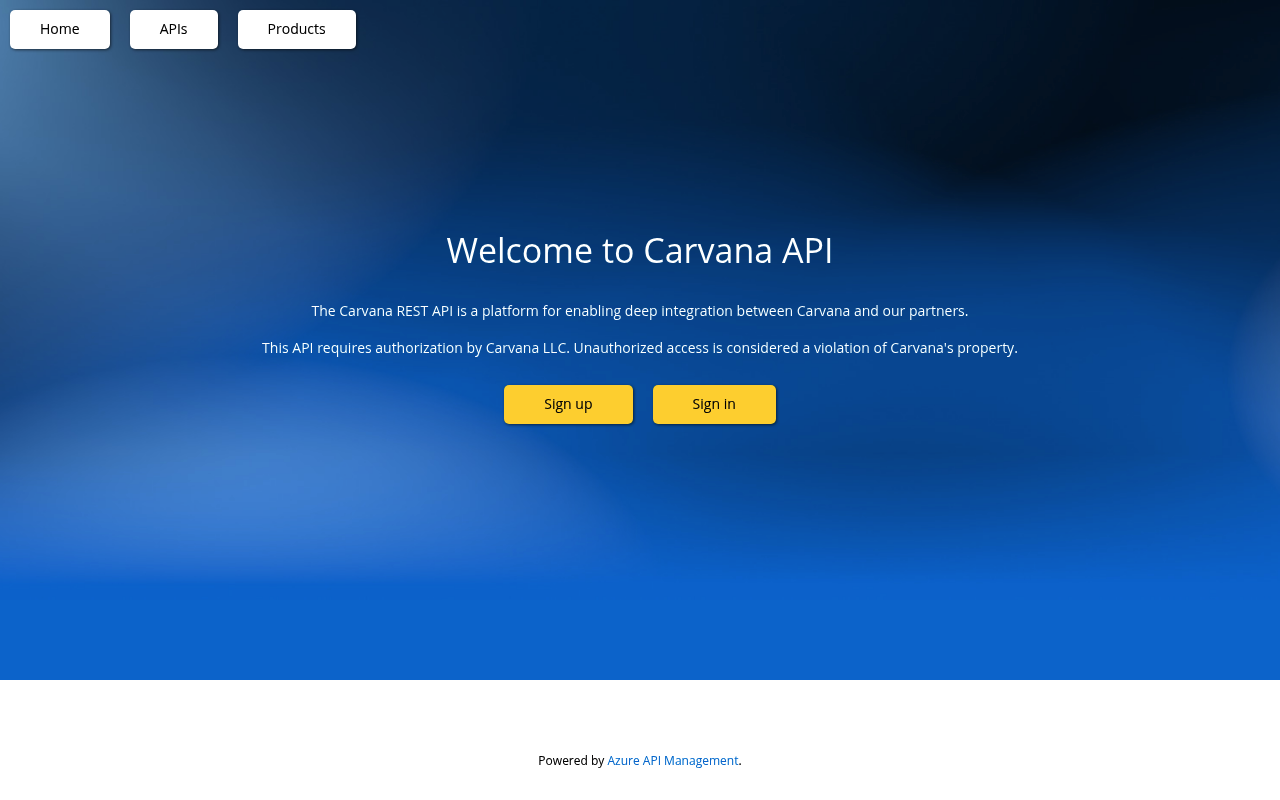
Carvana is an e-commerce platform for buying, selling, and financing used cars online, with home delivery or pickup at its car vending machines. Its developer-facing surface is the Carvana Partner REST API on Azure API Management at api-developer.carvana.com, which lets authorized rental companies, wholesalers and fleet partners post, update and manage inventory in Carvana's catalog. A second surface, the Carvana Collective API, answers every request with an HTTP Basic challenge whose realm is "Collective API Reference". Both are closed: the portal's own management proxy returns an empty API and product list to anonymous callers, so no contract, product, quota or price is readable until Carvana LLC authorizes a partner. What Carvana does publish for machines is an llms.txt at www.carvana.com/llms.txt and a Bugcrowd-hosted responsible disclosure programme.
Carvana is listed with 2 APIs on the APIs.io network. Tagged areas include Automotive, E-Commerce, Used Cars, Inventory, and Partner API.
The Carvana catalog on APIs.io includes 1 JSON-LD context.
Carvana’s developer surface includes developer portal, support, documentation, signup flow, authentication, and 23 more developer resources.
Kin Score
 Kin Score
How this is scored →
Kin Score
How this is scored →scored 2026-10-17 · rubric v0.24.0
APIs 2
Individual APIs this provider publishes, each with its own machine-readable definition.
Carvana Partner API
REST API that enables deep integration between Carvana and authorized partners (car rental companies, wholesalers, and fleet operators) for posting, updating, and managing used-...
Carvana Collective API
API surface supporting Carvana Collective partner-collaborative workflows; access is restricted to authorized Carvana partners.
Pricing Plans 1
Published pricing tiers and plan structures.
Rate Limits 1
Documented rate limits and quota policies.
Carvana Rate Limits
RATE LIMITSFinOps 1
Cost, billing, and metering signals for API financial operations.
Carvana Finops
FINOPSSemantic Vocabularies 1
JSON-LD contexts and semantic vocabularies used across these APIs.
Carvana Context
JSON-LDSecurity Posture 3
Authentication, domain security, vulnerability disclosure, and trust-center signals.
Resources
Get Started 3
Portal, sign-up, and the first successful call
Documentation 1
Reference material describing how the API behaves
Agent Surfaces 1
MCP servers, agent skills, and machine-readable catalogs
Design & Contract 3
Pagination, idempotency, versioning, errors, and events
Build 1
SDKs, sample code, and the tooling you integrate with
Access & Security 4
Authentication, authorization, and security posture
Operate 2
Status, limits, changes, and where to get help
Commercial 4
Pricing, plans, and the legal terms of use
Company 6
The organization behind the API
Other 3
Properties that don't map to a standard resource type
Source (apis.yml)
Work with this as data
Every provider here is available over the APIs.io API and to AI agents over MCP.