Bootic
Bootic is an e‑commerce platform based in Chile, offering a marketplace where multiple vendors sell products through a unified shopping experience. The site provides a modern storefront, advanced search, and integration options for businesses to reach customers online.
Bootic publishes 19 API contracts indexed on the APIs.io network, including Catalog API, Collections API, Content API, and 16 more. Tagged areas include E-Commerce, Marketplace, Chile, Platform, and Retail.
The Bootic catalog on APIs.io includes 1 event-driven AsyncAPI specification.
Bootic’s developer surface includes authentication, engineering blog, getting-started guide, documentation, API reference, and 13 more developer resources.
Kin Score
 Kin Score
How this is scored →
Kin Score
How this is scored →scored 2026-10-23 · rubric v0.25.0
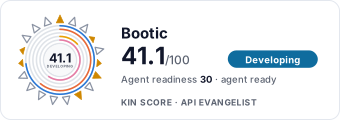 It updates itself when the score changes. Paste this where you link to your API docs:
<a href="https://apis.io/providers/bootic/"><img src="https://apis.io/badge/bootic/card.svg" alt="Bootic on APIs.io — Kin Score by API Evangelist"></a>Other styles, a README pill and a shields.io endpoint are on the badge page.
APIs 19
Individual APIs this provider publishes, each with its own machine-readable definition.
Bootic Catalog API
The Catalog API from Bootic — 3 operation(s) for catalog.
Bootic Collections API
Curated product collections (manually or rule-based). Products can belong to multiple collections.
Bootic Content API
CMS-style content for a shop's storefront — blog posts, static pages, and contact/lead-capture forms.
Bootic Customers API
Shop customers. Includes customer authentication and password-reset flows.
Bootic Orders API
Shop orders. Supports batch status updates and per-order document management.
Bootic Price Lists API
Named price lists for B2B / wholesale pricing. Products can have per-variant price overrides within a price list.
Bootic Product Types API
Product type definitions used to group and filter catalog products.
Bootic Products API
Catalog products, automatically scoped to the authenticated account's sellers. Account-scoped tokens need no extra parameters; tokens without an account/seller scope must supply...
Bootic Promotions API
Promotional discount codes and automatic discounts applied at checkout.
Bootic Root API
API entry point — embeds sellers, shops, and navigation links to every resource
Bootic Sellers API
Seller entities — the business layer between an account and its shops. An account can have multiple sellers, each owning one or more shops and their product catalog.
Bootic Shops API
Shops owned by the authenticated account. A shop is the customer-facing storefront that belongs to a seller. Settings, admins, shipping tables, payment methods, exchange rates, ...
Bootic Store API
The Store API from Bootic — 1 operation(s) for store.
Bootic Subscriptions API
Recurring product subscriptions. `SubscriptionFee` defines the recurring payment terms attached to a product/variant; `SubscriptionPurchase` is a customer's active subscription ...
Bootic Themes API
Hosted-storefront themes, templates, and assets. Applies only to shops with a hosted storefront (`store:` namespace); absent for headless shops.
Bootic Variants API
Product variants (size, colour, etc.). Nested under `/products/{product_id}/variants`. Each variant holds its own SKU, price, stock level, and images.
Bootic Volume Discounts API
Quantity-based discount rules (tiered pricing by units purchased).
Bootic Wallets API
Points and store-credit wallets, one per contact per program. A seller runs at most one active `PointsProgram` and one active `CreditProgram`, each covering every shop under the...
Bootic Webhooks API
Event webhooks. Subscribe to events such as `orders.created`, `products.updated`, etc. Inactive subscriptions can be reactivated and their delivery history inspected.
Scroll for all 19
Event Specifications 1
AsyncAPI definitions for this provider's event-driven and streaming APIs.
Bootic Webhooks
ASYNCAPIOpenAPI Overlays 1
Overlays applied on top of this provider's contracts. Each card says who wrote it: a document the provider publishes, or one API Evangelist derived or generated.
Bootic Openapi Overlay
DERIVEDSecurity Posture 2
Authentication, domain security, vulnerability disclosure, and trust-center signals.
Resources
Get Started 2
Portal, sign-up, and the first successful call
Documentation 2
Reference material describing how the API behaves
Agent Surfaces 1
MCP servers, agent skills, and machine-readable catalogs
Design & Contract 4
Pagination, idempotency, versioning, errors, and events
Build 3
SDKs, sample code, and the tooling you integrate with
Access & Security 2
Authentication, authorization, and security posture
Company 2
The organization behind the API
Other 2
Properties that don't map to a standard resource type
Source (apis.yml)
Work with this as data
Every provider here is available over the APIs.io API and to AI agents over MCP.