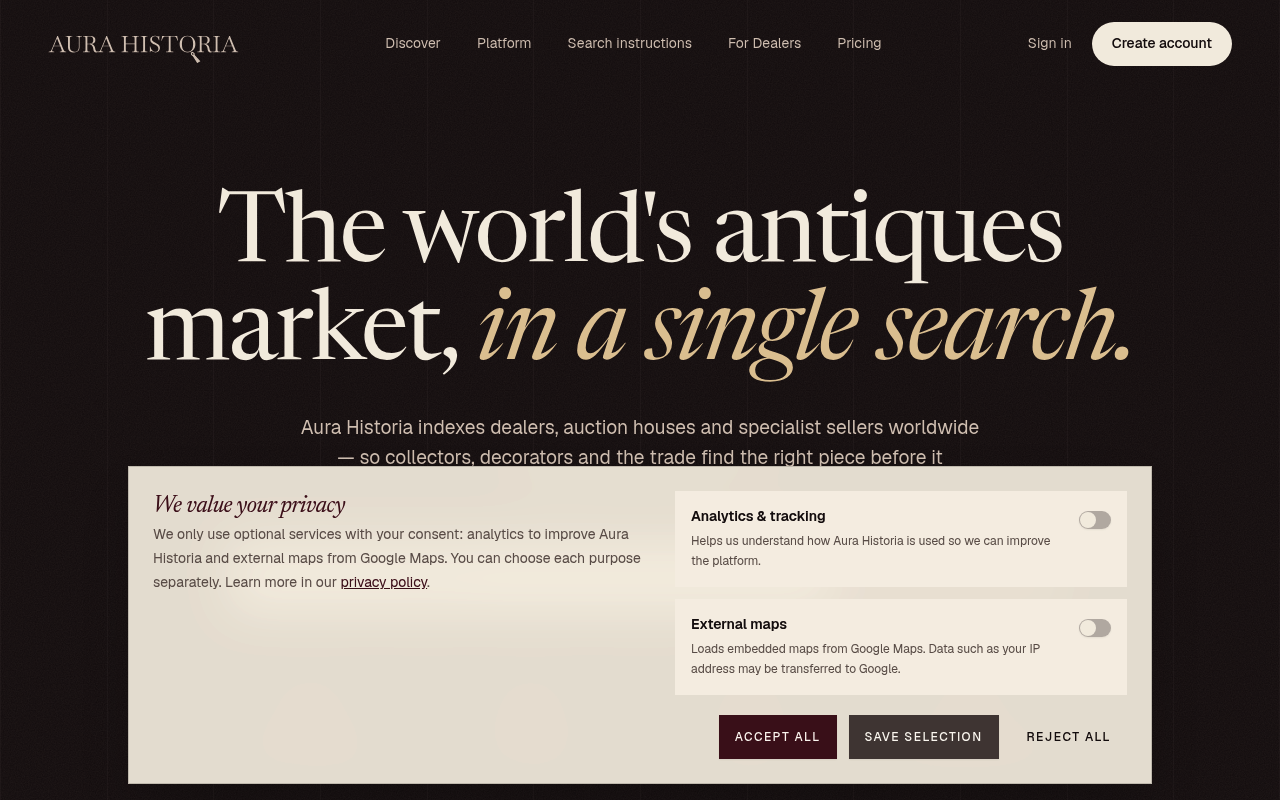
Aura Historia is a global platform for antiques, art, and distinctive objects. It indexes dealers, auction houses, and specialist sellers worldwide, providing a single searchable view for collectors, decorators, and trade professionals. The service aggregates scattered inventory, offers watchlists, alerts, and multilingual search, and connects users directly to original listings, ensuring clarity and accessibility across markets.
Aura Historia publishes 18 API contracts indexed on the APIs.io network, including Administration API, Auctions API, Billing API, and 15 more. Tagged areas include Company, Antiques, Marketplace, Search, and Software-as-a-Service.
The Aura Historia catalog on APIs.io includes 1 JSON-LD context and 1 Spectral governance ruleset.
Aura Historia’s developer surface includes authentication, API reference, pricing, signup flow, and 24 more developer resources.
Pull Aura Historia's APIs, OpenAPI, scores and pricing into your own code or AI agent
with a free APIs.io key —
sign in with
GitHub,
Google or
LinkedIn.
No form to fill in; signing in shares your email address with us (Privacy).
Regulatory Posture applies to this provider. Its tags matched the
Horizontal (data, software, accessibility, platform) regime, so
Regulatory Posture carries 15 points of the composite.
If this regime is wrong for your business, say so on your
provider repo — the
applicability map is public and we will correct it.
Create-or-Update Ergonomics applies to this provider. This API accepts writes, so it
carries 10 points of the composite. It is scored from the published contracts
themselves: whether a caller can create-or-update in one call, whether the write accepts a key the caller already
holds, and whether the response says which branch ran. Without that, every write needs a search-and-branch in
front of it, and the first time that check is skipped a duplicate record is created.
Scored against the observed mean rather than raw — a provider at the catalog average is unchanged by this facet,
not penalised by it.
The six quality facets above are damped to 75 points between them,
because the conditional facet above carries the other
25. That is why each facet's contribution is shown against a damped
maximum: raising a quality facet moves the composite by 75% of its nominal
weight, not 100%. The full arithmetic is at apis.io/rating/.
Show this score on your site.
It updates itself when the score changes. Paste this where you link to your API docs:
<a href="https://apis.io/providers/aura-historia-com/"><img src="https://apis.io/badge/aura-historia-com/card.svg" alt="Aura Historia on APIs.io — Kin Score by API Evangelist"></a>
Other styles, a README pill and a shields.io endpoint are on the badge page.
Raise your score.
Agent readiness — checks not met, largest first (exact, from this profile):
Rate-Limit Signaling+7 pts — OpenAPI responses document X-RateLimit-* / RateLimit headers (verified), else a rate_limits artifact or RateLimits link (documented) Ask about this →
Typed Event Surface+6 pts — AsyncAPI document, OR webhooks/callbacks objects in the as-published OpenAPI, OR common[].type includes Webhooks Ask about this →
Pagination+5 pts — share of collection GETs (an array, or one wrapped in data/items/results ...) that declare a page/limit/offset/cursor parameter, a Link header or a next/cursor field; na with no collection GETs Ask about this →
Agentic Commerce Well-Known Document+5 pts — a parsing /.well-known/ucp (the IANA-registered path, probed first) or ucp.json / acp.json declaring a version and at least one service, OR (0.27) a live x402 payment challenge from _data/x402-adoption.json — `self` when its endpoints are on the provider's own domain, `platform` when they are on a vendor's Ask about this →
3 more unmet checks in the Agent Readiness table above.
Kin Score — facets with the most composite points still available (weight × headroom):
Each check links to what satisfies it. Publish the artifact, or tell us where it already lives, and the score moves on the next scoring run.
Not sure how this applies to your stack? Ask about any one item. Kin Lane reads every question, looks at your profile and your situation, and replies with what a fix would take — scoped to that one area, priced up front, yours whether you ship it or not. Ask a question →
Standards this provider implements or carries. De facto ones are profiled and measured by the API Commons; formal ones come from the standards directory and are linked by the provider's own tags. The evidence column says how each claim was established — not that it was made.
Yes. APIs.io lists 18 APIs from Aura Historia, including Aura Historia Administration API, Aura Historia Auctions API and Aura Historia Billing API, and 15 more.
Is there an OpenAPI specification for the Aura Historia API?
Yes. APIs.io indexes 18 OpenAPI specifications for Aura Historia, each linked for download from this page.
How do I authenticate with the Aura Historia API?
Aura Historia documents its authentication (2 schemes). The details are profiled on APIs.io as Aura Historia Authentication.
Does Aura Historia have an MCP server?
Yes. APIs.io lists 1 MCP server for Aura Historia: Remote MCP server at mcp.aura-historia.com.
Is the Aura Historia API ready for AI agents?
Aura Historia has a Kin Score of 48.1 out of 100 (developing) and an Agent Readiness score of 52.8 (agent-native), scored by API Evangelist on 2026-11-21.
Calls without X-API-Key need no key. Calls with it need a paid plan — get a key.
Get an API key
Free tier, no form to fill in. Signing in shares your email address with us — we
store it to create your key and to recognise you if you sign in with another
provider. By signing up you are subscribing to the APIs.io and API Evangelist
newsletters — you can unsubscribe from any issue. See our
Privacy Policy and Terms.
 Kin Score
How this is scored →
 It updates itself when the score changes. Paste this where you link to your API docs: