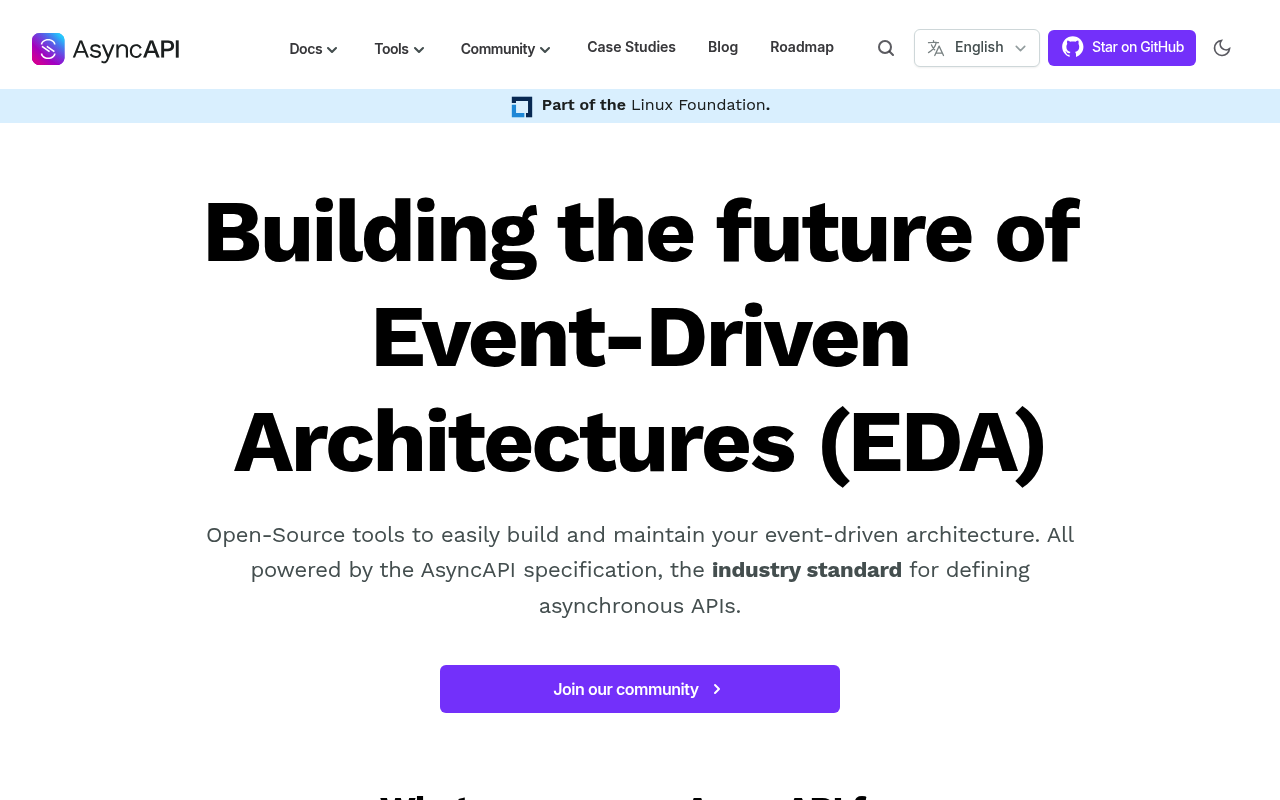
AsyncAPI website screenshot

AsyncAPI

AsyncAPI is a Linux Foundation project that improves the state of event-driven architectures by providing an open specification and tooling ecosystem for defining asynchronous and event-driven APIs. It enables developers to document, validate, generate code, and manage message-driven APIs across protocols including Kafka, MQTT, WebSocket, AMQP, and others. The AsyncAPI specification serves as the industry standard for describing asynchronous messaging interfaces, similar to how OpenAPI serves REST APIs.

AsyncAPI publishes 9 APIs on the APIs.io network, including Specification, Server API, Bundle API, and 6 more. Tagged areas include Event-Driven, Linux Foundation, Messaging, Standards, and Specification.

AsyncAPI’s developer surface includes developer portal, documentation, engineering blog, CLI, authentication, changelog, sandbox, and 26 more developer resources.

44.4/100 developing ▬ flat Agent 31/100 agent ready Full breakdown ↓
scored 2026-09-08 · rubric v0.20.0
AccessFree⚡ Free to try
1 APIs 5 Features 3 Use Cases
Event-DrivenLinux FoundationMessagingStandardsSpecification

Kin Score

Kin Score Kin Score How this is scored →
scored 2026-09-08 · rubric v0.20.0
Create-or-Update Ergonomics applies to this provider. This API accepts writes, so it carries 10 points of the composite. It is scored from the published contracts themselves: whether a caller can create-or-update in one call, whether the write accepts a key the caller already holds, and whether the response says which branch ran. Without that, every write needs a search-and-branch in front of it, and the first time that check is skipped a duplicate record is created. Scored against the observed mean rather than raw — a provider at the catalog average is unchanged by this facet, not penalised by it.
Improve this rating by publishing the missing artifacts — every area above can be raised, and the full rubric is at apis.io/rating/. Every facet and dimension name above is a link: it opens that measurement's own page — what it means, the exact checks that feed it, how the whole catalog distributes on it, and the providers at the top of it. This rating is computed from github.com/api-evangelist/asyncapi: open an issue to ask a question, or submit a pull request to add artifacts. Submit an artifact on GitHub — free → Manage your own listing — the Influence plan, $499/mo →

APIs 9

Individual APIs this provider publishes, each with its own machine-readable definition.

AsyncAPI Specification

The AsyncAPI Specification is an open standard for describing asynchronous and event-driven APIs. It provides a machine-readable format for defining messaging interfaces across ...

AsyncAPI Server API

The AsyncAPI Server API is the only callable HTTP API the AsyncAPI Initiative operates. It exposes the official AsyncAPI toolchain — validate, parse, convert, generate, bundle a...

AsyncAPI Bundle API

The Bundle API from AsyncAPI — 1 operation(s) for bundle.

AsyncAPI Convert API

The Convert API from AsyncAPI — 1 operation(s) for convert.

AsyncAPI Diff API

The Diff API from AsyncAPI — 1 operation(s) for diff.

AsyncAPI Generate API

The Generate API from AsyncAPI — 1 operation(s) for generate.

AsyncAPI Help API

The Help API from AsyncAPI — 1 operation(s) for help.

AsyncAPI Parse API

The Parse API from AsyncAPI — 1 operation(s) for parse.

AsyncAPI Validate API

The Validate API from AsyncAPI — 1 operation(s) for validate.

Scroll for all 9

Open Collections 9

Open, tool-agnostic API collections (OpenAPI-derived and Bruno).

API Collection

OPEN COLLECTION

AsyncAPI Server API

OPEN COLLECTION

Scroll for all 9

Pricing Plans 1

Published pricing tiers and plan structures.

Rate Limits 1

Documented rate limits and quota policies.

Asyncapi Rate Limits

0 limits

RATE LIMITS

FinOps 2

Cost, billing, and metering signals for API financial operations.

Features 5

Notable capabilities this provider offers.

AsyncAPI Specification

An open specification standard for describing asynchronous and event-driven APIs, supporting multiple messaging protocols including Kafka, MQTT, WebSocket, AMQP, and more.

AsyncAPI Generator

Code and documentation generation tool that uses AsyncAPI definitions to produce boilerplate code, documentation, and other artifacts in multiple programming languages.

AsyncAPI CLI

Command-line interface tool for working with AsyncAPI files including validation, generation, and conversion operations from the terminal.

AsyncAPI Studio

Web-based editor and visualization tool for creating, editing, and previewing AsyncAPI specification documents with real-time validation.

Protocol Support

Broad protocol support covering Kafka, MQTT, WebSocket, AMQP, NATS, JMS, and other messaging protocols through a unified specification format.

Security Posture 3

Authentication, domain security, vulnerability disclosure, and trust-center signals.

Asyncapi Authentication

0 schemes

SECURITY

Asyncapi Domain Security

TLSv1.3 · HSTS

SECURITY

Asyncapi Vulnerability Disclosure

security.txt · contact published

SECURITY

Agentic Access 1

Recommended x-agentic-access execution contracts for AI agents.

Asyncapi Agentic Access

7 operations · 6 acting

7 operations · 6 acting

AGENTIC

Use Cases 3

What developers build with this provider.

Event-Driven API Documentation

Development teams use AsyncAPI to create machine-readable documentation for their message-driven APIs, making it easier for consumers to understand and integrate with event stre...

Code Generation for Messaging

Engineers generate boilerplate code for Kafka consumers, MQTT publishers, and other messaging clients directly from AsyncAPI specifications to accelerate development.

API Governance for Event-Driven Systems

Platform teams apply AsyncAPI specifications to enforce standards and governance across microservices architectures using event-driven communication.

Integrations 3

Pre-built integrations with other platforms and tools.

Apache Kafka

AsyncAPI supports defining Kafka-based event-driven APIs with topic, message schema, and broker configuration documentation.

MQTT Brokers

IoT and messaging platforms using MQTT can document their pub/sub interfaces using AsyncAPI specifications for device and service integration.

CI/CD Pipelines

AsyncAPI CLI integrates into continuous integration pipelines for automated validation and linting of AsyncAPI specification files.

Resources

Get Started 4

Portal, sign-up, and the first successful call

Documentation 2

Reference material describing how the API behaves

Agent Surfaces 3

MCP servers, agent skills, and machine-readable catalogs

Design & Contract 6

Pagination, idempotency, versioning, errors, and events

Build 4

SDKs, sample code, and the tooling you integrate with

Access & Security 4

Authentication, authorization, and security posture

Operate 3

Status, limits, changes, and where to get help

Commercial 3

Pricing, plans, and the legal terms of use

Company 3

The organization behind the API

Other 1

Properties that don't map to a standard resource type

Source (apis.yml)

apis.yml Raw ↑
aid: asyncapi
name: AsyncAPI
description: AsyncAPI is a Linux Foundation project that improves the state of event-driven architectures by providing an
  open specification and tooling ecosystem for defining asynchronous and event-driven APIs. It enables developers to document,
  validate, generate code, and manage message-driven APIs across protocols including Kafka, MQTT, WebSocket, AMQP, and others.
  The AsyncAPI specification serves as the industry standard for describing asynchronous messaging interfaces, similar to
  how OpenAPI serves REST APIs.
type: Index
deliveryModel:
  model: open-source
  open_source: true
  commercial: false
  callable_host: true
  label: Open source (Apache-2.0) with a free hosted API
  confidence: high
  source:
  - openapi
  - packages
  - plans
  note: The specification and every first-party tool are Apache-2.0 under the Linux Foundation, and the AsyncAPI Server API
    is callable at https://api.asyncapi.com/v1 — verified by an anonymous HTTP 200 on 2026-09-06. There is no commercial offering
    of any kind.
  generated: '2026-09-06'
  method: probed
accessModel:
  pricing: free
  onboarding: none
  trial: false
  try_now: true
  public: true
  label: Free and keyless — no account required
  confidence: high
  source:
  - plans
  - authentication
  note: No pricing page, no plans, no signup and no API key. An anonymous POST to https://api.asyncapi.com/v1/validate returned
    HTTP 200 on 2026-09-06, and AsyncAPI Studio at https://studio.asyncapi.com is usable without an account.
  generated: '2026-09-06'
  method: probed
image: https://kinlane-images.s3.amazonaws.com/shared/apis-json/icons/asyncapi.png
tags:
- Event-Driven
- Linux Foundation
- Messaging
- Standards
- Specification
url: https://raw.githubusercontent.com/api-evangelist/asyncapi/refs/heads/main/apis.yml
created: '2026-03-16'
modified: '2026-09-06'
specificationVersion: '0.23'
apis:
- aid: asyncapi:asyncapi-spec
  name: AsyncAPI Specification
  description: The AsyncAPI Specification is an open standard for describing asynchronous and event-driven APIs. It provides
    a machine-readable format for defining messaging interfaces across protocols like Kafka, MQTT, WebSocket, and AMQP, enabling
    documentation generation, code generation, and validation tooling for event-driven architectures.
  humanURL: https://www.asyncapi.com/docs
  tags:
  - Event-Driven
  - Messaging
  - Specification
  - Standards
  properties:
  - type: Documentation
    url: https://www.asyncapi.com/docs
  - type: GettingStarted
    url: https://www.asyncapi.com/docs/tutorials/getting-started
  - type: AsyncAPI
    url: https://github.com/asyncapi/spec/blob/master/spec/asyncapi.md
- aid: asyncapi:asyncapi-server-api
  name: AsyncAPI Server API
  description: 'The AsyncAPI Server API is the only callable HTTP API the AsyncAPI Initiative operates. It exposes the official
    AsyncAPI toolchain — validate, parse, convert, generate, bundle and diff — over HTTP at https://api.asyncapi.com/v1, free,
    keyless and without signup. It is stateless: every operation takes an AsyncAPI (or OpenAPI 3.0) document in the request
    body and returns a derived document, diagnostics or service metadata. The same service is self-hostable via Docker or
    `asyncapi start api`.'
  humanURL: https://api.asyncapi.com/v1/docs
  baseURL: https://api.asyncapi.com/v1
  tags:
  - Event-Driven
  - Specification
  - Tooling
  - Validation
  - Code Generation
  properties:
  - type: OpenAPI
    url: openapi/asyncapi-server-api-openapi.yml
  - type: APIReference
    url: https://api.asyncapi.com/v1/docs
  - type: Overlay
    url: overlays/asyncapi-server-api-overlay.yaml
  - type: ErrorCatalog
    url: errors/asyncapi-problem-types.yml
  - type: DataModel
    url: data-model/asyncapi-data-model.yml
  - type: SourceCode
    url: https://github.com/asyncapi/cli/tree/master/src/apps/api
- aid: asyncapi:asyncapi-bundle-api
  name: AsyncAPI Bundle API
  description: The Bundle API from AsyncAPI — 1 operation(s) for bundle.
  humanURL: https://api.asyncapi.com/v1/docs
  baseURL: https://api.asyncapi.com/v1
  tags:
  - Bundle
  properties:
  - type: OpenAPI
    url: openapi/asyncapi-bundle-api-openapi.yml
- aid: asyncapi:asyncapi-convert-api
  name: AsyncAPI Convert API
  description: The Convert API from AsyncAPI — 1 operation(s) for convert.
  humanURL: https://api.asyncapi.com/v1/docs
  baseURL: https://api.asyncapi.com/v1
  tags:
  - Convert
  properties:
  - type: OpenAPI
    url: openapi/asyncapi-convert-api-openapi.yml
- aid: asyncapi:asyncapi-diff-api
  name: AsyncAPI Diff API
  description: The Diff API from AsyncAPI — 1 operation(s) for diff.
  humanURL: https://api.asyncapi.com/v1/docs
  baseURL: https://api.asyncapi.com/v1
  tags:
  - Diff
  properties:
  - type: OpenAPI
    url: openapi/asyncapi-diff-api-openapi.yml
- aid: asyncapi:asyncapi-generate-api
  name: AsyncAPI Generate API
  description: The Generate API from AsyncAPI — 1 operation(s) for generate.
  humanURL: https://api.asyncapi.com/v1/docs
  baseURL: https://api.asyncapi.com/v1
  tags:
  - Generate
  properties:
  - type: OpenAPI
    url: openapi/asyncapi-generate-api-openapi.yml
- aid: asyncapi:asyncapi-help-api
  name: AsyncAPI Help API
  description: The Help API from AsyncAPI — 1 operation(s) for help.
  humanURL: https://api.asyncapi.com/v1/docs
  baseURL: https://api.asyncapi.com/v1
  tags:
  - Help
  properties:
  - type: OpenAPI
    url: openapi/asyncapi-help-api-openapi.yml
- aid: asyncapi:asyncapi-parse-api
  name: AsyncAPI Parse API
  description: The Parse API from AsyncAPI — 1 operation(s) for parse.
  humanURL: https://api.asyncapi.com/v1/docs
  baseURL: https://api.asyncapi.com/v1
  tags:
  - Parse
  properties:
  - type: OpenAPI
    url: openapi/asyncapi-parse-api-openapi.yml
- aid: asyncapi:asyncapi-validate-api
  name: AsyncAPI Validate API
  description: The Validate API from AsyncAPI — 1 operation(s) for validate.
  humanURL: https://api.asyncapi.com/v1/docs
  baseURL: https://api.asyncapi.com/v1
  tags:
  - Validate
  properties:
  - type: OpenAPI
    url: openapi/asyncapi-validate-api-openapi.yml
common:
- type: Website
  url: https://www.asyncapi.com/
- type: AgenticAccess
  url: agentic-access/asyncapi-agentic-access.yml
- type: DomainSecurity
  url: security/asyncapi-domain-security.yml
- type: LinkedIn
  url: https://www.linkedin.com/company/asyncapi
- type: Portal
  url: https://www.asyncapi.com/
  title: AsyncAPI Website
- type: Documentation
  url: https://www.asyncapi.com/docs
  title: Documentation
- type: GitHubOrganization
  url: https://github.com/asyncapi
  title: AsyncAPI GitHub Organization
- type: Blog
  url: https://www.asyncapi.com/blog
  title: Blog
- type: Features
  data:
  - name: AsyncAPI Specification
    description: An open specification standard for describing asynchronous and event-driven APIs, supporting multiple messaging
      protocols including Kafka, MQTT, WebSocket, AMQP, and more.
  - name: AsyncAPI Generator
    description: Code and documentation generation tool that uses AsyncAPI definitions to produce boilerplate code, documentation,
      and other artifacts in multiple programming languages.
  - name: AsyncAPI CLI
    description: Command-line interface tool for working with AsyncAPI files including validation, generation, and conversion
      operations from the terminal.
  - name: AsyncAPI Studio
    description: Web-based editor and visualization tool for creating, editing, and previewing AsyncAPI specification documents
      with real-time validation.
  - name: Protocol Support
    description: Broad protocol support covering Kafka, MQTT, WebSocket, AMQP, NATS, JMS, and other messaging protocols through
      a unified specification format.
- type: UseCases
  data:
  - name: Event-Driven API Documentation
    description: Development teams use AsyncAPI to create machine-readable documentation for their message-driven APIs, making
      it easier for consumers to understand and integrate with event streams.
  - name: Code Generation for Messaging
    description: Engineers generate boilerplate code for Kafka consumers, MQTT publishers, and other messaging clients directly
      from AsyncAPI specifications to accelerate development.
  - name: API Governance for Event-Driven Systems
    description: Platform teams apply AsyncAPI specifications to enforce standards and governance across microservices architectures
      using event-driven communication.
- type: Integrations
  data:
  - name: Apache Kafka
    description: AsyncAPI supports defining Kafka-based event-driven APIs with topic, message schema, and broker configuration
      documentation.
  - name: MQTT Brokers
    description: IoT and messaging platforms using MQTT can document their pub/sub interfaces using AsyncAPI specifications
      for device and service integration.
  - name: CI/CD Pipelines
    description: AsyncAPI CLI integrates into continuous integration pipelines for automated validation and linting of AsyncAPI
      specification files.
- type: Packages
  url: packages/asyncapi-packages.yml
  title: First-party packages and SDKs
- type: SDKs
  url: packages/asyncapi-packages.yml
  title: AsyncAPI client libraries and tooling packages
- type: CLI
  url: cli/asyncapi-cli.yml
  title: AsyncAPI CLI command surface
- type: Components
  url: components/asyncapi-components.yml
  title: Embeddable AsyncAPI document renderers
- type: Authentication
  url: authentication/asyncapi-authentication.yml
  title: Authentication profile (keyless public API)
- type: Conventions
  url: conventions/asyncapi-conventions.yml
  title: API conventions and runtime semantics
- type: ErrorCatalog
  url: errors/asyncapi-problem-types.yml
  title: Problem-details error catalog
- type: Lifecycle
  url: lifecycle/asyncapi-lifecycle.yml
  title: Versioning and lifecycle
- type: ChangeLog
  url: changelog/asyncapi-changelog.yml
  title: Specification and CLI release history
- type: Conformance
  url: conformance/asyncapi-conformance.yml
  title: Standards conformance
- type: DataModel
  url: data-model/asyncapi-data-model.yml
  title: Server API data model
- type: Plans
  url: plans/asyncapi-plans-pricing.yml
  title: Plans and pricing (none — open source, no commercial tiers)
- type: RateLimits
  url: rate-limits/asyncapi-rate-limits.yml
  title: Rate limits (none published)
- type: Sandbox
  url: sandbox/asyncapi-sandbox.yml
  title: AsyncAPI Studio and self-hosted API
- type: Console
  url: https://studio.asyncapi.com
  title: AsyncAPI Studio
- type: Overlay
  url: overlays/asyncapi-server-api-overlay.yaml
  title: API Evangelist enhancements overlay
- type: LLMsTxt
  url: llms/asyncapi-llms.txt
  title: llms.txt
- type: AgentSkill
  url: skills/_index.yml
  title: Packaged agent skills for the AsyncAPI Server API
- type: VulnerabilityDisclosure
  url: security/asyncapi-vulnerability-disclosure.yml
  title: Coordinated vulnerability disclosure
- type: Security
  url: https://github.com/asyncapi/.github/blob/master/SECURITY.md
  title: AsyncAPI Security Policy
- type: APIReference
  url: https://api.asyncapi.com/v1/docs
  title: AsyncAPI Server API reference
- type: GettingStarted
  url: https://www.asyncapi.com/docs/tutorials/getting-started
  title: Getting Started
- type: Support
  url: https://www.asyncapi.com/community
  title: Community
- type: TermsOfService
  url: https://lfprojects.org/policies/terms-of-use/
  title: LF Projects Terms of Use
- type: PrivacyPolicy
  url: https://lfprojects.org/policies/privacy-policy/
  title: LF Projects Privacy Policy
maintainers:
- FN: Kin Lane
  email: kin@apievangelist.com
x-enrichment:
  date: '2026-09-06'
  status: enriched
  artifacts_added: 31
  pass: local-v3

Work with this as data

Every provider here is available over the APIs.io API and to AI agents over MCP.

MCP server

One button, every client — Claude, Cursor, VS Code and the rest.

https://apis.io/mcp

Tools for providers

9 MCP tools reach this
  • find_providersBrowse and filter every provider in the catalog.
  • get_provider_artifactsEvery artifact this provider publishes, grouped by type.
  • get_provider_operationsEvery operation across all of their OpenAPIs — one call instead of parsing every spec.
  • get_provider_toolsEvery MCP tool they ship, with the operation each wraps.
  • get_provider_evidenceHow each part of their score was established. Free — the basis for a claim should not sit behind it.
  • get_provider_ratingPRO — composite, band, trend and facet scores.
  • apis_io_searchSTART HERE — APIs, providers and tags for one query, each with its total.
  • resolveTurn a domain, URL or GitHub org into the provider it belongs to.
  • find_cohortsEvery scored population of providers in the catalog.
All 92 tools →

Call it yourself

curl for this page
This provider
curl "https://apis.io/api/v1/providers/asyncapi"
All providers
curl "https://apis.io/api/v1/providers?limit=25"
Every operation they expose
curl "https://apis.io/api/v1/providers/asyncapi/operations?limit=25"
How their score was established
curl "https://apis.io/api/v1/providers/asyncapi/evidence"

Discovery needs no key. Ratings and market analysis are Pro.

Get an API key

Free tier, no form to fill in. Signing in shares your email address with us — we store it to create your key and to recognise you if you sign in with another provider. See our Privacy Policy and Terms.

A second provider on the same verified email joins the account you already have.
