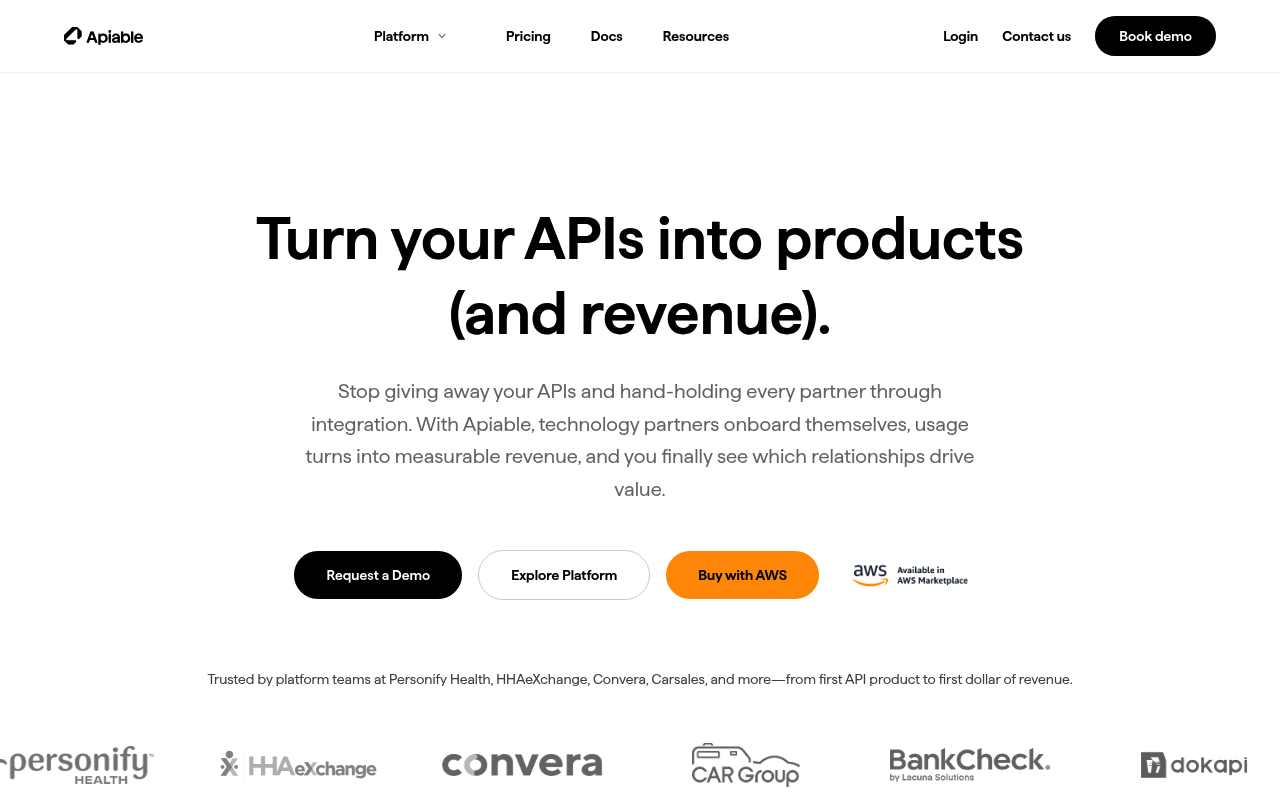
Apiable is an API portal platform that enables businesses to create single-tenant, white-label developer portals with custom domains, branding, and API product management. It supports API monetization, developer self-service onboarding, usage metrics, subscription lifecycle management, and integrates with API gateways including Amazon API Gateway and Kong.
Apiable publishes 13 API contracts indexed on the APIs.io network, including Companies API, Custom Properties API, Docs API, and 10 more. Tagged areas include Amazon API Gateway, API Gateway, API Monetization, API Portal, and Developer Experience.
The Apiable catalog on APIs.io includes 1 event-driven AsyncAPI specification.
Apiable’s developer surface includes API reference, documentation, getting-started guide, support, signup flow, authentication, pricing, and 29 more developer resources.
Regulatory Posture applies to this provider. Its tags matched the
Horizontal (data, software, accessibility, platform) regime, so
Regulatory Posture carries 15 points of the composite.
If this regime is wrong for your business, say so on your
provider repo — the
applicability map is public and we will correct it.
Create-or-Update Ergonomics applies to this provider. This API accepts writes, so it
carries 10 points of the composite. It is scored from the published contracts
themselves: whether a caller can create-or-update in one call, whether the write accepts a key the caller already
holds, and whether the response says which branch ran. Without that, every write needs a search-and-branch in
front of it, and the first time that check is skipped a duplicate record is created.
Scored against the observed mean rather than raw — a provider at the catalog average is unchanged by this facet,
not penalised by it.
The six quality facets above are damped to 75 points between them,
because the conditional facet above carries the other
25. That is why each facet's contribution is shown against a damped
maximum: raising a quality facet moves the composite by 75% of its nominal
weight, not 100%. The full arithmetic is at apis.io/rating/.
Improve this rating by publishing the missing artifacts — every area above can be raised, and the full rubric is at apis.io/rating/. Every facet and dimension name above is a link: it opens that measurement's own page — what it means, the exact checks that feed it, how the whole catalog distributes on it, and the providers at the top of it. This rating is computed from github.com/api-evangelist/apiable: open an issue to ask a question, or submit a pull request to add artifacts.
Submit an artifact on GitHub — free →Manage your own listing — the Influence plan, $499/mo →
Markets this provider is in provisional
The Kin Score Market layer reads a provider inside its market:
its position, and how deep its integrations go. Depth is only comparable within a position. Provisional and unweighted:
not part of the Kin Score or agent readiness.
Registered MCP server and declares compatibility are report only — not weighted.
Undeclared means we found nothing we can read, so there is no number: we never infer integrations.
Apiable provides a self-service API portal platform for API product managers and developers. It offers single-tenant dedicated portals with custom domains, automated API documen...
Companies, similar to teams are a way to group users together. Companies are a way to manage multiple teams and users together. An example being a company that has teams for dif...
Docs are a way to store documentation in the system. The documentation can be used to store API and Plan level API documentations in the system.A documentation entry is always a...
Invitations are a way to invite new users to join the platform and team of the inviter. Invitations are typically sent by team members to new users, and can be accepted or ignor...
Operations related to managing subscriptions, including retrieval, update, approval, rejection, and refreshing the status of connected monetization. For security reasons, API ke...
Teams are a way to group users together. Teams are used to manage team-based access to subscriptions on the platform with internal roles and permissions. Teams typically consist...
Users are the people who use the platform. Users can be invited to join the platform by an admin or they can sign up themselves. Users can be assigned to teams and have roles an...
# How Webhooks Work Webhooks are a way for services to communicate with each other in real time. When an event occurs, the Webhook sends an HTTP POST request to the URL that you...
Overlays applied on top of this provider's contracts. Each card says who wrote it: a document the provider publishes, or one API Evangelist derived or generated.
aid: apiable
name: Apiable
description: Apiable is an API portal platform that enables businesses to create single-tenant, white-label developer portals
  with custom domains, branding, and API product management. It supports API monetization, developer self-service onboarding,
  usage metrics, subscription lifecycle management, and integrates with API gateways including Amazon API Gateway and Kong.
type: Index
deliveryModel:
  model: saas
  open_source: false
  commercial: true
  callable_host: false
  label: Hosted service · you call their endpoint
  confidence: medium
  source:
  - pricing
  generated: '2026-08-28'
  method: derived
accessModel:
  pricing: freemium
  onboarding: unknown
  trial: false
  try_now: false
  public: false
  label: Freemium
  confidence: medium
  source:
  - plans
  generated: '2026-07-22'
  method: derived
image: https://kinlane-images.s3.amazonaws.com/shared/apis-json/icons/apiable.png
tags:
- Amazon API Gateway
- API Gateway
- API Monetization
- API Portal
- Developer Experience
- Developer Portal
- Developer Tools
- Kong
- Platform
- Self-Service
url: https://raw.githubusercontent.com/api-evangelist/apiable/refs/heads/main/apis.yml
created: '2025-01-08'
modified: '2026-09-16'
specificationVersion: '0.23'
apis:
- aid: apiable:api-portal-platform
  name: Apiable API Portal Platform
  description: Apiable provides a self-service API portal platform for API product managers and developers. It offers single-tenant
    dedicated portals with custom domains, automated API documentation with try-out functionality, developer onboarding, subscription
    management, usage dashboards, and role-based access control integrated with existing API gateways.
  humanURL: https://www.apiable.io/platform/api-portal/
  x-note: Product listing, not a callable endpoint. Apiable's portal platform is delivered as a single-tenant portal on each
    customer's own host, so this entry has no single public base URL and none is invented for it. Apiable's one callable,
    publicly specified API surface is catalogued as apiable:platform-api above (baseURL https://developer.apiable.io).
  tags:
  - API Gateway
  - API Portal
  - Developer Experience
  - Developer Portal
  - Monetization
  properties:
  - type: Documentation
    url: https://www.apiable.io/platform/api-portal/
  - type: Pricing
    url: https://www.apiable.io/pricing/
- aid: apiable:apiable-companies-api
  name: Apiable Companies API
  description: Companies, similar to teams are a way to group users together. Companies are a way to manage multiple teams
    and users together. An example being a company that has teams for different departments, such as backend and frontend
    development teams.Multiple teams can be part of the same company, and unlike teams, companies do not have roles and permissions,
    nor are subscriptions shared between different teams under the same company.
  humanURL: https://www.apiable.io/docs/api-reference/
  baseURL: https://developer.apiable.io
  tags:
  - Companies
  properties:
  - type: OpenAPI
    url: openapi/apiable-companies-api-openapi.yml
  - type: APIReference
    url: https://www.apiable.io/docs/api-reference/
  - type: Documentation
    url: https://www.apiable.io/docs/automation/
  - type: Authentication
    url: authentication/apiable-authentication.yml
  - type: OAuthScopes
    url: scopes/apiable-scopes.yml
  - type: Webhooks
    url: asyncapi/apiable-webhooks.yml
  - type: ErrorCatalog
    url: errors/apiable-problem-types.yml
  - type: Conventions
    url: conventions/apiable-conventions.yml
  - type: DataModel
    url: data-model/apiable-data-model.yml
- aid: apiable:apiable-custom-properties-api
  name: Apiable Custom Properties API
  description: Custom properties are additional fields that can be used to store extra information about the subscription.
  humanURL: https://www.apiable.io/docs/api-reference/
  baseURL: https://developer.apiable.io
  tags:
  - Custom Properties
  properties:
  - type: OpenAPI
    url: openapi/apiable-custom-properties-api-openapi.yml
  - type: APIReference
    url: https://www.apiable.io/docs/api-reference/
  - type: Documentation
    url: https://www.apiable.io/docs/automation/
  - type: Authentication
    url: authentication/apiable-authentication.yml
  - type: OAuthScopes
    url: scopes/apiable-scopes.yml
  - type: Webhooks
    url: asyncapi/apiable-webhooks.yml
  - type: ErrorCatalog
    url: errors/apiable-problem-types.yml
  - type: Conventions
    url: conventions/apiable-conventions.yml
  - type: DataModel
    url: data-model/apiable-data-model.yml
- aid: apiable:apiable-docs-api
  name: Apiable Docs API
  description: Docs are a way to store documentation in the system. The documentation can be used to store API and Plan level
    API documentations in the system.A documentation entry is always associated with either plan directly, or with an API,
    which is associated with a plan.The only exception to this, is the Full API Reference, which is a special case, and is
    not associated with any plan. But with the portal itself.
  humanURL: https://www.apiable.io/docs/api-reference/
  baseURL: https://developer.apiable.io
  tags:
  - Docs
  properties:
  - type: OpenAPI
    url: openapi/apiable-docs-api-openapi.yml
  - type: APIReference
    url: https://www.apiable.io/docs/api-reference/
  - type: Documentation
    url: https://www.apiable.io/docs/automation/
  - type: Authentication
    url: authentication/apiable-authentication.yml
  - type: OAuthScopes
    url: scopes/apiable-scopes.yml
  - type: Webhooks
    url: asyncapi/apiable-webhooks.yml
  - type: ErrorCatalog
    url: errors/apiable-problem-types.yml
  - type: Conventions
    url: conventions/apiable-conventions.yml
  - type: DataModel
    url: data-model/apiable-data-model.yml
- aid: apiable:apiable-files-api
  name: Apiable Files API
  description: Files are a way to store files in the system. All uploaded files are stored in an S3 bucket.
  humanURL: https://www.apiable.io/docs/api-reference/
  baseURL: https://developer.apiable.io
  tags:
  - File
  tags_raw:
  - Files
  properties:
  - type: OpenAPI
    url: openapi/apiable-files-api-openapi.yml
  - type: APIReference
    url: https://www.apiable.io/docs/api-reference/
  - type: Documentation
    url: https://www.apiable.io/docs/automation/
  - type: Authentication
    url: authentication/apiable-authentication.yml
  - type: OAuthScopes
    url: scopes/apiable-scopes.yml
  - type: Webhooks
    url: asyncapi/apiable-webhooks.yml
  - type: ErrorCatalog
    url: errors/apiable-problem-types.yml
  - type: Conventions
    url: conventions/apiable-conventions.yml
  - type: DataModel
    url: data-model/apiable-data-model.yml
- aid: apiable:apiable-invitations-api
  name: Apiable Invitations API
  description: Invitations are a way to invite new users to join the platform and team of the inviter. Invitations are typically
    sent by team members to new users, and can be accepted or ignored by the invitee.
  humanURL: https://www.apiable.io/docs/api-reference/
  baseURL: https://developer.apiable.io
  tags:
  - Invitations
  properties:
  - type: OpenAPI
    url: openapi/apiable-invitations-api-openapi.yml
  - type: APIReference
    url: https://www.apiable.io/docs/api-reference/
  - type: Documentation
    url: https://www.apiable.io/docs/automation/
  - type: Authentication
    url: authentication/apiable-authentication.yml
  - type: OAuthScopes
    url: scopes/apiable-scopes.yml
  - type: Webhooks
    url: asyncapi/apiable-webhooks.yml
  - type: ErrorCatalog
    url: errors/apiable-problem-types.yml
  - type: Conventions
    url: conventions/apiable-conventions.yml
  - type: DataModel
    url: data-model/apiable-data-model.yml
- aid: apiable:apiable-plans-api
  name: Apiable Plans API
  description: Plans are a way to group APIs and their documentation.
  humanURL: https://www.apiable.io/docs/api-reference/
  baseURL: https://developer.apiable.io
  tags:
  - Plans
  properties:
  - type: OpenAPI
    url: openapi/apiable-plans-api-openapi.yml
  - type: APIReference
    url: https://www.apiable.io/docs/api-reference/
  - type: Documentation
    url: https://www.apiable.io/docs/automation/
  - type: Authentication
    url: authentication/apiable-authentication.yml
  - type: OAuthScopes
    url: scopes/apiable-scopes.yml
  - type: Webhooks
    url: asyncapi/apiable-webhooks.yml
  - type: ErrorCatalog
    url: errors/apiable-problem-types.yml
  - type: Conventions
    url: conventions/apiable-conventions.yml
  - type: DataModel
    url: data-model/apiable-data-model.yml
- aid: apiable:apiable-products-api
  name: Apiable Products API
  description: Products are a high-level abstraction of your API products, they are used to group plans together and to provide
    a high level overview of the product.
  humanURL: https://www.apiable.io/docs/api-reference/
  baseURL: https://developer.apiable.io
  tags:
  - Product
  tags_raw:
  - Products
  properties:
  - type: OpenAPI
    url: openapi/apiable-products-api-openapi.yml
  - type: APIReference
    url: https://www.apiable.io/docs/api-reference/
  - type: Documentation
    url: https://www.apiable.io/docs/automation/
  - type: Authentication
    url: authentication/apiable-authentication.yml
  - type: OAuthScopes
    url: scopes/apiable-scopes.yml
  - type: Webhooks
    url: asyncapi/apiable-webhooks.yml
  - type: ErrorCatalog
    url: errors/apiable-problem-types.yml
  - type: Conventions
    url: conventions/apiable-conventions.yml
  - type: DataModel
    url: data-model/apiable-data-model.yml
- aid: apiable:apiable-subscriptions-api
  name: Apiable Subscriptions API
  description: Operations related to managing subscriptions, including retrieval, update, approval, rejection, and refreshing
    the status of connected monetization. For security reasons, API keys, secrets, and other sensitive information included
    in the subscriptions are not returned in the response.
  humanURL: https://www.apiable.io/docs/api-reference/
  baseURL: https://developer.apiable.io
  tags:
  - Subscription
  tags_raw:
  - Subscriptions
  properties:
  - type: OpenAPI
    url: openapi/apiable-subscriptions-api-openapi.yml
  - type: APIReference
    url: https://www.apiable.io/docs/api-reference/
  - type: Documentation
    url: https://www.apiable.io/docs/automation/
  - type: Authentication
    url: authentication/apiable-authentication.yml
  - type: OAuthScopes
    url: scopes/apiable-scopes.yml
  - type: Webhooks
    url: asyncapi/apiable-webhooks.yml
  - type: ErrorCatalog
    url: errors/apiable-problem-types.yml
  - type: Conventions
    url: conventions/apiable-conventions.yml
  - type: DataModel
    url: data-model/apiable-data-model.yml
- aid: apiable:apiable-teams-api
  name: Apiable Teams API
  description: Teams are a way to group users together. Teams are used to manage team-based access to subscriptions on the
    platform with internal roles and permissions. Teams typically consist of one to a handful of users.
  humanURL: https://www.apiable.io/docs/api-reference/
  baseURL: https://developer.apiable.io
  tags:
  - Team
  tags_raw:
  - Teams
  properties:
  - type: OpenAPI
    url: openapi/apiable-teams-api-openapi.yml
  - type: APIReference
    url: https://www.apiable.io/docs/api-reference/
  - type: Documentation
    url: https://www.apiable.io/docs/automation/
  - type: Authentication
    url: authentication/apiable-authentication.yml
  - type: OAuthScopes
    url: scopes/apiable-scopes.yml
  - type: Webhooks
    url: asyncapi/apiable-webhooks.yml
  - type: ErrorCatalog
    url: errors/apiable-problem-types.yml
  - type: Conventions
    url: conventions/apiable-conventions.yml
  - type: DataModel
    url: data-model/apiable-data-model.yml
- aid: apiable:apiable-users-api
  name: Apiable Users API
  description: Users are the people who use the platform. Users can be invited to join the platform by an admin or they can
    sign up themselves. Users can be assigned to teams and have roles and permissions within those teams. Each user has the
    possibility to be part of one or more teams, each with their separate roles, permissions and subscriptions.
  humanURL: https://www.apiable.io/docs/api-reference/
  baseURL: https://developer.apiable.io
  tags:
  - User
  tags_raw:
  - Users
  properties:
  - type: OpenAPI
    url: openapi/apiable-users-api-openapi.yml
  - type: APIReference
    url: https://www.apiable.io/docs/api-reference/
  - type: Documentation
    url: https://www.apiable.io/docs/automation/
  - type: Authentication
    url: authentication/apiable-authentication.yml
  - type: OAuthScopes
    url: scopes/apiable-scopes.yml
  - type: Webhooks
    url: asyncapi/apiable-webhooks.yml
  - type: ErrorCatalog
    url: errors/apiable-problem-types.yml
  - type: Conventions
    url: conventions/apiable-conventions.yml
  - type: DataModel
    url: data-model/apiable-data-model.yml
- aid: apiable:apiable-webhooks-api
  name: Apiable Webhooks API
  description: "# How Webhooks Work\n\nWebhooks are a way for services to communicate with each other in real time. When an\
    \ event occurs, the Webhook sends an HTTP POST request to the URL that you've configured. The Webhook itself is unaware\
    \ of any specific authorization mechanisms like the Apiable Lambda authorizer, and the Webhook URL can be any endpoint\
    \ capable of receiving HTTP POST requests.\n\nOptionally, you can include custom headers in the request. These headers\
    \ will be appended automatically by the Webhook to the HTTP POST request, adding any additional information required for\
    \ the endpoint.\n\n ## Testing a Webhook before posting\n\nYou can test a Webhook by sending a POST request to the Webhook\
    \ URL manually. Here’s an example curl command that simulates the Webhook sending a POST request:\n\n```bash\ncurl -X\
    \ POST https:/apiable.example.io/webhook \\\n -H \"Content-Type: application/json\" \\\n -H \"api-key: MY-API-KEY\" \\\
    \n -H \"Custom-Header-1: value1\" \\\n -H \"Custom-Header-2: value2\" \\\n -d '{\n   \"id\": \"67040bcb1eb964694d999a68\"\
    ,\n   \"events\": [\n     \"SUBSCRIPTION_CREATED\"\n   ],\n   \"whsec\": \"whsec_CoX***pc=\"\n }'\n```\n\n## Example Webhook\
    \ Configuration\n\nIn the following example, a Webhook is configured to send an HTTP POST request to a URL upon the occurrence\
    \ of a `SUBSCRIPTION_CREATED` event. The parameters \"whsec\" and \"headers\" are optional.\n\n```json\n{\n  \"id\": \"\
    67040bcb1eb964694d999a68\",\n  \"events\": [\n    \"SUBSCRIPTION_CREATED\"\n  ],\n  \"url\": \"https:/apiable.example.io/webhook\"\
    ,\n  \"headers\": {\n    \"api-key\": \"MY-API-KEY\",\n    \"Custom-Header-1\": \"value1\",\n    \"Custom-Header-2\":\
    \ \"value2\"\n  }\n}\n```"
  humanURL: https://www.apiable.io/docs/api-reference/
  baseURL: https://developer.apiable.io
  tags:
  - Webhook
  tags_raw:
  - Webhooks
  properties:
  - type: OpenAPI
    url: openapi/apiable-webhooks-api-openapi.yml
  - type: APIReference
    url: https://www.apiable.io/docs/api-reference/
  - type: Documentation
    url: https://www.apiable.io/docs/automation/
  - type: Authentication
    url: authentication/apiable-authentication.yml
  - type: OAuthScopes
    url: scopes/apiable-scopes.yml
  - type: Webhooks
    url: asyncapi/apiable-webhooks.yml
  - type: ErrorCatalog
    url: errors/apiable-problem-types.yml
  - type: Conventions
    url: conventions/apiable-conventions.yml
  - type: DataModel
    url: data-model/apiable-data-model.yml
- aid: apiable:apiable-server-info-api
  name: Apiable Server Info API
  description: Serverinfo is a way to get information about the server.
  humanURL: https://www.apiable.io/platform/api-portal/
  baseURL: https://developer.apiable.io
  tags:
  - Server Info
  properties:
  - type: OpenAPI
    url: openapi/apiable-server-info-api-openapi.yml
  - type: APIReference
    url: https://www.apiable.io/docs/api-reference/
  - type: Documentation
    url: https://www.apiable.io/docs/automation/
  - type: Authentication
    url: authentication/apiable-authentication.yml
  - type: OAuthScopes
    url: scopes/apiable-scopes.yml
  - type: Webhooks
    url: asyncapi/apiable-webhooks.yml
  - type: ErrorCatalog
    url: errors/apiable-problem-types.yml
  - type: Conventions
    url: conventions/apiable-conventions.yml
  - type: DataModel
    url: data-model/apiable-data-model.yml
common:
- type: FinOps
  url: finops/apiable-finops.yml
- type: CapabilityMap
  url: capabilities/apiable-capability-edges.yml
  name: Apiable Business Capability Map
- type: OpenAPI
  name: Apiable Platform API v2
  url: openapi/_original/apiable-platform-api-openapi.json
- type: APIReference
  url: https://www.apiable.io/docs/api-reference/
- type: Documentation
  url: https://www.apiable.io/docs/
- type: DeveloperPortal
  url: https://www.apiable.io/docs/
- type: GettingStarted
  url: https://www.apiable.io/docs/get-started/onboarding/
- type: GitHubOrganization
  url: https://github.com/apiable
- type: Support
  url: https://www.apiable.io/terms/support-policy/
- type: SignUp
  url: https://dashboard.apiable.io/
- type: TermsOfService
  url: https://www.apiable.io/terms/terms-of-service/
- type: PrivacyPolicy
  url: https://www.apiable.io/terms/privacy-policy/
- type: StatusPage
  url: https://status.apiable.io/
- type: Security
  url: https://www.apiable.io/security/
- type: Compliance
  url: https://www.apiable.io/security/
- type: Lifecycle
  url: lifecycle/apiable-lifecycle.yml
- type: Conventions
  url: conventions/apiable-conventions.yml
- type: ErrorCatalog
  url: errors/apiable-problem-types.yml
- type: Conformance
  url: conformance/apiable-conformance.yml
- type: DataModel
  url: data-model/apiable-data-model.yml
- type: Webhooks
  url: asyncapi/apiable-webhooks.yml
- type: X-MCPServerCandidate
  url: mcp/apiable-mcp.yml
  note: 'Renamed from MCPServer 2026-09-03 (roadmap#247): the manifest self-describes as status: candidate — a tool list derived
    from the published API contracts, not an existing server. The scorer already read the manifest and reported mcp_server
    correctly; the MCPServer type was crediting the artifact-type surfaces with a server that does not exist.'
- type: AgentSkill
  url: skills/_index.yml
- type: LLMsTxt
  url: llms/apiable-llms.txt
- type: Overlay
  url: overlays/apiable-platform-api-overlay.yaml
- type: Packages
  url: packages/apiable-packages.yml
- type: RateLimits
  url: rate-limits/apiable-rate-limits.yml
- type: Plans
  url: plans/apiable-plans-pricing.yml
- type: AgenticAccess
  url: agentic-access/apiable-agentic-access.yml
- type: OAuthScopes
  url: scopes/apiable-scopes.yml
- type: Authentication
  url: authentication/apiable-authentication.yml
- type: TrustCenter
  url: security/apiable-trust-center.yml
- type: DomainSecurity
  url: security/apiable-domain-security.yml
- type: Website
  url: https://www.apiable.io/
- type: Pricing
  url: https://www.apiable.io/pricing/
- type: Blog
  url: https://www.apiable.io/resources/
- type: Features
  data:
  - name: API Portal Generation
    description: Single-tenant dedicated portals with custom domains, branding, logos, and CSS whitelabeling.
  - name: API Product Management
    description: Bundle APIs into products and plans with monetization options and subscription lifecycle management.
  - name: Auto-Generated API Documentation
    description: Automatically generate API documentation from specs with interactive try-out functionality and code samples.
  - name: Developer Self-Service Onboarding
    description: Self-service account creation, API subscription, and credential generation for developers.
  - name: Usage Metrics and Dashboards
    description: Real-time API consumption tracking and usage dashboards for developers and administrators.
  - name: Role-Based Access Control
    description: Team access control with role-based permissions and shared API credential management.
  - name: Google Tag Manager Integration
    description: Deploy analytics and tracking tags via Google Tag Manager integration in developer portals.
- type: UseCases
  data:
  - name: Partner API Onboarding
    description: Streamline partner API access with self-service portals and automated credential provisioning.
  - name: API Product Monetization
    description: Implement usage-based billing and subscription plans for API product revenue generation.
  - name: Developer Self-Service Portals
    description: Create branded developer portals where consumers can discover, subscribe to, and manage API access independently.
  - name: API Adoption Scaling
    description: Scale API adoption by reducing onboarding friction through self-service workflows and automated access management.
- type: Integrations
  data:
  - name: Amazon API Gateway
    description: Native integration with Amazon API Gateway for managing API products and subscriptions.
  - name: Kong
    description: Integration with Kong API Gateway for portal-driven API access management.
  - name: Google Tag Manager
    description: Deploy analytics, tracking, and marketing tags into developer portals via Google Tag Manager.
- type: Integrations
  url: https://www.apiable.io/partners/
integrations:
- name: Apiable
- name: API Portal
- name: API Products
- name: API Monetization
- name: API Developer Experience
- name: Amazon Web Services
- name: AWS Well-Architected Partner
- name: Available in AWS Marketplace
- name: Playbook
maintainers:
- FN: Kin Lane
  email: info@apievangelist.com
x-enrichment:
  date: '2026-09-02'
  status: enriched
  artifacts_added: 21
  pass: local-v1
Discovery needs no key. Ratings and market analysis are Pro.
Get an API key
Free tier, no form to fill in. Signing in shares your email address with us — we
store it to create your key and to recognise you if you sign in with another
provider. See our Privacy Policy and
Terms.
 Kin Score
How this is scored →
Kin Score
How this is scored →