AnyImageDetector
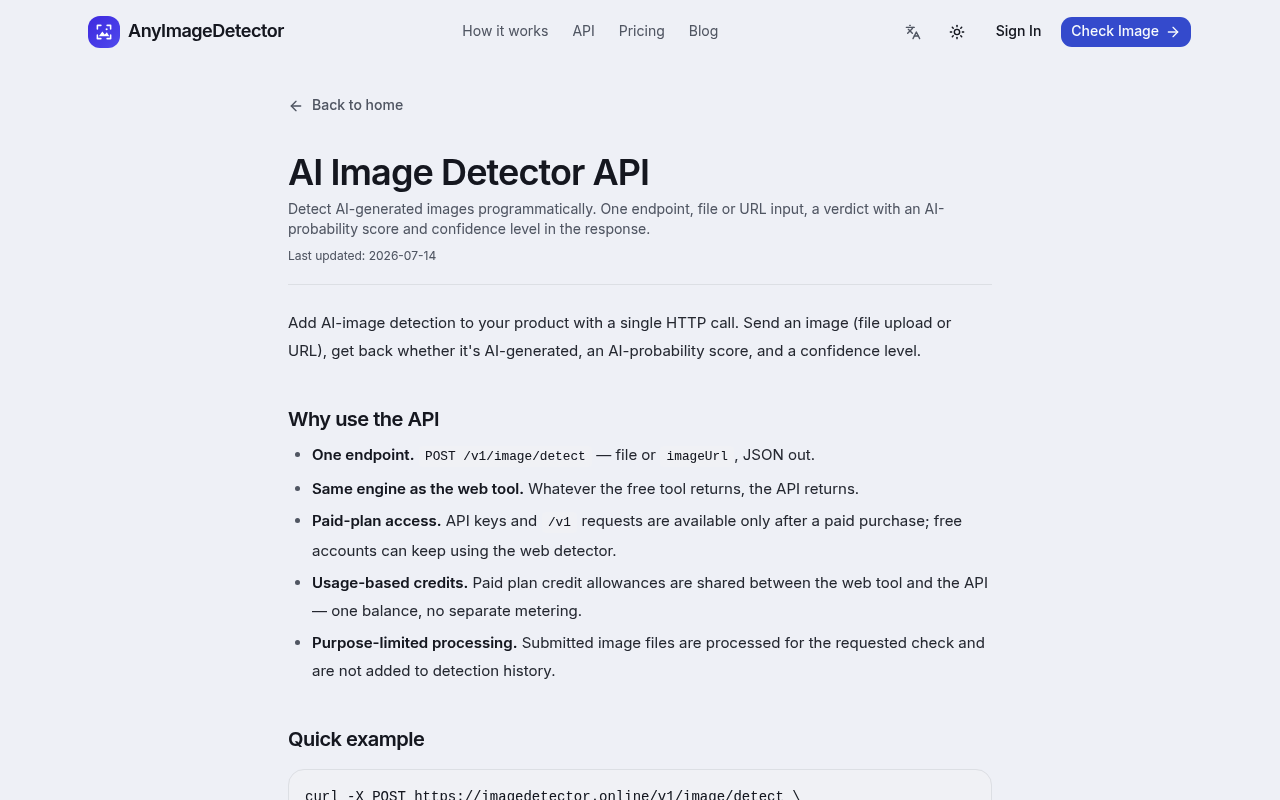
AnyImageDetector (imagedetector.online) is a single-purpose AI-image-detection service for individuals, trust-and-safety reviewers, journalists and developers. Its AI Image Detector API exposes one REST endpoint, POST /v1/image/detect, that accepts a JPG/PNG/WebP file up to 8 MB or a public image URL and returns a verdict (likely_ai, likely_human or uncertain), an ai_score from 0 to 1, a confidence label, and a source_breakdown array reserved for future per-generator scores. The provider publishes the exact score bands that map ai_score to verdict and confidence, and deliberately declines to publish a single accuracy percentage, stating that one number would hide differences between generators, image styles, resolutions and editing conditions. Authentication is a static sk_ API key sent as a Bearer token or an x-api-key header; API access requires a paid plan and each successful detection consumes one credit from the same balance as the web tool. Requests are limited to one per second per key, with Retry-After returned on 429.
AnyImageDetector publishes 1 API contract indexed on the APIs.io network: Detection API. Tagged areas include AI image detection, Image Analysis, Computer Vision, Content Moderation, and Trust and Safety.
AnyImageDetector’s developer surface includes documentation, API reference, support, engineering blog, pricing, signup flow, authentication, and 19 more developer resources.
Kin Score
 Kin Score
How this is scored →
Kin Score
How this is scored →scored 2026-10-17 · rubric v0.24.0
APIs 1
Individual APIs this provider publishes, each with its own machine-readable definition.
AnyImageDetector Detection API
Analyze an image and report whether it is AI-generated.
Open Collections 1
Open, tool-agnostic API collections (OpenAPI-derived and Bruno).
AI Image Detector API
OPEN COLLECTIONPricing Plans 1
Published pricing tiers and plan structures.
Rate Limits 1
Documented rate limits and quota policies.
Anyimagedetector Rate Limits
RATE LIMITSSecurity Posture 2
Authentication, domain security, vulnerability disclosure, and trust-center signals.
Resources
Get Started 3
Portal, sign-up, and the first successful call
Documentation 2
Reference material describing how the API behaves
Agent Surfaces 3
MCP servers, agent skills, and machine-readable catalogs
Design & Contract 5
Pagination, idempotency, versioning, errors, and events
Access & Security 2
Authentication, authorization, and security posture
Operate 2
Status, limits, changes, and where to get help
Commercial 4
Pricing, plans, and the legal terms of use
Company 3
The organization behind the API
Other 2
Properties that don't map to a standard resource type
Source (apis.yml)
Work with this as data
Every provider here is available over the APIs.io API and to AI agents over MCP.