AirCube
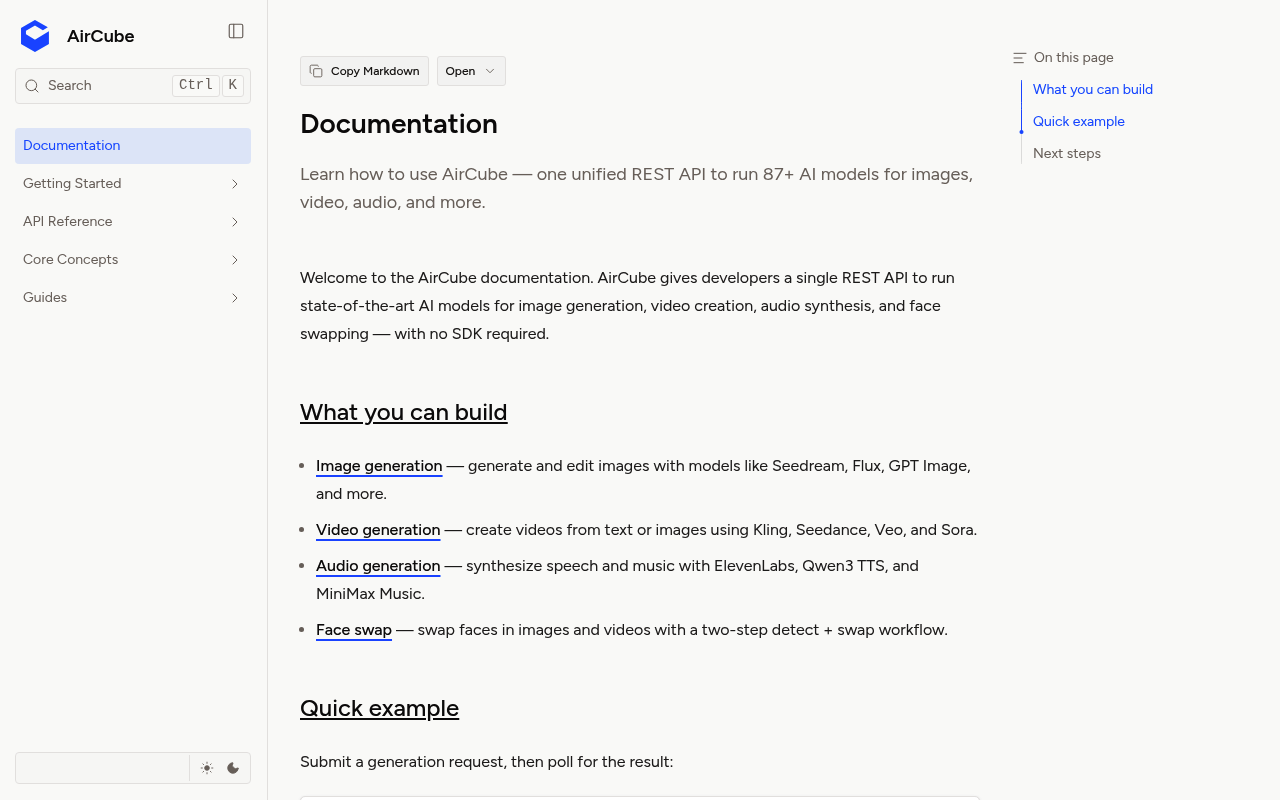
AirCube provides a unified API platform that gives developers access to over 450 AI models across image, video, audio, and text domains. Through a single REST endpoint and API key, users can generate media, synthesize speech, and run advanced model inference without managing multiple vendor integrations. The service offers free tier access, transparent usage‑based pricing, and enterprise features such as high‑availability scaling and dedicated support.
AirCube is listed with 4 APIs on the APIs.io network, including AirCube API, Models API, Qwen Image API, and 1 more. Tagged areas include Artificial Intelligence, Platform, Media Generation, and Unified API.
The AirCube catalog on APIs.io includes 1 JSON-LD context and 1 Spectral governance ruleset.
AirCube’s developer surface includes authentication, documentation, API reference, getting-started guide, pricing, engineering blog, signup flow, and 15 more developer resources.
Kin Score
 Kin Score
How this is scored →
scored 2026-10-17 · rubric v0.24.0
APIs 4
Individual APIs this provider publishes, each with its own machine-readable definition.
AirCube API
Unified REST API for AI model generation, image, video, audio, and text. Provides endpoints for model listing, generation submission, result polling, face swap, moderation, and ...
AirCube AirCube API
The AirCube API API from AirCube — 1 operation(s) for aircube api.
AirCube Models API
The Models API from AirCube — 2 operation(s) for models.
AirCube Qwen Image API
The Qwen Image API from AirCube — 1 operation(s) for qwen image.
Pricing Plans 1
Published pricing tiers and plan structures.
Semantic Vocabularies 1
JSON-LD contexts and semantic vocabularies used across these APIs.
Aircube Context
JSON-LDSpectral Rules 1
Spectral governance rulesets for linting and validating these APIs.
AirCube API Rules
SPECTRALJSON Schema 3
Standalone JSON Schema definitions for this provider's data models.
PostApiV3V3IdRequest
JSON SCHEMAPostApiV3V3IdResponse
JSON SCHEMASecurity Posture 2
Authentication, domain security, vulnerability disclosure, and trust-center signals.
Resources
Get Started 3
Portal, sign-up, and the first successful call
Documentation 2
Reference material describing how the API behaves
Agent Surfaces 1
MCP servers, agent skills, and machine-readable catalogs
Design & Contract 6
Pagination, idempotency, versioning, errors, and events
Access & Security 2
Authentication, authorization, and security posture
Commercial 4
Pricing, plans, and the legal terms of use
Company 2
The organization behind the API
Other 2
Properties that don't map to a standard resource type
Source (apis.yml)
Work with this as data
Every provider here is available over the APIs.io API and to AI agents over MCP.