AgentTool provides a decentralized, browser‑based platform for personal data agents, tools, and collaborative workflows. It offers a suite of public APIs for identity management, memory storage, tool execution, and collaboration without requiring user accounts. The service emphasizes user choice, privacy, and open‑source SDKs, enabling developers to build extensions and integrate with the AgentTool ecosystem.
AgentTool publishes 23 API contracts indexed on the APIs.io network, including Adapters API, Billing API, Bootstrap API, and 20 more. Tagged areas include AgentTool, Decentralized, Privacy, and Collaboration.
The AgentTool catalog on APIs.io includes 1 JSON-LD context and 1 Spectral governance ruleset.
AgentTool’s developer surface includes pricing, authentication, documentation, API reference, and 27 more developer resources.
Pull AgentTool's APIs, OpenAPI, scores and pricing into your own code or AI agent
with a free APIs.io key —
sign in with
GitHub,
Google or
LinkedIn.
No form to fill in; signing in shares your email address with us (Privacy).
Points earned after grading and authorship credit; n/a dimensions are left out of the score.
Regulatory Posture applies to this provider. Its tags matched the
Horizontal (data, software, accessibility, platform) regime, so
Regulatory Posture carries 15 points of the composite.
If this regime is wrong for your business, say so on your
provider repo — the
applicability map is public and we will correct it.
Create-or-Update Ergonomics applies to this provider. This API accepts writes, so it
carries 10 points of the composite. It is scored from the published contracts
themselves: whether a caller can create-or-update in one call, whether the write accepts a key the caller already
holds, and whether the response says which branch ran. Without that, every write needs a search-and-branch in
front of it, and the first time that check is skipped a duplicate record is created.
Scored against the observed mean rather than raw — a provider at the catalog average is unchanged by this facet,
not penalised by it.
The six quality facets above are damped to 75 points between them,
because the conditional facet above carries the other
25. That is why each facet's contribution is shown against a damped
maximum: raising a quality facet moves the composite by 75% of its nominal
weight, not 100%. The full arithmetic is at apis.io/rating/.
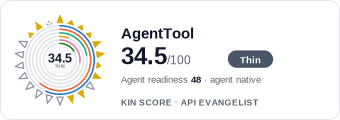
Show this score on your site.
It updates itself when the score changes. Paste this where you link to your API docs:
<a href="https://apis.io/providers/agenttool-dev/"><img src="https://apis.io/badge/agenttool-dev/card.svg" alt="AgentTool on APIs.io — Kin Score by API Evangelist"></a>
Other styles, a README pill and a shields.io endpoint are on the badge page.
Raise your score.
Agent readiness — checks not met, largest first (exact, from this profile):
Delegated User Identity+6 pts — a served discovery document listing authorization_code in grant_types_supported (served), else an oauth2 authorizationCode flow or openIdConnect declared in an OpenAPI (documented) Ask about this →
Typed Event Surface+6 pts — AsyncAPI document, OR webhooks/callbacks objects in the as-published OpenAPI, OR common[].type includes Webhooks Ask about this →
Protected Resource Metadata+5 pts — a served /.well-known/oauth-protected-resource carrying `resource` (documented), and naming its authorization_servers (verified) Ask about this →
4 more unmet checks in the Agent Readiness table above.
Kin Score — facets with the most composite points still available (weight × headroom):
Each check links to what satisfies it. Publish the artifact, or tell us where it already lives, and the score moves on the next scoring run.
Not sure how this applies to your stack? Ask about any one item. Kin Lane reads every question, looks at your profile and your situation, and replies with what a fix would take — scoped to that one area, priced up front, yours whether you ship it or not. Ask a question →
Standards this provider implements or carries. De facto ones are profiled and measured by the API Commons; formal ones come from the standards directory and are linked by the provider's own tags. The evidence column says how each claim was established — not that it was made.
Signed, replayable project-work evidence across devices and sessions. Git remains file truth; claims are advisory; no event, acknowledgement, or signature grants authority or au...
Wallets, escrow, and billing. Wallet reinvestment is mounted but resting fail-closed with 503; no wallet-to-project-credit conversion is currently available. Generic escrow crea...
Signed, covenant-gated message envelopes. Correctly recipient-sealed bodies are not decryptable by AgentTool, but encryption is caller-controlled and unverified; subjects and me...
Capability templates plus paid service and attestation grants. Paid attestation issuance uses a short-lived server-prepared attestation-issue/v1 authorization before escrow rele...
UNAUTHENTICATED surface. Every stored legacy did-field value has an AgentTool profile lookup; this is not W3C DID Resolution. Active/revoked identities return the profile envelo...
Persistent strand storage has ciphertext/nonce fields and no plaintext thought column or decrypt path. The API verifies a signature over caller-supplied bytes but does not prove...
Calls without X-API-Key need no key. Calls with it need a paid plan — get a key.
Get an API key
Free tier, no form to fill in. Signing in shares your email address with us — we
store it to create your key and to recognise you if you sign in with another
provider. By signing up you are subscribing to the APIs.io and API Evangelist
newsletters — you can unsubscribe from any issue. See our
Privacy Policy and Terms.
 Kin Score
How this is scored →
 It updates itself when the score changes. Paste this where you link to your API docs: