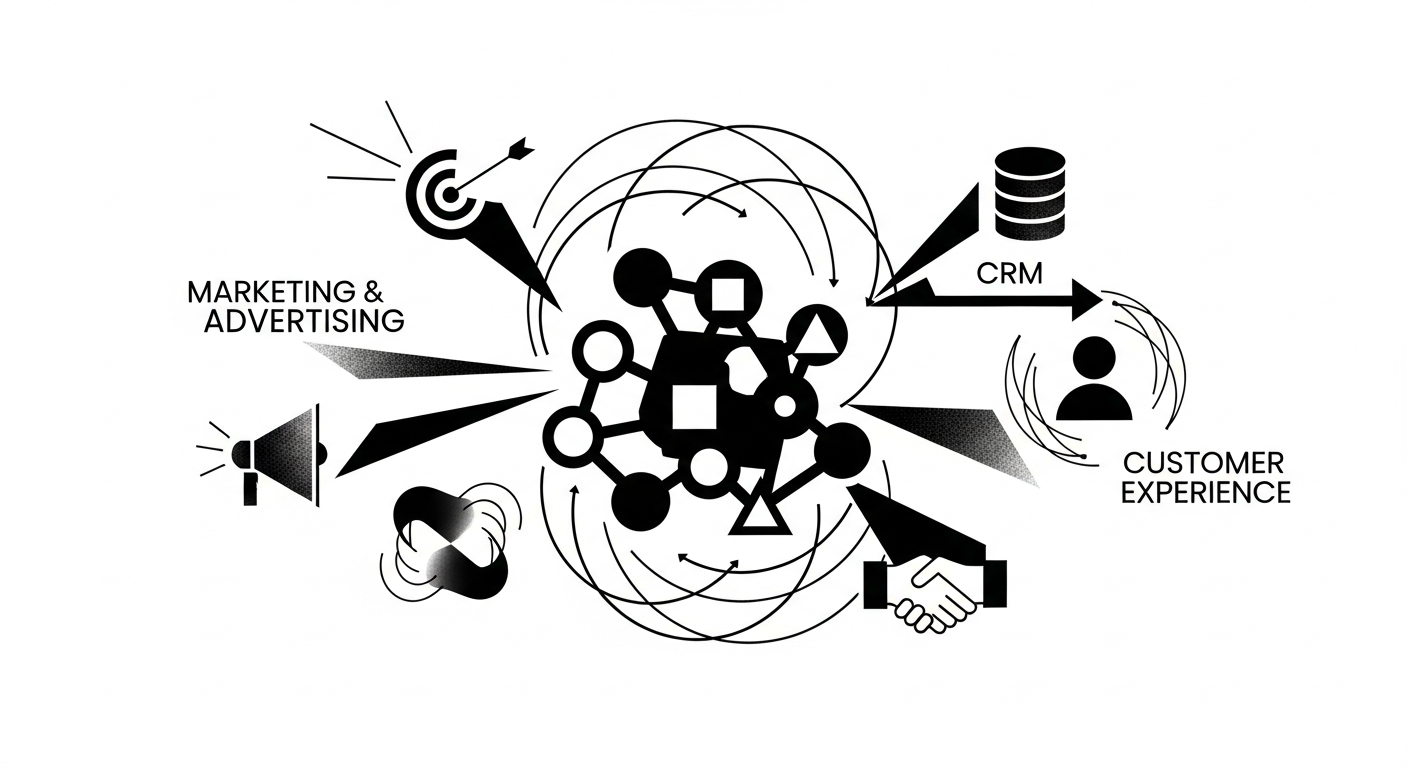
Marketing and advertising is a sprawling vertical on apis.io — 268 providers — and it’s where the catalog’s CRM, customer-experience, and engagement surfaces all live. What ties them together is a single asset: the customer graph. Every provider in this band is, in some form, reading from or writing to a shared picture of who the customer is and what they’ve done.
The bands
| Band | What it does | Providers on apis.io |
|---|---|---|
| CRM & sales | The customer system of record | Salesforce (40 APIs), HubSpot (63), Pipedrive (21), Close (28) |
| Customer experience | Support, success, engagement | Zendesk (145), Zoho (34) |
| Creative & content | Produce and manage assets | Adobe Suite (23) |
| Field & operations | Service businesses | ServiceTitan (23) |
What’s shifted recently
- CRM and CX stopped being separate categories. Zendesk — 145 APIs — sits in this vertical not as a help desk but as a customer-data platform. The line between “manage the relationship” and “manage the support ticket” has dissolved into one customer graph that both read from.
- Schema extensibility went mainstream. The leaders (Salesforce, HubSpot, Zendesk) all expose custom-object and custom-field APIs. Marketing systems are no longer fixed data models; they’re platforms you reshape, which is why API counts here run high.
- Engagement is increasingly agent-driven. AI agents that triage, route, and even resolve customer interactions need the underlying CRM and CX surfaces to be callable per-function. The fragmentation that looks messy is what makes that possible.
Where to start
- The Marketing and Advertising industry page ranks all 268 providers.
- For the largest surface, read the Zendesk profile — 145 APIs, governance and extensibility included.
- For the CRM core, HubSpot (63 APIs) and Salesforce (40) anchor the band.
The takeaway
This vertical is really one question asked many ways: what do we know about the customer, and what can we do about it? The catalog’s structure lets you see the customer graph from every angle — sales, support, creative, field service — and assemble across vendors rather than betting on a single suite to hold the whole relationship.