YeshID
YeshID is an AI-native workforce identity and access control platform that helps IT and security teams understand, govern, and automate access across fragmented SaaS apps, identity providers, OAuth grants, service accounts, non-human identities, AI agents, app-local permissions, and lifecycle workflows. Rather than starting at login, YeshID focuses on effective access — the roles, admin privileges, API tokens, and SaaS-to-SaaS connections that people and machines actually hold — powering onboarding/offboarding, access requests, access reviews, and remediation for SMB and mid-market teams.
YeshID is profiled on the APIs.io network. Tagged areas include Company, Cybersecurity, Identity and Access Management, Identity Governance, and Workforce Identity.
YeshID’s developer surface includes documentation, getting-started guide, engineering blog, pricing, signup flow, support, and 6 more developer resources.
Kin Score
 Kin Score
How this is scored →
scored 2026-11-06 · rubric v0.27.0
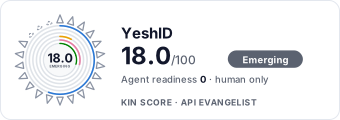 It updates itself when the score changes. Paste this where you link to your API docs:
<a href="https://apis.io/providers/yeshid/"><img src="https://apis.io/badge/yeshid/card.svg" alt="YeshID on APIs.io — Kin Score by API Evangelist"></a>Other styles, a README pill and a shields.io endpoint are on the badge page.
- Machine-Readable Contract +18 pts — api_specs includes an OpenAPI document
- MCP Server +12 pts — deployment.mode + probe verdict on the mcp/ manifest, not the pointer; an unprobed slug falls back to authorship
- Agentic Access Contract +10 pts — agentic_access artifact present (x-agentic-access), graded by author
- Machine-Readable Auth +10 pts — a served openid-configuration/oauth-authorization-server carrying `issuer` (served), else the securitySchemes class in the provider OpenAPIs — bound (mutualTLS, DPoP, Signature) > negotiable (oauth2 authorizationCode/clientCredentials, openIdConnect) > bearer (http bearer, apiKey)
- Idempotency +9 pts — OpenAPI mutating operations declare an idempotency key — a header, a request-body property, or a named de-duplication token whose own description says so (verified); else common[].type matches /idempoten/i (documented)
- Stable Error Semantics +8 pts — OpenAPI $refs a shared error schema across 4xx/5xx responses (verified), else common[].type includes ErrorCatalog / ErrorCodes / DeclineCodes
- Contract Quality scores 0.0 — up to +25.0 composite points
- Developer Ergonomics scores 28.6 — up to +14.3 composite points
- Access Clarity scores 28.9 — up to +14.2 composite points
Standards implemented 2
Standards this provider implements or carries. De facto ones are profiled and measured by the API Commons; formal ones come from the standards directory and are linked by the provider's own tags. The evidence column says how each claim was established — not that it was made.
Security Posture 1
Authentication, domain security, vulnerability disclosure, and trust-center signals.
Resources
Get Started 2
Portal, sign-up, and the first successful call
Documentation 1
Reference material describing how the API behaves
Agent Surfaces 1
MCP servers, agent skills, and machine-readable catalogs
Access & Security 2
Authentication, authorization, and security posture
Operate 2
Status, limits, changes, and where to get help
Commercial 2
Pricing, plans, and the legal terms of use
Company 2
The organization behind the API
Source (apis.yml)
Work with this as data
Every provider here is available over the APIs.io API and to AI agents over MCP.