The World Wide Web Consortium (W3C) is the main international standards body for the World Wide Web, founded by Tim Berners-Lee in 1994. W3C develops web standards and guidelines to ensure the long-term growth of the Web, focusing on accessibility, internationalization, privacy, and security. W3C specifications include HTML, CSS, XML, SVG, WebAssembly, ARIA, WCAG, JSON-LD, Verifiable Credentials, and hundreds of other foundational web technologies. W3C operates through Working Groups, Interest Groups, and Community Groups that develop specifications through a consensus-based process, resulting in W3C Recommendations.
W3C publishes 15 API contracts indexed on the APIs.io network, including Affiliations API, Ecosystems API, Groups API, and 12 more. Tagged areas include Accessibility, Standards, Web, Web Standards, and W3C.
The W3C catalog on APIs.io includes 1 JSON-LD context and 2 Spectral governance rulesets.
W3C’s developer surface includes product news, engineering blog, YouTube channel, and 17 more developer resources.
Regulatory Posture applies to this provider. Its tags matched the
Horizontal (data, software, accessibility, platform) regime, so
Regulatory Posture carries 15 points of the composite.
If this regime is wrong for your business, say so on your
provider repo — the
applicability map is public and we will correct it.
Create-or-Update Ergonomics does not apply to this provider. The published contracts declare
no write operations, and a read-only API cannot create-or-update. The facet is excluded from this provider's
denominator entirely — not scored zero. A reference or data API is not deficient for being unable to
upsert.
The six quality facets above are damped to 85 points between them,
because the conditional facet above carries the other
15. That is why each facet's contribution is shown against a damped
maximum: raising a quality facet moves the composite by 85% of its nominal
weight, not 100%. The full arithmetic is at apis.io/rating/.
Show this score on your site.
It updates itself when the score changes. Paste this where you link to your API docs:
<a href="https://apis.io/providers/w3c/"><img src="https://apis.io/badge/w3c/card.svg" alt="W3C on APIs.io — Kin Score by API Evangelist"></a>
Other styles, a README pill and a shields.io endpoint are on the badge page.
Improve this rating by publishing the missing artifacts — every area above can be raised, and the full rubric is at apis.io/rating/. Every facet and dimension name above is a link: it opens that measurement's own page — what it means, the exact checks that feed it, how the whole catalog distributes on it, and the providers at the top of it. This rating is computed from github.com/api-evangelist/w3c: open an issue to ask a question, or submit a pull request to add artifacts.
Submit an artifact on GitHub — free →Manage your own listing — the Influence plan, $499/mo →
Standards this provider implements or carries. De facto ones are profiled and measured by the API Commons; formal ones come from the standards directory and are linked by the provider's own tags. The evidence column says how each claim was established — not that it was made.
The W3C API provides programmatic access to W3C data including specifications, working groups, editors, translations, and affiliations. It enables developers to query W3C's cata...
WCAG is the international standard for web accessibility, providing guidelines for making web content more accessible to people with disabilities. WCAG 2.2 is the current Recomm...
The HyperText Markup Language specification maintained by WHATWG as a living standard, published as a W3C Recommendation. HTML defines the semantic structure of web pages and fo...
The Cascading Style Sheets (CSS) specification family maintained by the W3C CSS Working Group. CSS defines the presentation and styling of HTML documents. Key modules include CS...
JSON-LD (JSON for Linking Data) is a W3C Recommendation for encoding linked data using JSON. It provides a way to add semantic meaning to JSON documents through the use of @cont...
The Verifiable Credentials Data Model is a W3C Recommendation enabling cryptographically secure, privacy-respecting digital credentials. The VC family includes the data model, d...
WebAssembly (Wasm) is a W3C Recommendation defining a portable binary instruction format for a stack-based virtual machine. It enables near-native performance in web browsers fo...
Accessible Rich Internet Applications (WAI-ARIA) is a W3C Recommendation defining a set of HTML attributes that define ways to make web content and web applications more accessi...
The Resource Description Framework (RDF) is a W3C standard for representing information in the web. RDF 1.2 and SPARQL 1.2 are the latest versions, providing the foundation for ...
The W3C Digital Credentials API provides browser support for mediating presentation and issuance of digital credentials such as digital identity documents. It enables web applic...
aid: w3c
url: https://raw.githubusercontent.com/api-evangelist/w3c/refs/heads/main/apis.yml
name: W3C
description: The World Wide Web Consortium (W3C) is the main international standards body for the World Wide Web, founded
  by Tim Berners-Lee in 1994. W3C develops web standards and guidelines to ensure the long-term growth of the Web, focusing
  on accessibility, internationalization, privacy, and security. W3C specifications include HTML, CSS, XML, SVG, WebAssembly,
  ARIA, WCAG, JSON-LD, Verifiable Credentials, and hundreds of other foundational web technologies. W3C operates through Working
  Groups, Interest Groups, and Community Groups that develop specifications through a consensus-based process, resulting in
  W3C Recommendations.
deliveryModel:
  model: unknown
  license_evidence:
    not_product:
    - w3c/aria
    - w3c/csswg-drafts
    - w3c/digital-credentials
    - w3c/json-ld-syntax
    - w3c/rdf-star-wg
  open_source: unknown
  commercial: false
  callable_host: true
  label: Delivery model not determined — needs a product licence on record
  confidence: low
  source:
  - openapi
  - repository-not-product
  generated: '2026-09-25'
  method: derived
accessModel:
  pricing: freemium
  onboarding: unknown
  trial: false
  try_now: false
  public: false
  label: Freemium
  confidence: medium
  source:
  - plans
  generated: '2026-07-22'
  method: derived
image: https://kinlane-images.s3.amazonaws.com/shared/apis-json/icons/w3c.png
tags:
- Accessibility
- Standards
- Web
- Web Standards
- W3C
created: '2025-08-25'
modified: '2026-05-03'
specificationVersion: '0.23'
type: Index
access: 3rd-Party
position: Consuming
apis:
- aid: w3c:w3c-api
  name: W3C API
  description: The W3C API provides programmatic access to W3C data including specifications, working groups, editors, translations,
    and affiliations. It enables developers to query W3C's catalog of technical reports, discover active working groups, find
    specification editors and contributors, and access specification version history and status information.
  humanURL: https://api.w3.org/
  baseUrl: https://api.w3.org/
  tags:
  - Data
  - Specification
  - Standards
  - W3C
  tags_raw:
  - API
  - Data
  - Specifications
  - Standards
  - W3C
  properties:
  - url: https://api.w3.org/doc
    type: Documentation
  - url: https://api.w3.org/
    type: BaseURL
  - url: https://github.com/w3c/w3c-api
    type: GitHub
- aid: w3c:wcag
  name: Web Content Accessibility Guidelines (WCAG)
  description: WCAG is the international standard for web accessibility, providing guidelines for making web content more
    accessible to people with disabilities. WCAG 2.2 is the current Recommendation, with WCAG 3.0 in development. Guidelines
    cover perceivability, operability, understandability, and robustness (POUR).
  humanURL: https://www.w3.org/TR/WCAG22/
  tags:
  - Accessibility
  - Guidelines
  - Standards
  - W3C
  properties:
  - url: https://www.w3.org/TR/WCAG22/
    type: Specification
  - url: https://www.w3.org/WAI/standards-guidelines/wcag/
    type: Documentation
  - url: https://github.com/w3c/wcag
    type: GitHub
- aid: w3c:html
  name: HTML Living Standard
  description: The HyperText Markup Language specification maintained by WHATWG as a living standard, published as a W3C Recommendation.
    HTML defines the semantic structure of web pages and forms the foundation of the web platform.
  humanURL: https://html.spec.whatwg.org/
  tags:
  - HTML
  - Standards
  - Web Platform
  properties:
  - url: https://html.spec.whatwg.org/
    type: Specification
  - url: https://www.w3.org/TR/html52/
    type: W3C Recommendation
  - url: https://github.com/whatwg/html
    type: GitHub
- aid: w3c:css
  name: CSS Specifications
  description: The Cascading Style Sheets (CSS) specification family maintained by the W3C CSS Working Group. CSS defines
    the presentation and styling of HTML documents. Key modules include CSS Grid Layout, Flexbox, Custom Properties, Animations,
    and CSS Functions and Mixins.
  humanURL: https://www.w3.org/Style/CSS/
  tags:
  - CSS
  - Standards
  - Styling
  - Web Platform
  properties:
  - url: https://www.w3.org/TR/CSS/
    type: Specification
  - url: https://www.w3.org/Style/CSS/Overview.en.html
    type: Documentation
  - url: https://github.com/w3c/csswg-drafts
    type: GitHub
- aid: w3c:json-ld
  name: JSON-LD
  description: JSON-LD (JSON for Linking Data) is a W3C Recommendation for encoding linked data using JSON. It provides a
    way to add semantic meaning to JSON documents through the use of @context, @id, and @type keywords, enabling interoperability
    through shared vocabularies like schema.org.
  humanURL: https://www.w3.org/TR/json-ld11/
  tags:
  - JSON
  - Linked Data
  - Semantic Web
  - Standards
  properties:
  - url: https://www.w3.org/TR/json-ld11/
    type: Specification
  - url: https://json-ld.org/
    type: Website
  - url: https://json-ld.org/playground/
    type: Playground
  - url: https://github.com/w3c/json-ld-syntax
    type: GitHub
- aid: w3c:verifiable-credentials
  name: Verifiable Credentials
  description: The Verifiable Credentials Data Model is a W3C Recommendation enabling cryptographically secure, privacy-respecting
    digital credentials. The VC family includes the data model, data integrity proof suites, and JSON Web Token/COSE encoding
    methods. VC 2.0 was published as a W3C Recommendation in 2025.
  humanURL: https://www.w3.org/TR/vc-data-model-2.0/
  tags:
  - Credentials
  - Identity
  - Privacy
  - Security
  - Standards
  properties:
  - url: https://www.w3.org/TR/vc-data-model-2.0/
    type: Specification
  - url: https://www.w3.org/groups/wg/vc/
    type: Working Group
  - url: https://github.com/w3c/vc-data-model
    type: GitHub
- aid: w3c:wasm
  name: WebAssembly
  description: WebAssembly (Wasm) is a W3C Recommendation defining a portable binary instruction format for a stack-based
    virtual machine. It enables near-native performance in web browsers for code compiled from languages like C, C++, and
    Rust, and is a core web platform technology.
  humanURL: https://www.w3.org/TR/wasm-core-2/
  tags:
  - Performance
  - Standards
  - WebAssembly
  - Web Platform
  properties:
  - url: https://www.w3.org/TR/wasm-core-2/
    type: Specification
  - url: https://webassembly.org/
    type: Website
  - url: https://github.com/WebAssembly/spec
    type: GitHub
- aid: w3c:aria
  name: WAI-ARIA
  description: Accessible Rich Internet Applications (WAI-ARIA) is a W3C Recommendation defining a set of HTML attributes
    that define ways to make web content and web applications more accessible to people with disabilities. ARIA roles, states,
    and properties supplement HTML semantics for dynamic content.
  humanURL: https://www.w3.org/TR/wai-aria-1.2/
  tags:
  - Accessibility
  - ARIA
  - Standards
  - W3C
  properties:
  - url: https://www.w3.org/TR/wai-aria-1.2/
    type: Specification
  - url: https://www.w3.org/WAI/ARIA/
    type: Documentation
  - url: https://github.com/w3c/aria
    type: GitHub
- aid: w3c:rdf
  name: RDF and SPARQL
  description: The Resource Description Framework (RDF) is a W3C standard for representing information in the web. RDF 1.2
    and SPARQL 1.2 are the latest versions, providing the foundation for the semantic web and linked data. RDF triples express
    knowledge as subject-predicate-object relationships.
  humanURL: https://www.w3.org/RDF/
  tags:
  - Linked Data
  - RDF
  - Semantic Web
  - SPARQL
  - Standards
  properties:
  - url: https://www.w3.org/TR/rdf12-primer/
    type: Specification
  - url: https://www.w3.org/TR/sparql12-overview/
    type: SPARQL Specification
  - url: https://github.com/w3c/rdf-star-wg
    type: GitHub
- aid: w3c:digital-credentials
  name: Digital Credentials API
  description: The W3C Digital Credentials API provides browser support for mediating presentation and issuance of digital
    credentials such as digital identity documents. It enables web applications to request and receive verifiable digital
    identity credentials from digital wallets in a privacy-preserving way.
  humanURL: https://www.w3.org/TR/digital-credentials/
  tags:
  - Credentials
  - Identity
  - Privacy
  - Security
  - Standards
  properties:
  - url: https://www.w3.org/TR/digital-credentials/
    type: Specification
  - url: https://github.com/w3c/digital-credentials
    type: GitHub
- aid: w3c:w3c-affiliations-api
  name: W3C Affiliations API
  description: The Affiliations API from W3C — 2 operation(s) for affiliations.
  humanURL: https://api.w3.org/
  tags:
  - Affiliations
  properties:
  - type: OpenAPI
    url: openapi/w3c-affiliations-api-openapi.yml
- aid: w3c:w3c-ecosystems-api
  name: W3C Ecosystems API
  description: The Ecosystems API from W3C — 1 operation(s) for ecosystems.
  humanURL: https://api.w3.org/
  tags:
  - Ecosystem
  tags_raw:
  - Ecosystems
  properties:
  - type: OpenAPI
    url: openapi/w3c-ecosystems-api-openapi.yml
- aid: w3c:w3c-groups-api
  name: W3C Groups API
  description: The Groups API from W3C — 2 operation(s) for groups.
  humanURL: https://api.w3.org/
  tags:
  - Group
  tags_raw:
  - Groups
  properties:
  - type: OpenAPI
    url: openapi/w3c-groups-api-openapi.yml
- aid: w3c:w3c-specifications-api
  name: W3C Specifications API
  description: The Specifications API from W3C — 3 operation(s) for specifications.
  humanURL: https://api.w3.org/
  tags:
  - Specification
  tags_raw:
  - Specifications
  properties:
  - type: OpenAPI
    url: openapi/w3c-specifications-api-openapi.yml
- aid: w3c:w3c-translations-api
  name: W3C Translations API
  description: The Translations API from W3C — 1 operation(s) for translations.
  humanURL: https://api.w3.org/
  tags:
  - Translation
  tags_raw:
  - Translations
  properties:
  - type: OpenAPI
    url: openapi/w3c-translations-api-openapi.yml
common:
- type: Plans
  url: plans/w3c-plans-pricing.yml
- type: RateLimits
  url: rate-limits/w3c-rate-limits.yml
- type: FinOps
  url: finops/w3c-finops.yml
- type: AgenticAccess
  url: agentic-access/w3c-agentic-access.yml
- type: DomainSecurity
  url: security/w3c-domain-security.yml
- url: https://www.w3.org/
  type: Website
- url: https://www.w3.org/TR/
  type: TechnicalReports
- url: https://api.w3.org/
  type: API
- url: https://github.com/w3c/
  type: GitHubOrg
- url: https://www.w3.org/news/
  type: News
- url: https://www.w3.org/blog/
  type: Blog
- url: https://www.w3.org/events/
  type: Events
- url: https://www.w3.org/donate/
  type: Donations
- url: https://w3c.social/@w3c
  type: Mastodon
- url: https://www.linkedin.com/company/w3c/
  type: LinkedIn
- url: https://www.youtube.com/@W3COfficial
  type: YouTube
- url: https://www.w3.org/sponsor/
  type: Sponsorship
- url: vocabulary/w3c-vocabulary.yml
  type: Vocabulary
- url: json-ld/w3c-context.jsonld
  type: JSONLDContext
- url: rules/w3c-rules.yml
  type: SpectralRules
maintainers:
- FN: Kin Lane
  email: kin@apievangelist.com
Discovery needs no key. Ratings and market analysis are Pro.
Get an API key
Free tier, no form to fill in. Signing in shares your email address with us — we
store it to create your key and to recognise you if you sign in with another
provider. See our Privacy Policy and
Terms.
 Kin Score
How this is scored →
Kin Score
How this is scored →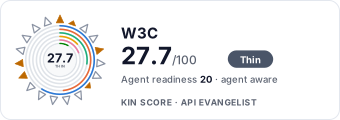 It updates itself when the score changes. Paste this where you link to your API docs: