Virtual Instruments
Virtual Instruments provides a platform for virtual instrumentation and data acquisition, enabling developers to integrate hardware-like measurement capabilities into software applications via APIs. The company focuses on delivering scalable, cloud‑native solutions for test and measurement, supporting a range of industries including manufacturing, research, and IoT. Their services include virtual sensor data streams, real‑time analytics, and SDKs for multiple programming languages, aiming to simplify complex instrumentation workflows for modern developers.
Virtual Instruments is listed with 1 API on the APIs.io network. Tagged areas include Company, Virtual Instruments, Data Acquisition, Instrumentation, and Cloud Services.
Virtual Instruments’ developer surface includes support, engineering blog, and 11 more developer resources.
Kin Score
 Kin Score
How this is scored →
scored 2026-10-31 · rubric v0.25.0
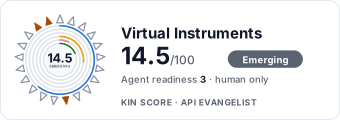 It updates itself when the score changes. Paste this where you link to your API docs:
<a href="https://apis.io/providers/virtualinstruments-com/"><img src="https://apis.io/badge/virtualinstruments-com/card.svg" alt="Virtual Instruments on APIs.io — Kin Score by API Evangelist"></a>Other styles, a README pill and a shields.io endpoint are on the badge page.
- Machine-Readable Contract +18 pts — api_specs includes an OpenAPI document
- MCP Server +12 pts — deployment.mode + probe verdict on the mcp/ manifest, not the pointer; an unprobed slug falls back to authorship
- Agentic Access Contract +10 pts — agentic_access artifact present (x-agentic-access), graded by author
- Machine-Readable Auth +10 pts — a served openid-configuration/oauth-authorization-server carrying `issuer` (served), else the securitySchemes class in the provider OpenAPIs — bound (mutualTLS, DPoP, Signature) > negotiable (oauth2 authorizationCode/clientCredentials, openIdConnect) > bearer (http bearer, apiKey)
- Idempotency +9 pts — OpenAPI mutating operations declare an idempotency key — a header, a request-body property, or a named de-duplication token whose own description says so (verified); else common[].type matches /idempoten/i (documented)
- A2A Agent Card +8 pts — a2a/
-a2a.yml manifest, graded on conformance.grade against A2A 1.0.0
- Contract Quality scores 0.0 — up to +25.0 composite points
- Developer Ergonomics scores 7.1 — up to +18.6 composite points
- Access Clarity scores 18.4 — up to +16.3 composite points
APIs 1
Individual APIs this provider publishes, each with its own machine-readable definition.
Virtual Instruments API
API for Virtual Instruments platform providing virtual sensor data and analytics.
Security Posture 1
Authentication, domain security, vulnerability disclosure, and trust-center signals.
Resources
Agent Surfaces 1
MCP servers, agent skills, and machine-readable catalogs
Access & Security 3
Authentication, authorization, and security posture
Operate 2
Status, limits, changes, and where to get help
Commercial 1
Pricing, plans, and the legal terms of use
Company 3
The organization behind the API
Other 3
Properties that don't map to a standard resource type
Source (apis.yml)
Virtual Instruments API — frequently asked questions
Does Virtual Instruments have an API?
Yes. APIs.io lists 1 API from Virtual Instruments, including Virtual Instruments API.
Is the Virtual Instruments API ready for AI agents?
Virtual Instruments has a Kin Score of 14.5 out of 100 (emerging) and an Agent Readiness score of 2.9 (human-only), scored by API Evangelist on 2026-10-31.
Work with this as data
Every provider here is available over the APIs.io API and to AI agents over MCP.