
Uptime.com
Uptime.com is a website, application, and infrastructure monitoring platform providing uptime checks, transaction and API monitoring, page speed checks, SLA reporting, status pages, and alerting from a global network of probe servers. Its REST API at https://uptime.com/api/v1 (Token authentication) lets customers programmatically manage checks, outages, SLA reports, status pages, contacts, integrations, and tags.
Uptime.com publishes 7 API contracts indexed on the APIs.io network, including Checks API, Contacts API, Integrations API, and 4 more. Tagged areas include Monitoring, Uptime, Website Monitoring, Status Pages, and SLA.
Uptime.com’s developer surface includes authentication, documentation, engineering blog, and 10 more developer resources.
What this lets a business do 2
Business capabilities this provider's published APIs can perform, derived from its own contracts. Browse all capabilities →
Kin Score
 Kin Score
How this is scored →
Kin Score
How this is scored →scored 2026-10-23 · rubric v0.25.0
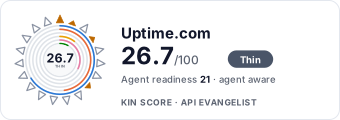 It updates itself when the score changes. Paste this where you link to your API docs:
<a href="https://apis.io/providers/uptime-com/"><img src="https://apis.io/badge/uptime-com/card.svg" alt="Uptime.com on APIs.io — Kin Score by API Evangelist"></a>Other styles, a README pill and a shields.io endpoint are on the badge page.
What adopting Uptime.com moves on the Kin Score 1
Uptime.com is an area vendor: providers adopt it to run part of their developer surface. This is the Kin Score checks its features can move for a provider that adopts it, what each one really earns, and what it earns nothing for.
Uptime.com status pages move one Kin Score check, status_page_present (6 of 38 operational-transparency points), once the provider declares the page as a StatusPage in apis.yml. The hosting clears the pointer-liveness probe: uptime.com and status.uptime.com return a real 404 for nonsense paths, so the pointer grades live. No vendor-registry key detects it. SLA reports, component uptime, maintenance and subscriber channels are good practice that scores nothing.
| Check | Earns | Through |
|---|---|---|
| Status page Operational TransparencyBinary check, cleared in full. The only check the status-page area touches. |
6.0 of 6 | Public, private and customer-specific status pages |
What Uptime.com ships that earns nothing (1)
- Subscriptions via Slack, SMS, RSS, email and webhooks — Status-notification webhooks are the vendor’s event stream about the page, not webhooks of the provider’s API.
A model, not a score. Adopting this vendor changes a provider's Kin Score only when the provider publishes the resulting artifacts on its own surface; nothing here writes a score, and no sponsorship or partnership can. The rating is not for sale → · Full vendor facets artifact
Markets this provider is in provisional
The Kin Score Market layer reads a provider inside its market: its position, and how deep its integrations go. Depth is only comparable within a position. Provisional and unweighted: not part of the Kin Score or agent readiness.
| Market | Position | Depth | Registered MCP server | Declares compatibility |
|---|---|---|---|---|
| Infrastructure-as-Code Provider Registries (Terraform, OpenTofu, Pulumi) | undeclared | - | - | - |
Registered MCP server and declares compatibility are report only — not weighted. Undeclared means we found nothing we can read, so there is no number: we never infer integrations.
APIs 7
Individual APIs this provider publishes, each with its own machine-readable definition.
Uptime.com Checks API
Create, list, update, pause, resume, and delete monitoring checks.
Uptime.com Contacts API
Manage contact groups used for alert notifications.
Uptime.com Integrations API
Manage notification integrations.
Uptime.com Outages API
List and retrieve detected outage records.
Uptime.com SLA Reports API
Create, list, update, and delete SLA reports.
Uptime.com Status Pages API
Manage status pages, components, and incidents.
Uptime.com Tags API
Manage color-coded check tags.
Scroll for all 7
Open Collections 8
Open, tool-agnostic API collections (OpenAPI-derived and Bruno).
Uptime.com REST Checks API
OPEN COLLECTIONUptime.com REST Checks Contacts API
OPEN COLLECTIONUptime.com REST Checks Integrations API
OPEN COLLECTIONUptime.com REST Checks Outages API
OPEN COLLECTIONUptime.com REST Checks SLA Reports API
OPEN COLLECTIONUptime.com REST Checks Status Pages API
OPEN COLLECTIONUptime.com REST Checks Tags API
OPEN COLLECTIONUptime.com REST API
OPEN COLLECTIONScroll for all 8
Pricing Plans 1
Published pricing tiers and plan structures.
Rate Limits 1
Documented rate limits and quota policies.
Uptime Com Rate Limits
RATE LIMITSFinOps 1
Cost, billing, and metering signals for API financial operations.
Uptime Com Finops
FINOPSSecurity Posture 2
Authentication, domain security, vulnerability disclosure, and trust-center signals.
Agentic Access 1
Recommended x-agentic-access execution contracts for AI agents.
Resources
Documentation 1
Reference material describing how the API behaves
Agent Surfaces 1
MCP servers, agent skills, and machine-readable catalogs
Build 1
SDKs, sample code, and the tooling you integrate with
Access & Security 2
Authentication, authorization, and security posture
Operate 1
Status, limits, changes, and where to get help
Commercial 2
Pricing, plans, and the legal terms of use
Company 3
The organization behind the API
Other 2
Properties that don't map to a standard resource type
Source (apis.yml)
Work with this as data
Every provider here is available over the APIs.io API and to AI agents over MCP.