Surge AI
Surge AI is a human-data company that provides large-scale, expert-quality labeled data for training and evaluating frontier AI models. The product surface spans RL environments and agents (rich, complex environments that challenge agentic models), rubrics and verifiers (scoring systems for AI outputs), RLHF (preference and reward data), SFT (foundational skill demonstrations), human evaluation, expert professional domains, internationalization across 70+ languages, multimodal (image, audio, video) data, and off-the-shelf datasets. Surge ships an official Python SDK (surge-python) wrapping the Surge API, with API-key authentication, and exposes the dashboard and API reference at app.surgehq.ai. Public datasets published by Surge include the toxicity dataset (the world's largest social-media toxicity dataset).
Surge AI publishes 14 API contracts indexed on the APIs.io network, including Projects API, Tasks API, Teams API, and 11 more. Tagged areas include Human Data, RLHF, SFT, Rubrics, and Verifiers.
The Surge AI catalog on APIs.io includes 1 JSON-LD context and 1 Spectral governance ruleset.
Surge AI’s developer surface includes authentication, developer portal, documentation, API reference, signup flow, developer console, engineering blog, and 39 more developer resources.
What this lets a business do 1
Business capabilities this provider's published APIs can perform, derived from its own contracts. Browse all capabilities →
Kin Score
 Kin Score
How this is scored →
scored 2026-11-13 · rubric v0.28.0
 It updates itself when the score changes. Paste this where you link to your API docs:
<a href="https://apis.io/providers/surge-ai/"><img src="https://apis.io/badge/surge-ai/card.svg" alt="Surge AI on APIs.io — Kin Score by API Evangelist"></a>Other styles, a README pill and a shields.io endpoint are on the badge page.
- MCP Server +12 pts — deployment.mode + probe verdict on the mcp/ manifest, not the pointer; an unprobed slug falls back to authorship Ask about this →
- Idempotency +9 pts — OpenAPI mutating operations declare an idempotency key — a header, a request-body property, or a named de-duplication token whose own description says so (verified); else common[].type matches /idempoten/i (documented) Ask about this →
- Stable Error Semantics +8 pts — OpenAPI $refs a shared error schema across 4xx/5xx responses (verified), else common[].type includes ErrorCatalog / ErrorCodes / DeclineCodes Ask about this →
- A2A Agent Card +8 pts — a2a/
-a2a.yml manifest, graded on conformance.grade against A2A 1.0.0 Ask about this → - Request/Response Examples +7 pts — share of operations carrying request/response examples; else an Examples / Code Samples link Ask about this →
- Registration Without a Human +6 pts — a `registration_endpoint` in the served RFC 8414 / OIDC discovery document Ask about this →
- Access Clarity scores 42.6 — up to +11.5 composite points Ask about this →
- Contract Quality scores 58.9 — up to +10.3 composite points Ask about this →
- Operational Transparency scores 26.2 — up to +9.6 composite points Ask about this →
Standards implemented 1
Standards this provider implements or carries. De facto ones are profiled and measured by the API Commons; formal ones come from the standards directory and are linked by the provider's own tags. The evidence column says how each claim was established — not that it was made.
APIs 14
Individual APIs this provider publishes, each with its own machine-readable definition.
Surge API
Surge's REST API for managing labeling projects, tasks, and results. Endpoints cover projects (list, retrieve, create, download results, save reports in multiple formats), tasks...
Surge Python SDK
Official Python SDK (surge-api on PyPI) wrapping the Surge API. Requires Python 3.10+, MIT-licensed, and last updated May 2026. Configured via surge.api_key or the SURGE_API_KEY...
Surge RL Environments and Agents
Surge's product surface for delivering complex reinforcement-learning environments and agents that challenge and evaluate agentic models.
Surge Rubrics and Verifiers
Scoring rubrics and automated verifiers for grading AI outputs across domains.
Surge RLHF
Preference and reward data for reinforcement learning from human feedback.
Surge SFT
Foundational-skill demonstration data for supervised fine-tuning.
Surge Human Evaluation
Quality assessment of AI outputs by Surge's expert workforce.
Surge Multimodal Data
Image, audio, and video data collection and labeling.
Surge Internationalization
Multilingual data across 70+ languages for localization, translation, and multilingual model evaluation.
Surge Off-The-Shelf Data
Pre-built datasets ready for licensing and download.
Surge Toxicity Dataset
The world's largest open social-media toxicity dataset, published under MIT license.
Surge AI Projects API
The Projects API from Surge AI — 9 operation(s) for projects.
Surge AI Tasks API
The Tasks API from Surge AI — 5 operation(s) for tasks.
Surge AI Teams API
The Teams API from Surge AI — 1 operation(s) for teams.
Scroll for all 14
Open Collections 4
Open, tool-agnostic API collections (OpenAPI-derived and Bruno).
Surge AI Projects API
OPEN COLLECTIONSurge AI Projects Tasks API
OPEN COLLECTIONSurge AI Projects Teams API
OPEN COLLECTIONSurge AI API
OPEN COLLECTIONAgent Skills 4
Packaged agent skills for driving this provider's APIs from an AI assistant.
collect-task-responses
AGENT SKILLcreate-and-launch-a-labeling-project
AGENT SKILLmanage-project-lifecycle
AGENT SKILLseed-gold-standards
AGENT SKILLSurge AI API pricing
Pricing Plans 1
Published pricing tiers and plan structures.
Rate Limits 1
Documented rate limits and quota policies.
Surge AI Rate Limits
RATE LIMITSTerms of Service 1
What its API terms permit and prohibit, quoted from its own page.
Privacy & Data 1
Its role, the data it processes, retention and transfers, quoted from its own privacy page.
Eligibility 1
Who may sign up and where, quoted from its own terms.
AI Preferences 1
Its stance on AI training, inference and agents, quoted from its own pages.
Data License 1
How its data and outputs may be reused, quoted from its own terms.
FinOps 1
Cost, billing, and metering signals for API financial operations.
Surge AI Finops
FINOPSFeatures 11
Notable capabilities this provider offers.
Surge REST API
Endpoints for projects, tasks, and blueprints, with API-key authentication.
Python SDK
Official surge-python SDK on PyPI, MIT-licensed, Python 3.10+.
RL Environments and Agents
Complex environments that challenge agentic models.
Rubrics and Verifiers
Scoring systems for AI outputs across domains.
RLHF and SFT
Preference, reward, and demonstration data for foundation-model training.
Human Evaluation
Expert workforce grades AI output quality.
Expert Professional Domains
Specialized expertise across finance, law, medicine, and more.
70+ Languages
Internationalization coverage spanning more than 70 languages.
Multimodal Data
Image, audio, and video collection and labeling.
Off-The-Shelf Datasets
Pre-built datasets available for licensing.
Open Datasets
Public releases including the world's largest social-media toxicity dataset.
Scroll for all 11
Semantic Vocabularies 1
JSON-LD contexts and semantic vocabularies used across these APIs.
Surge Ai Context
JSON-LDSpectral Rules 1
Spectral governance rulesets for linting and validating these APIs. Counts are the severity each rule declares, not results of running them.
Surge AI API Rules
SPECTRALOpenAPI Overlays 3
Overlays applied on top of this provider's contracts. Each card says who wrote it: a document the provider publishes, or one API Evangelist derived or generated.
Surge AI Projects Api Overlay
GENERATEDSurge AI Tasks Api Overlay
GENERATEDSurge AI Teams Api Overlay
GENERATEDJSON Schema 6
Standalone JSON Schema definitions for this provider's data models.
ProjectCreate
JSON SCHEMAProject
JSON SCHEMAProjectUpdate
JSON SCHEMATaskCreate
JSON SCHEMATask
JSON SCHEMATeam
JSON SCHEMASecurity Posture 2
Authentication, domain security, vulnerability disclosure, and trust-center signals.
Agentic Access (API Evangelist recommendations) 1
Recommended x-agentic-access execution contracts for AI agents.
Use Cases 5
What developers build with this provider.
Frontier Model RLHF
Preference and reward data for reinforcement learning from human feedback.
Supervised Fine-Tuning
Demonstration data for SFT across professional domains.
Agentic Evals
Benchmark agents in complex RL environments with structured rubrics.
Multilingual Model Evaluation
Evaluate model quality across 70+ languages.
Trust and Safety Research
Use the toxicity dataset and human evaluation pipelines for trust and safety work.
Integrations 3
Pre-built integrations with other platforms and tools.
Python SDK
Programmatic integration via the official surge-python SDK.
API Key Authentication
Standard API-key auth (SURGE_API_KEY env var or programmatic configuration).
Custom Project Blueprints
Use Surge blueprints as templates for new labeling projects.
Resources
Get Started 4
Portal, sign-up, and the first successful call
Documentation 4
Reference material describing how the API behaves
Agent Surfaces 2
MCP servers, agent skills, and machine-readable catalogs
Design & Contract 7
Pagination, idempotency, versioning, errors, and events
Scroll for all 7
Build 5
SDKs, sample code, and the tooling you integrate with
Access & Security 3
Authentication, authorization, and security posture
Operate 4
Status, limits, changes, and where to get help
Commercial 6
Pricing, plans, and the legal terms of use
Company 4
The organization behind the API
Other 7
Properties that don't map to a standard resource type
Scroll for all 7
Source (apis.yml)
Surge AI API — frequently asked questions
Does Surge AI have an API?
Yes. APIs.io lists 14 APIs from Surge AI, including Surge API, Surge Python SDK and Surge RL Environments and Agents, and 11 more.
Is there an OpenAPI specification for the Surge AI API?
Yes. APIs.io indexes 3 OpenAPI specifications for Surge AI, each linked for download from this page.
How do I authenticate with the Surge AI API?
Surge AI uses bearer-token authentication (http · 1 scheme). The details are profiled on APIs.io as Surge AI Authentication.
Is the Surge AI API ready for AI agents?
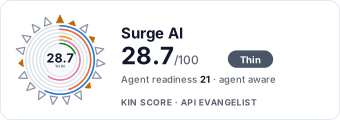
Surge AI has a Kin Score of 41.9 out of 100 (developing) and an Agent Readiness score of 21.2 (agent-aware), scored by API Evangelist on 2026-11-13.
Work with this as data
Every provider here is available over the APIs.io API and to AI agents over MCP.