Sparx Enterprise Architect is a comprehensive modeling, design, and management platform for enterprise architecture, software engineering, and systems engineering. It provides automation APIs including a COM Automation Interface, Add-In Framework, and scripting capabilities for programmatic access to models, diagrams, elements, connectors, and repository management.
Sparx Enterprise Architect is listed with 4 APIs on the APIs.io network. Tagged areas include Enterprise Architecture, Modeling, Software Engineering, Systems Engineering, and UML.
Sparx Enterprise Architect’s developer surface includes engineering blog, documentation, getting-started guide, pricing, support, FAQ, training material, and 27 more developer resources.
Regulatory Posture applies to this provider. Its tags matched the
Horizontal (data, software, accessibility, platform) regime, so
Regulatory Posture carries 15 points of the composite.
If this regime is wrong for your business, say so on your
provider repo — the
applicability map is public and we will correct it.
Create-or-Update Ergonomics could not be measured. We hold no machine-readable contract for
this provider to read, so there is nothing to measure a write surface against. Excluded rather than scored zero:
never-measured and measured-empty are different facts. Publishing an OpenAPI is what makes this facet — and
several others — scorable at all.
The six quality facets above are damped to 85 points between them,
because the conditional facet above carries the other
15. That is why each facet's contribution is shown against a damped
maximum: raising a quality facet moves the composite by 85% of its nominal
weight, not 100%. The full arithmetic is at apis.io/rating/.
Show this score on your site.
It updates itself when the score changes. Paste this where you link to your API docs:
<a href="https://apis.io/providers/sparx-enterprise-architect/"><img src="https://apis.io/badge/sparx-enterprise-architect/card.svg" alt="Sparx Enterprise Architect on APIs.io — Kin Score by API Evangelist"></a>
Other styles, a README pill and a shields.io endpoint are on the badge page.
Framework for building custom add-ins that extend Enterprise Architect with new functionality. Add-ins can respond to application events, add custom menu items, and integrate wi...
Built-in scripting engine supporting JavaScript, JScript, and VBScript for automating tasks within Enterprise Architect. Scripts can access the full automation interface to mani...
HTTP-based API provided by the Sparx Systems Pro Cloud Server for remote access to Enterprise Architect repositories. Enables integration with web-based clients, third-party too...
Official Model Context Protocol server for Sparx Systems Enterprise Architect. Published by Sparx Systems Japan Co., Ltd. and announced on the official Sparx Systems community f...
aid: sparx-enterprise-architect
name: Sparx Enterprise Architect
description: Sparx Enterprise Architect is a comprehensive modeling, design, and management platform for enterprise architecture,
  software engineering, and systems engineering. It provides automation APIs including a COM Automation Interface, Add-In
  Framework, and scripting capabilities for programmatic access to models, diagrams, elements, connectors, and repository
  management.
type: Index
deliveryModel:
  model: saas
  open_source: false
  commercial: true
  callable_host: false
  label: Hosted service · you call their endpoint
  confidence: medium
  source:
  - pricing
  generated: '2026-08-28'
  method: derived
accessModel:
  pricing: freemium
  onboarding: unknown
  trial: false
  try_now: false
  public: false
  label: Freemium
  confidence: medium
  source:
  - plans
  generated: '2026-07-22'
  method: derived
image: https://kinlane-images.s3.amazonaws.com/shared/apis-json/icons/sparx-enterprise-architect.png
url: https://raw.githubusercontent.com/api-evangelist/sparx-enterprise-architect/refs/heads/main/apis.yml
created: '2026-03-16'
modified: '2026-10-06'
specificationVersion: '0.23'
access: 3rd-Party
tags:
- Enterprise Architecture
- Modeling
- Software Engineering
- Systems Engineering
- UML
- ArchiMate
- BPMN
- SysML
- OSLC
- MCP
- Model-Driven Development
tags_raw:
- Enterprise Architecture
- Modeling
- Software Engineering
- Systems Engineering
- UML
- ArchiMate
- BPMN
- SysML
- OSLC
- Model Context Protocol
- Model-Driven Development
apis:
- aid: sparx-enterprise-architect:automation-interface
  name: Enterprise Architect Automation Interface
  description: COM-based Automation Interface providing programmatic access to Enterprise Architect repositories, models,
    packages, elements, diagrams, connectors, attributes, and tagged values. Supports creating, reading, updating, and deleting
    model elements through the Repository, Element, Diagram, Package, and Connector object hierarchy.
  humanURL: https://sparxsystems.com/enterprise_architect_user_guide/17.0/automation.htm
  tags:
  - Automation
  - COM
  - Diagramming
  - Elements
  - Models
  - Repository
  tags_raw:
  - Automation
  - COM
  - Diagrams
  - Elements
  - Models
  - Repository
  properties:
  - type: Documentation
    url: https://sparxsystems.com/enterprise_architect_user_guide/17.0/automation.htm
  - type: APIReference
    url: https://sparxsystems.com/enterprise_architect_user_guide/17.0/automation_and_scripting/automation_interface.htm
- aid: sparx-enterprise-architect:add-in-framework
  name: Enterprise Architect Add-In Framework
  description: Framework for building custom add-ins that extend Enterprise Architect with new functionality. Add-ins can
    respond to application events, add custom menu items, and integrate with external systems using COM interop from .NET,
    Java, or other languages.
  humanURL: https://sparxsystems.com/enterprise_architect_user_guide/17.0/add-ins_2.htm
  tags:
  - Add-Ins
  - Extensions
  - Plugins
  properties:
  - type: Documentation
    url: https://sparxsystems.com/enterprise_architect_user_guide/17.0/add-ins_2.htm
- aid: sparx-enterprise-architect:scripting
  name: Enterprise Architect Scripting
  description: Built-in scripting engine supporting JavaScript, JScript, and VBScript for automating tasks within Enterprise
    Architect. Scripts can access the full automation interface to manipulate models, generate reports, validate models, and
    perform bulk operations.
  humanURL: https://sparxsystems.com/enterprise_architect_user_guide/17.0/scripting.htm
  tags:
  - Automation
  - JavaScript
  - Scripting
  - VBScript
  properties:
  - type: Documentation
    url: https://sparxsystems.com/enterprise_architect_user_guide/17.0/scripting.htm
- aid: sparx-enterprise-architect:pro-cloud-server-api
  name: Pro Cloud Server API
  description: HTTP-based API provided by the Sparx Systems Pro Cloud Server for remote access to Enterprise Architect repositories.
    Enables integration with web-based clients, third-party tools, and automation systems via REST-like endpoints for model
    queries and operations.
  humanURL: https://sparxsystems.com/enterprise_architect_user_guide/17.0/pcs_overview.htm
  baseURL: https://{server}/{model_name}/oslc/
  baseURLNote: Templated on purpose. Pro Cloud Server is customer-installed software, so the OSLC RESTful API is served by
    the customer's own host, not by a Sparx Systems host. The provider's own documented example is http://localhost:480/firebird_model/oslc/.
    There is no vendor-hosted base URL to record.
  tags:
  - Cloud
  - HTTP
  - Remote Access
  - Repository
  properties:
  - type: Documentation
    url: https://sparxsystems.com/enterprise_architect_user_guide/17.0/pcs_overview.htm
  - type: APIReference
    url: https://sparxsystems.com/enterprise_architect_user_guide/17.0/the_model_repository/oslc_am_top.html
  - type: Authentication
    url: authentication/sparx-enterprise-architect-authentication.yml
  - type: Conventions
    url: conventions/sparx-enterprise-architect-conventions.yml
common:
- type: FinOps
  url: finops/sparx-enterprise-architect-finops.yml
- url: https://sparxsystems.com/prolaborate/articles
  type: Blog
- url: https://sparxsystems.com/prolaborate/feed
  type: BlogRSS
- type: Website
  url: https://sparxsystems.com/
- type: DomainSecurity
  url: security/sparx-enterprise-architect-domain-security.yml
- type: Documentation
  url: https://sparxsystems.com/enterprise_architect_user_guide/17.0/
- type: GettingStarted
  url: https://sparxsystems.com/enterprise_architect_user_guide/17.0/getting_started.htm
- type: Pricing
  url: https://sparxsystems.com/products/ea/pricing.html
- type: Support
  url: https://sparxsystems.com/support/
- type: FAQ
  url: https://sparxsystems.com/resources/faq/
- type: Training
  url: https://sparxsystems.com/training/
- type: ReleaseNotes
  url: https://sparxsystems.com/products/ea/release_notes.html
- type: Blog
  url: https://sparxsystems.com/resources/blog/
- type: X
  url: https://x.com/SparxSystems
- type: LinkedIn
  url: https://www.linkedin.com/company/sparx-systems/
- type: YouTube
  url: https://www.youtube.com/user/SparxSystems
- type: Features
  data:
  - name: UML Modeling
    description: Comprehensive support for all 14 UML 2.5 diagram types for software and systems design.
  - name: ArchiMate Support
    description: Native ArchiMate 3.2 modeling for enterprise architecture frameworks.
  - name: BPMN Process Modeling
    description: Business process modeling with BPMN 2.0 for workflow and process documentation.
  - name: Code Generation
    description: Generate source code in C++, Java, C#, Python, PHP, and other languages from UML models.
  - name: Reverse Engineering
    description: Import existing codebases to create UML models from source code automatically.
  - name: Model Simulation
    description: Execute and simulate state machines and activity diagrams for validation.
  - name: Document Generation
    description: Generate rich documentation from models in RTF, HTML, PDF, and DOCX formats.
  - name: Team Collaboration
    description: Multi-user repository access with role-based security and version control integration.
- type: UseCases
  data:
  - name: Enterprise Architecture Governance
    description: Define and maintain enterprise architecture models aligned with TOGAF, Zachman, or ArchiMate frameworks.
  - name: Software Design Documentation
    description: Create detailed software designs with UML class, sequence, and component diagrams.
  - name: Requirements Management
    description: Capture, trace, and manage requirements from stakeholder needs through to implementation.
  - name: Database Design
    description: Model database schemas with ER diagrams and generate DDL scripts for multiple databases.
  - name: Model-Driven Development
    description: Use models as the primary artifact for generating code, tests, and documentation.
- type: Integrations
  data:
  - name: Jira
    description: Integrate with Atlassian Jira for requirements traceability and issue tracking.
  - name: Azure DevOps
    description: Connect to Azure DevOps for work item synchronization and version control.
  - name: Git
    description: Version control model packages with Git repositories.
  - name: Eclipse
    description: Integrate with Eclipse IDE for model-driven Java development.
  - name: Visual Studio
    description: Integrate with Microsoft Visual Studio for .NET development workflows.
- type: MCPServer
  url: mcp/sparx-enterprise-architect-mcp.yml
- type: Packages
  url: packages/sparx-enterprise-architect-packages.yml
- type: LLMsTxt
  url: llms/sparx-enterprise-architect-llms.txt
- type: Authentication
  url: authentication/sparx-enterprise-architect-authentication.yml
- type: Conventions
  url: conventions/sparx-enterprise-architect-conventions.yml
- type: Conformance
  url: conformance/sparx-enterprise-architect-conformance.yml
- type: Lifecycle
  url: lifecycle/sparx-enterprise-architect-lifecycle.yml
- type: ErrorCatalog
  url: errors/sparx-enterprise-architect-problem-types.yml
- type: DataModel
  url: data-model/sparx-enterprise-architect-data-model.yml
- type: ChangeLog
  url: changelog/sparx-enterprise-architect-changelog.yml
- type: AgentSkill
  url: skills/_index.yml
- type: Plans
  url: plans/sparx-enterprise-architect-plans-pricing.yml
- type: RateLimits
  url: rate-limits/sparx-enterprise-architect-rate-limits.yml
- type: APIReference
  url: https://sparxsystems.com/enterprise_architect_user_guide/17.0/automation_and_scripting/automation_interface.htm
- type: PrivacyPolicy
  url: https://sparxsystems.com/privacy.html
- type: TermsOfService
  url: https://sparxsystems.com/products/ea/17.1/eula.html
- type: Login
  url: https://sparxsystems.com/products/ea/login.html
- type: SignUp
  url: https://www.sparxsystems.us/enterprise-architect/download-free-trial
maintainers:
- FN: Kin Lane
  email: kin@apievangelist.com
x-enrichment:
  date: '2026-08-29'
  status: enriched
  artifacts_added: 16
  pass: local-v1
x-coverage:
  state: covered
  reason: covered
  detail: 'Enterprise Architect is a licensed desktop modelling product, so its programmatic surface is real but never vendor-hosted:
    a first-party STDIO MCP server (v2.8.11, 38 tools) and a documented OSLC Architecture Management 2.0 RESTful API that
    runs on the customer''s own Pro Cloud Server. Contract discovery was run in full and found no OpenAPI/GraphQL/AsyncAPI
    on any vendor origin, correctly, because the only machine-readable discovery document is the OSLC Service Provider Resource
    served by each customer''s own deployment. Note for future runs: sparxsystems.com and sparxsystems.com.au serve a Cloudflare
    managed challenge (HTTP 403) to every non-browser client, so all documentation was read from the Sparx Systems Japan help
    mirror (www.sparxsystems.jp/help/17.0/) and the Sparx Systems North America site (www.sparxsystems.us), both Sparx Systems
    entities. Every sparxsystems.com pointer in this file returned the same ~5.7KB challenge body, which is a bot policy and
    not a dead page — none were removed.'
  evidence:
  - url: https://www.sparxsystems.jp/en/MCP/
    status: 200
  - url: https://www.sparxsystems.jp/help/17.0/oslc_user_cred.html
    status: 200
  - url: https://www.sparxsystems.us/llms.txt
    status: 200
  - url: https://www.sparxsystems.us/openapi.json
    status: 404
  - url: https://sparxsystems.com/.well-known/agent-card.json
    status: 404
  - url: https://sparxsystems.com/enterprise_architect_user_guide/17.0/pcs_overview.htm
    status: 403
  checked: '2026-08-29'
Discovery needs no key. Ratings and market analysis are Pro.
Get an API key
Free tier, no form to fill in. Signing in shares your email address with us — we
store it to create your key and to recognise you if you sign in with another
provider. See our Privacy Policy and
Terms.
 Kin Score
How this is scored →
Kin Score
How this is scored →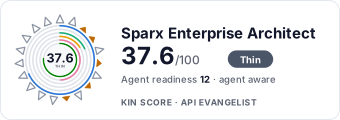 It updates itself when the score changes. Paste this where you link to your API docs: