SecondFactor
SecondFactor provides an OTP Delivery & Verification API that enables developers to send one‑time passwords via SMS, WhatsApp, Viber, and RCS. The platform intelligently routes messages to the lowest‑cost channel, offers automatic fallback, delivery logs, template management, and a pricing calculator. It aims to reduce authentication costs and improve user experience with a single, multi‑channel API. Documentation, pricing, and support are available online, and the service is trusted by global companies for secure, fast, and affordable OTP delivery.
SecondFactor is listed with 2 APIs on the APIs.io network. Tagged areas include Company, OTP, Authentication, Multi-Channel, and Messaging.
The SecondFactor catalog on APIs.io includes 1 event-driven AsyncAPI specification, 1 JSON-LD context, and 1 Spectral governance ruleset.
SecondFactor’s developer surface includes getting-started guide, authentication, documentation, support, engineering blog, pricing, signup flow, and 26 more developer resources.
Kin Score
 Kin Score
How this is scored →
scored 2026-11-21 · rubric v0.28.1
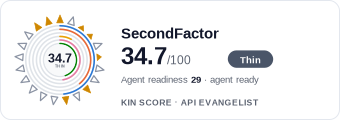 It updates itself when the score changes. Paste this where you link to your API docs:
<a href="https://apis.io/providers/secondfactor/"><img src="https://apis.io/badge/secondfactor/card.svg" alt="SecondFactor on APIs.io — Kin Score by API Evangelist"></a>Other styles, a README pill and a shields.io endpoint are on the badge page.
- MCP Server +12 pts — deployment.mode + probe verdict on the mcp/ manifest, not the pointer; an unprobed slug falls back to authorship Ask about this →
- Agentic Access Contract +10 pts — agentic_access artifact present (x-agentic-access), graded by author Ask about this →
- A2A Agent Card +8 pts — a2a/
-a2a.yml manifest, graded on conformance.grade against A2A 1.0.0 Ask about this → - Rate-Limit Signaling +7 pts — OpenAPI responses document X-RateLimit-* / RateLimit headers (verified), else a rate_limits artifact or RateLimits link (documented) Ask about this →
- Registration Without a Human +6 pts — a `registration_endpoint` in the served RFC 8414 / OIDC discovery document Ask about this →
- Delegated User Identity +6 pts — a served discovery document listing authorization_code in grant_types_supported (served), else an oauth2 authorizationCode flow or openIdConnect declared in an OpenAPI (documented) Ask about this →
- Contract Quality scores 33.8 — up to +16.6 composite points Ask about this →
- Operational Transparency scores 7.1 — up to +12.1 composite points Ask about this →
- Access Clarity scores 48.9 — up to +10.2 composite points Ask about this →
APIs 2
Individual APIs this provider publishes, each with its own machine-readable definition.
SecondFactor API
SecondFactor provides an OTP Delivery & Verification API for sending one‑time passwords via SMS, WhatsApp, Viber, and RCS.
SecondFactor API
SecondFactor API as documented publicly: 7 operations. Contract generated from the documentation by API Evangelist (2026-11-10); not the provider's own document.
Agent Skills 1
Packaged agent skills for driving this provider's APIs from an AI assistant.
verification
AGENT SKILLTerms of Service 1
What its API terms permit and prohibit, quoted from its own page.
Privacy & Data 1
Its role, the data it processes, retention and transfers, quoted from its own privacy page.
Eligibility 1
Who may sign up and where, quoted from its own terms.
Data License 1
How its data and outputs may be reused, quoted from its own terms.
Event Specifications 1
AsyncAPI definitions for this provider's event-driven and streaming APIs.
Secondfactor Webhooks
ASYNCAPISemantic Vocabularies 1
JSON-LD contexts and semantic vocabularies used across these APIs.
Secondfactor Context
JSON-LDSpectral Rules 1
Spectral governance rulesets for linting and validating these APIs. Counts are the severity each rule declares, not results of running them.
SecondFactor API Rules
SPECTRALJSON Schema 6
Standalone JSON Schema definitions for this provider's data models.
PostV2ServicesResponse
JSON SCHEMAPostV2ServicesServicesidVerificationsRequest
JSON SCHEMASecurity Posture 2
Authentication, domain security, vulnerability disclosure, and trust-center signals.
Resources
Get Started 3
Portal, sign-up, and the first successful call
Documentation 2
Reference material describing how the API behaves
Agent Surfaces 2
MCP servers, agent skills, and machine-readable catalogs
Design & Contract 9
Pagination, idempotency, versioning, errors, and events
Scroll for all 9
Build 3
SDKs, sample code, and the tooling you integrate with
Access & Security 2
Authentication, authorization, and security posture
Operate 1
Status, limits, changes, and where to get help
Commercial 5
Pricing, plans, and the legal terms of use
Company 2
The organization behind the API
Other 4
Properties that don't map to a standard resource type
Source (apis.yml)
SecondFactor API — frequently asked questions
Does SecondFactor have an API?
Yes. APIs.io lists 2 APIs from SecondFactor, including SecondFactor API and SecondFactor API.
Is there an OpenAPI specification for the SecondFactor API?
Yes. APIs.io indexes 1 OpenAPI specification for SecondFactor, each linked for download from this page.
How do I authenticate with the SecondFactor API?
SecondFactor uses bearer-token authentication (1 scheme). The details are profiled on APIs.io as SecondFactor Authentication.
Is the SecondFactor API ready for AI agents?
SecondFactor has a Kin Score of 42.0 out of 100 (developing) and an Agent Readiness score of 27.8 (agent-aware), scored by API Evangelist on 2026-11-21.
Work with this as data
Every provider here is available over the APIs.io API and to AI agents over MCP.