Radicle
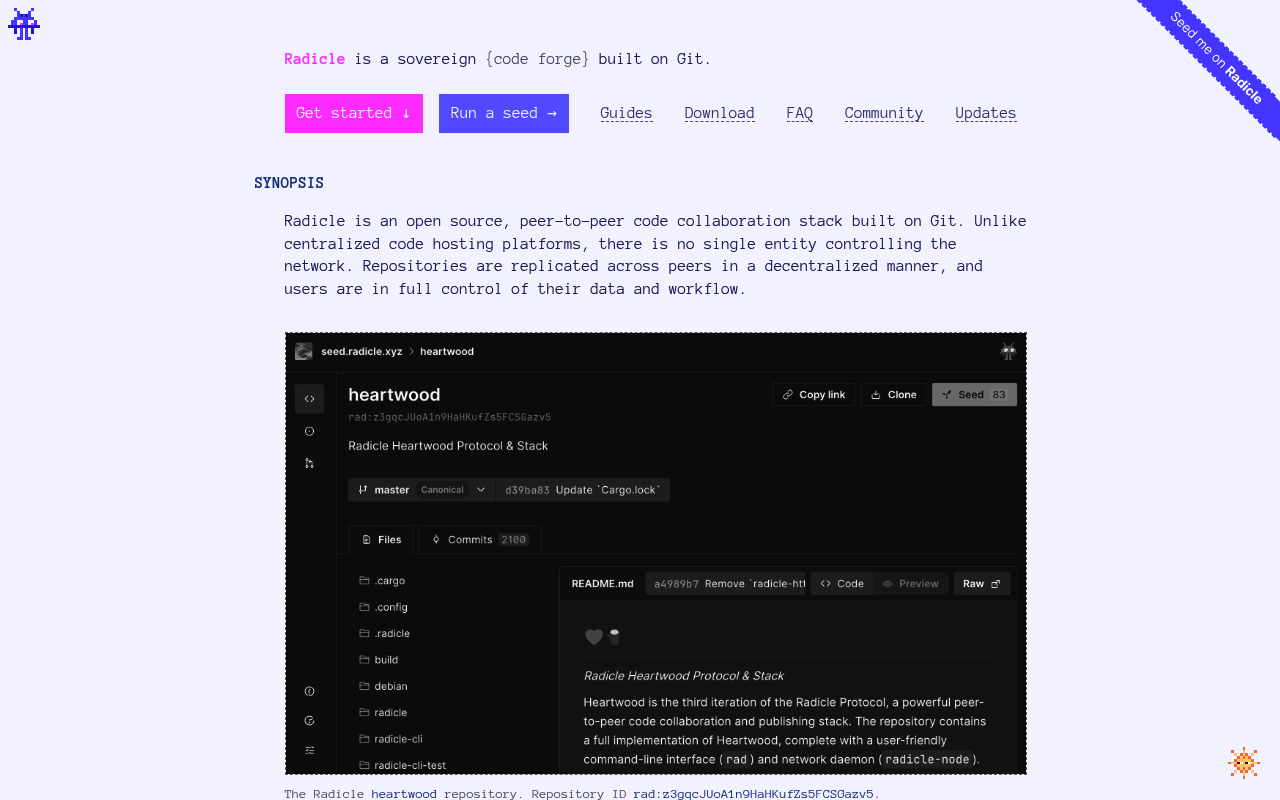
Radicle is a sovereign, peer-to-peer code collaboration stack built on Git, developed by Radicle (radicle.dev) and backed by Electric Capital. Instead of relying on a central host, every user runs their own node, and repositories, issues and patches replicate across the network as cryptographically-signed Collaborative Objects (COBs). The stack ships the `rad` command-line tooling, the Heartwood protocol and node, a terminal UI, a desktop app, and a web explorer. Each node can run `radicle-httpd`, a lightweight HTTP daemon that exposes a read-oriented JSON API over the node's storage — repositories, issues, patches, commits, source trees, node info and network statistics — which powers the Radicle web explorer and third-party tooling. Identity is key-based (DIDs / did:key), so there are no accounts, passwords or platform lock-in. This profile was enriched from Radicle's public surface: the live seed node API, the security.txt, the Heartwood source, and the CLI manuals.
Radicle publishes 7 API contracts indexed on the APIs.io network, including Issues API, Node API, Patches API, and 4 more. Tagged areas include Company, Developer Tools, Code Collaboration, Git, and Peer-to-Peer.
Radicle’s developer surface includes documentation, getting-started guide, API reference, engineering blog, FAQ, support, CLI, and 21 more developer resources.
What this lets a business do 1
Business capabilities this provider's published APIs can perform, derived from its own contracts. Browse all capabilities →
Kin Score
 Kin Score
How this is scored →
Kin Score
How this is scored →scored 2026-10-17 · rubric v0.24.0
APIs 7
Individual APIs this provider publishes, each with its own machine-readable definition.
Radicle Issues API
Repository issues (collaborative objects)
Radicle Node API
Node identity, configuration and peers
Radicle Patches API
Repository patches (change proposals)
Radicle Repositories API
Radicle repositories seeded by the node
Radicle Service API
API root and service metadata
Radicle Source API
Commits, trees, blobs and READMEs
Radicle Stats API
Aggregate node statistics
Scroll for all 7
Open Collections 8
Open, tool-agnostic API collections (OpenAPI-derived and Bruno).
API Collection
OPEN COLLECTIONRadicle HTTP API (radicle-httpd) Issues API
OPEN COLLECTIONRadicle HTTP API (radicle-httpd) Issues Node API
OPEN COLLECTIONRadicle HTTP API (radicle-httpd) Issues Patches API
OPEN COLLECTIONRadicle HTTP API (radicle-httpd) Issues Repositories API
OPEN COLLECTIONRadicle HTTP API (radicle-httpd) Issues Service API
OPEN COLLECTIONRadicle HTTP API (radicle-httpd) Issues Source API
OPEN COLLECTIONRadicle HTTP API (radicle-httpd) Issues Stats API
OPEN COLLECTIONScroll for all 8
OpenAPI Overlays 1
Overlays applied on top of this provider's contracts. Each card says who wrote it: a document the provider publishes, or one API Evangelist derived or generated.
Radicle Httpd Overlay
UNRECORDEDSecurity Posture 3
Authentication, domain security, vulnerability disclosure, and trust-center signals.
Resources
Get Started 2
Portal, sign-up, and the first successful call
Documentation 2
Reference material describing how the API behaves
Agent Surfaces 4
MCP servers, agent skills, and machine-readable catalogs
Design & Contract 1
Pagination, idempotency, versioning, errors, and events
Build 4
SDKs, sample code, and the tooling you integrate with
Access & Security 5
Authentication, authorization, and security posture
Operate 3
Status, limits, changes, and where to get help
Commercial 1
Pricing, plans, and the legal terms of use
Company 3
The organization behind the API
Other 3
Properties that don't map to a standard resource type
Source (apis.yml)
Work with this as data
Every provider here is available over the APIs.io API and to AI agents over MCP.