PHP-FPM
PHP-FPM (FastCGI Process Manager) is the primary PHP FastCGI implementation bundled with PHP for handling heavy-loaded sites, providing advanced process management with multiple worker pools, graceful start/stop, adaptive process spawning (static, dynamic, ondemand), slowlog tracking, and accelerated upload support. It is configured via php.ini-style pool files and is typically deployed behind a web server such as Nginx, Apache, Caddy, or LiteSpeed via FastCGI. PHP-FPM exposes operational status pages (in plain, JSON, XML, OpenMetrics, and HTML formats) but does not provide a public HTTP API; it runs only on POSIX systems that support fork().
PHP-FPM publishes 3 API contracts indexed on the APIs.io network, including Ping API, Status API, and 1 more. Tagged areas include PHP, FastCGI, Process-Manager, Web Server, and Application Server.
The PHP-FPM catalog on APIs.io includes 1 Spectral governance ruleset.
PHP-FPM’s developer surface includes documentation and 14 more developer resources.
Kin Score
 Kin Score
How this is scored →
scored 2026-11-13 · rubric v0.28.0
 It updates itself when the score changes. Paste this where you link to your API docs:
<a href="https://apis.io/providers/php-fpm/"><img src="https://apis.io/badge/php-fpm/card.svg" alt="PHP-FPM on APIs.io — Kin Score by API Evangelist"></a>Other styles, a README pill and a shields.io endpoint are on the badge page.
- MCP Server +12 pts — deployment.mode + probe verdict on the mcp/ manifest, not the pointer; an unprobed slug falls back to authorship Ask about this →
- Machine-Readable Auth +10 pts — a served openid-configuration/oauth-authorization-server carrying `issuer` (served), else the securitySchemes class in the provider OpenAPIs — bound (mutualTLS, DPoP, Signature) > negotiable (oauth2 authorizationCode/clientCredentials, openIdConnect) > bearer (http bearer, apiKey) Ask about this →
- Stable Error Semantics +8 pts — OpenAPI $refs a shared error schema across 4xx/5xx responses (verified), else common[].type includes ErrorCatalog / ErrorCodes / DeclineCodes Ask about this →
- A2A Agent Card +8 pts — a2a/
-a2a.yml manifest, graded on conformance.grade against A2A 1.0.0 Ask about this → - Rate-Limit Signaling +7 pts — OpenAPI responses document X-RateLimit-* / RateLimit headers (verified), else a rate_limits artifact or RateLimits link (documented) Ask about this →
- Registration Without a Human +6 pts — a `registration_endpoint` in the served RFC 8414 / OIDC discovery document Ask about this →
- Access Clarity scores 4.3 — up to +19.1 composite points Ask about this →
- Developer Ergonomics scores 9.5 — up to +18.1 composite points Ask about this →
- Contract Quality scores 42.9 — up to +14.3 composite points Ask about this →
Standards implemented 1
Standards this provider implements or carries. De facto ones are profiled and measured by the API Commons; formal ones come from the standards directory and are linked by the provider's own tags. The evidence column says how each claim was established — not that it was made.
APIs 3
Individual APIs this provider publishes, each with its own machine-readable definition.
PHP-FPM Ping API
PHP-FPM liveness check.
PHP-FPM Status API
PHP-FPM pool status.
PHP-FPM Status Endpoint
Operational status endpoint exposed by PHP-FPM via the pm.status_path directive. Returns pool statistics (active processes, idle processes, accepted connections, slow requests) ...
Open Collections 3
Open, tool-agnostic API collections (OpenAPI-derived and Bruno).
PHP-FPM Status and Endpoints Ping API
OPEN COLLECTIONPHP-FPM and Endpoints Ping Status API
OPEN COLLECTIONPHP-FPM Status and Ping Endpoints
OPEN COLLECTIONData License 1
How its data and outputs may be reused, quoted from its own terms.
Spectral Rules 1
Spectral governance rulesets for linting and validating these APIs. Counts are the severity each rule declares, not results of running them.
PHP-FPM API Rules
SPECTRALSecurity Posture 2
Authentication, domain security, vulnerability disclosure, and trust-center signals.
Agentic Access (API Evangelist recommendations) 1
Recommended x-agentic-access execution contracts for AI agents.
Resources
Documentation 2
Reference material describing how the API behaves
Agent Surfaces 1
MCP servers, agent skills, and machine-readable catalogs
Build 1
SDKs, sample code, and the tooling you integrate with
Access & Security 3
Authentication, authorization, and security posture
Operate 3
Status, limits, changes, and where to get help
Commercial 2
Pricing, plans, and the legal terms of use
Company 2
The organization behind the API
Other 1
Properties that don't map to a standard resource type
Source (apis.yml)
PHP-FPM API — frequently asked questions
Does PHP-FPM have an API?
Yes. APIs.io lists 3 APIs from PHP-FPM, including PHP-FPM Ping API, PHP-FPM Status API and PHP-FPM Status Endpoint.
Is there an OpenAPI specification for the PHP-FPM API?
Yes. APIs.io indexes 2 OpenAPI specifications for PHP-FPM, each linked for download from this page.
Is the PHP-FPM API ready for AI agents?
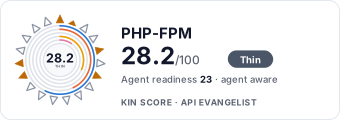
PHP-FPM has a Kin Score of 30.1 out of 100 (thin) and an Agent Readiness score of 22.9 (agent-aware), scored by API Evangelist on 2026-11-13.
Work with this as data
Every provider here is available over the APIs.io API and to AI agents over MCP.