ocapi-shop is a company surfaced via the API Evangelist harvest backlog (source: mcp-registry) and added to the network as a stub for full-pipeline profiling.
ocapi-shop publishes 16 API contracts indexed on the APIs.io network, including Account API, Categories API, Discounts API, and 13 more. Tagged areas include AI Catalog and No‑commission sales.
The ocapi-shop catalog on APIs.io includes 1 event-driven AsyncAPI specification, 1 JSON-LD context, and 1 Spectral governance ruleset.
ocapi-shop’s developer surface includes engineering blog, authentication, and 18 more developer resources.
Pull ocapi-shop's APIs, OpenAPI, scores and pricing into your own code or AI agent
with a free APIs.io key —
sign in with
GitHub,
Google or
LinkedIn.
No form to fill in; signing in shares your email address with us (Privacy).
Points earned after grading and authorship credit; n/a dimensions are left out of the score.
Regulatory Posture applies to this provider. Its tags matched the
Horizontal (data, software, accessibility, platform) regime, so
Regulatory Posture carries 15 points of the composite.
If this regime is wrong for your business, say so on your
provider repo — the
applicability map is public and we will correct it.
Create-or-Update Ergonomics could not be measured. We hold no machine-readable contract for
this provider to read, so there is nothing to measure a write surface against. Excluded rather than scored zero:
never-measured and measured-empty are different facts. Publishing an OpenAPI is what makes this facet — and
several others — scorable at all.
The six quality facets above are damped to 85 points between them,
because the conditional facet above carries the other
15. That is why each facet's contribution is shown against a damped
maximum: raising a quality facet moves the composite by 85% of its nominal
weight, not 100%. The full arithmetic is at apis.io/rating/.
Show this score on your site.
It updates itself when the score changes. Paste this where you link to your API docs:
<a href="https://apis.io/providers/ocapi-shop/"><img src="https://apis.io/badge/ocapi-shop/card.svg" alt="ocapi-shop on APIs.io — Kin Score by API Evangelist"></a>
Other styles, a README pill and a shields.io endpoint are on the badge page.
Raise your score.
Agent readiness — checks not met, largest first (exact, from this profile):
MCP Server+12 pts — deployment.mode + probe verdict on the mcp/ manifest, not the pointer; an unprobed slug falls back to authorship Ask about this →
Idempotency+9 pts — OpenAPI mutating operations declare an idempotency key — a header, a request-body property, or a named de-duplication token whose own description says so (verified); else common[].type matches /idempoten/i (documented) Ask about this →
Rate-Limit Signaling+7 pts — OpenAPI responses document X-RateLimit-* / RateLimit headers (verified), else a rate_limits artifact or RateLimits link (documented) Ask about this →
Pagination+5 pts — share of collection GETs (an array, or one wrapped in data/items/results ...) that declare a page/limit/offset/cursor parameter, a Link header or a next/cursor field; na with no collection GETs Ask about this →
5 more unmet checks in the Agent Readiness table above.
Kin Score — facets with the most composite points still available (weight × headroom):
Each check links to what satisfies it. Publish the artifact, or tell us where it already lives, and the score moves on the next scoring run.
Not sure how this applies to your stack? Ask about any one item. Kin Lane reads every question, looks at your profile and your situation, and replies with what a fix would take — scoped to that one area, priced up front, yours whether you ship it or not. Ask a question →
Discount codes customers type at checkout or open as a link (`https:///d/CODE`, or any storefront page with `?discount=CODE`), and automatic discounts (`automatic: true`) that a...
Custom domains for the storefront. Add a domain, have its owner create the DNS record in `dns` at their domain provider, then verify it: a verified (`ready`) domain serves the s...
The store's own riders for local deliveries. A driver has no Ocapi account: each one gets a private link to a page with the orders assigned to them for the day, where they mark ...
Get images into Ocapi, then use the returned `public_url` in a product's `image_urls` or a store's `logo_url` and `cover_url`. Upload a file with a presigned URL, or import one ...
Orders placed on the storefront or recorded by hand. Online payments update themselves through the payment provider; orders paid outside Ocapi (`manualPayment`) are marked paid ...
For members of the Ocapi partner program: the client stores they brought in or work on, each store's billing status and the partner's earnings. Partners see nothing else of a cl...
The store's catalog. Products have a price, optional variants (sizes, colors...) with their own price and stock, images, deals (combos, bulk discounts, buy X get Y) and addons (...
The storefront's design, as the dashboard's store editor edits it: the look (colors, font, corners), the announcement bar, the home (the profile page, or a brand home built from...
Dine-in ordering for cafés and restaurants: each table (or area, like a bar or terrace) has a QR code with a signed link. Scanning it opens the storefront for that table, with n...
Webhooks push the store's events to a URL of yours as they happen, instead of you polling for them. Owners only. A store has up to 10 endpoints (IDs `whk_`), each listening for ...
aid: ocapi-shop
name: ocapi-shop
accessModel:
  pricing: paid
  onboarding: unknown
  trial: false
  try_now: false
  public: false
  label: Paid
  confidence: medium
  source:
  - plans
  - authentication
  - security
  generated: '2026-11-20'
  method: derived
image: https://ocapi.shop/assets/share-card-es-15ecdd3b.png
description: 'ocapi-shop is a company surfaced via the API Evangelist harvest backlog (source: mcp-registry) and added to
  the network as a stub for full-pipeline profiling.'
url: https://artifacts.apis.io/ocapi-shop/apis.yml
x-type: company
x-source: harvest:mcp-registry
x-tier: profiled
x-tier-reason: enrichment pass 2026-11-19 (modular-v1; was harvest)
specificationVersion: '0.20'
created: '2026-11-19'
modified: '2026-11-19'
tags:
- AI Catalog
- No‑commission sales
tags_raw:
- AI catalog
- No‑commission sales
maintainers:
- FN: Kin Lane
  email: kin@apievangelist.com
- FN: APIs.json
  email: info@apis.io
common:
- type: AgenticAccess
  url: agentic-access/ocapi-shop-agentic-access.yml
- type: Plans
  url: plans/ocapi-shop-plans-pricing.yml
- type: Spectral
  url: rules/ocapi-shop-rules.yml
- type: JSONLD
  url: json-ld/ocapi-shop-context.jsonld
- type: Vocabulary
  url: vocabulary/ocapi-shop-vocabulary.yml
- type: AgentSkill
  url: skills/_index.yml
- type: Webhooks
  url: asyncapi/ocapi-shop-webhooks.yml
- type: DataModel
  url: data-model/ocapi-shop-data-model.yml
- type: ErrorCatalog
  url: errors/ocapi-shop-problem-types.yml
- type: Conformance
  url: conformance/ocapi-shop-conformance.yml
- type: WellKnown
  url: well-known/ocapi-shop-well-known.yml
- type: Hosts
  url: hosts/ocapi-shop-hosts.yml
- type: Vendors
  url: vendors/ocapi-shop-vendors.yml
- type: TermsOfService
  url: https://ocapi.shop/terms
- type: PrivacyPolicy
  url: https://ocapi.shop/privacy
- type: Login
  url: https://dashboard.ocapi.shop/auth/signin
- type: Blog
  url: https://ocapi.shop/es/blog
- type: Authentication
  url: authentication/ocapi-shop-authentication.yml
- type: DomainSecurity
  url: security/ocapi-shop-domain-security.yml
- type: Website
  url: https://ocapi.shop/
apis:
- aid: ocapi-shop:ocapi-shop-account-api
  name: ocapi-shop Account API
  description: The signed-in user and what their token can do.
  humanURL: https://dashboard.ocapi.shop/docs
  baseURL: https://dashboard.ocapi.shop
  tags:
  - Account
  properties:
  - type: OpenAPI
    url: openapi/ocapi-shop-account-api-openapi.yml
- aid: ocapi-shop:ocapi-shop-categories-api
  name: ocapi-shop Categories API
  description: 'Categories group products on the storefront. Products refer to their category by name, so

    renaming a category renames it on its products.'
  humanURL: https://dashboard.ocapi.shop/docs
  baseURL: https://dashboard.ocapi.shop
  tags:
  - Categories
  properties:
  - type: OpenAPI
    url: openapi/ocapi-shop-categories-api-openapi.yml
- aid: ocapi-shop:ocapi-shop-discounts-api
  name: ocapi-shop Discounts API
  description: 'Discount codes customers type at checkout or open as a link (`https://<store>/d/CODE`, or any storefront

    page with `?discount=CODE`), and automatic discounts (`automatic: true`) that apply without a code when a

    cart meets their conditions: a minimum subtotal or number of units, some products or categories, buy X get

    Y, a date range.


    How they stack: a cart gets at most one automatic discount that changes prices (the one that takes the most

    off) plus one automatic free shipping. A code and an automatic discount don''t add up: the customer gets the

    better of the two, unless the automatic one has `combines_with_codes`; then it applies first and the code

    takes its share of what''s left. Free shipping combines with anything, and gift cards always pay what''s left.

    Checkout enforces all of it, so the total charged, the order, its emails and its WhatsApp message agree.'
  humanURL: https://dashboard.ocapi.shop/docs
  baseURL: https://dashboard.ocapi.shop
  tags:
  - Discounts
  properties:
  - type: OpenAPI
    url: openapi/ocapi-shop-discounts-api-openapi.yml
- aid: ocapi-shop:ocapi-shop-domains-api
  name: ocapi-shop Domains API
  description: 'Custom domains for the storefront. Add a domain, have its owner create the DNS record in

    `dns` at their domain provider, then verify it: a verified (`ready`) domain serves the

    storefront.


    Owners can also buy a domain through Ocapi, where it is offered: search names with

    their price, then start a purchase. A person pays it in Stripe Checkout (`checkout_url`);

    once paid, Ocapi registers it, points its DNS at the store, adds it to the domains and

    renews it every year.'
  humanURL: https://dashboard.ocapi.shop/docs
  baseURL: https://dashboard.ocapi.shop
  tags:
  - Domains
  properties:
  - type: OpenAPI
    url: openapi/ocapi-shop-domains-api-openapi.yml
- aid: ocapi-shop:ocapi-shop-drivers-api
  name: ocapi-shop Drivers API
  description: 'The store''s own riders for local deliveries. A driver has no Ocapi account: each one gets a private link
    to a

    page with the orders assigned to them for the day, where they mark each on its way (the order ships and the

    customer is told), delivered with a photo as proof, or not delivered with a reason. Assign an order with

    assignOrderDriver; the order''s `delivery` has how it went.'
  humanURL: https://dashboard.ocapi.shop/docs
  baseURL: https://dashboard.ocapi.shop
  tags:
  - Drivers
  properties:
  - type: OpenAPI
    url: openapi/ocapi-shop-drivers-api-openapi.yml
  - type: JSONSchema
    url: json-schema/ocapi-shop-order-schema.json
- aid: ocapi-shop:ocapi-shop-images-api
  name: ocapi-shop Images API
  description: 'Get images into Ocapi, then use the returned `public_url` in a product''s `image_urls` or a

    store''s `logo_url` and `cover_url`. Upload a file with a presigned URL, or import one that

    is already online.'
  humanURL: https://dashboard.ocapi.shop/docs
  baseURL: https://dashboard.ocapi.shop
  tags:
  - Image
  tags_raw:
  - Images
  properties:
  - type: OpenAPI
    url: openapi/ocapi-shop-images-api-openapi.yml
- aid: ocapi-shop:ocapi-shop-insights-api
  name: ocapi-shop Insights API
  description: Storefront analytics and the newsletter's subscribers.
  humanURL: https://dashboard.ocapi.shop/docs
  baseURL: https://dashboard.ocapi.shop
  tags:
  - Insights
  properties:
  - type: OpenAPI
    url: openapi/ocapi-shop-insights-api-openapi.yml
- aid: ocapi-shop:ocapi-shop-orders-api
  name: ocapi-shop Orders API
  description: 'Orders placed on the storefront or recorded by hand. Online payments update themselves

    through the payment provider; orders paid outside Ocapi (`manualPayment`) are marked paid

    by the merchant.'
  humanURL: https://dashboard.ocapi.shop/docs
  baseURL: https://dashboard.ocapi.shop
  tags:
  - Order
  tags_raw:
  - Orders
  properties:
  - type: OpenAPI
    url: openapi/ocapi-shop-orders-api-openapi.yml
  - type: JSONSchema
    url: json-schema/ocapi-shop-order-schema.json
- aid: ocapi-shop:ocapi-shop-partners-api
  name: ocapi-shop Partners API
  description: 'For members of the Ocapi partner program: the client stores they brought in or work on, each

    store''s billing status and the partner''s earnings. Partners see nothing else of a client''s

    store unless its owner invites them to the team.'
  humanURL: https://dashboard.ocapi.shop/docs
  baseURL: https://dashboard.ocapi.shop
  tags:
  - Partners
  properties:
  - type: OpenAPI
    url: openapi/ocapi-shop-partners-api-openapi.yml
- aid: ocapi-shop:ocapi-shop-products-api
  name: ocapi-shop Products API
  description: 'The store''s catalog. Products have a price, optional variants (sizes, colors...) with their

    own price and stock, images, deals (combos, bulk discounts, buy X get Y) and addons

    (extra choices such as gift wrap or an engraving).'
  humanURL: https://dashboard.ocapi.shop/docs
  baseURL: https://dashboard.ocapi.shop
  tags:
  - Product
  tags_raw:
  - Products
  properties:
  - type: OpenAPI
    url: openapi/ocapi-shop-products-api-openapi.yml
  - type: JSONSchema
    url: json-schema/ocapi-shop-product-input-schema.json
  - type: JSONSchema
    url: json-schema/ocapi-shop-product-schema.json
  - type: JSONSchema
    url: json-schema/ocapi-shop-catalog-import-schema.json
- aid: ocapi-shop:ocapi-shop-settings-api
  name: ocapi-shop Settings API
  description: 'How the store gets paid and ships (owners only), the greetings that start a customer''s

    WhatsApp message, and the storefront''s tracking pixels.'
  humanURL: https://dashboard.ocapi.shop/docs
  baseURL: https://dashboard.ocapi.shop
  tags:
  - Settings
  properties:
  - type: OpenAPI
    url: openapi/ocapi-shop-settings-api-openapi.yml
  - type: JSONSchema
    url: json-schema/ocapi-shop-checkout-input-schema.json
- aid: ocapi-shop:ocapi-shop-storefront-api
  name: ocapi-shop Storefront API
  description: 'The storefront''s design, as the dashboard''s store editor edits it: the look (colors, font,

    corners), the announcement bar, the home (the profile page, or a brand home built from

    blocks), the menu and footer, custom pages, how products are presented, and the store''s

    links, collections and shoppable videos.


    Changes go to the editor''s draft, the same one the dashboard editor shows, so the merchant

    can review them there (`editor_url`) before Publish storefront makes them live.'
  humanURL: https://dashboard.ocapi.shop/docs
  baseURL: https://dashboard.ocapi.shop
  tags:
  - Storefront
  properties:
  - type: OpenAPI
    url: openapi/ocapi-shop-storefront-api-openapi.yml
  - type: JSONSchema
    url: json-schema/ocapi-shop-storefront-input-schema.json
- aid: ocapi-shop:ocapi-shop-stores-api
  name: ocapi-shop Stores API
  description: 'The stores the user owns or is a member of, and their public profile. Start here: every

    other endpoint takes a `store_id`.'
  humanURL: https://dashboard.ocapi.shop/docs
  baseURL: https://dashboard.ocapi.shop
  tags:
  - Stores
  properties:
  - type: OpenAPI
    url: openapi/ocapi-shop-stores-api-openapi.yml
- aid: ocapi-shop:ocapi-shop-tables-api
  name: ocapi-shop Tables API
  description: 'Dine-in ordering for cafés and restaurants: each table (or area, like a bar or terrace) has a QR code with
    a

    signed link. Scanning it opens the storefront for that table, with no shipping or address, and the order reaches

    the kitchen tagged with the table: its `table` and `table_session`. Orders from the same table, from one phone or

    several, share its sitting until the staff close the table on the dashboard, which records what was left to pay.

    Turn it on, and choose how guests pay, with updateDineIn.'
  humanURL: https://dashboard.ocapi.shop/docs
  baseURL: https://dashboard.ocapi.shop
  tags:
  - Tables
  properties:
  - type: OpenAPI
    url: openapi/ocapi-shop-tables-api-openapi.yml
- aid: ocapi-shop:ocapi-shop-team-api
  name: ocapi-shop Team API
  description: 'Who can manage the store. Owners invite people by email as owners or members, change their

    role and take their access away.'
  humanURL: https://dashboard.ocapi.shop/docs
  baseURL: https://dashboard.ocapi.shop
  tags:
  - Team
  properties:
  - type: OpenAPI
    url: openapi/ocapi-shop-team-api-openapi.yml
- aid: ocapi-shop:ocapi-shop-webhooks-api
  name: ocapi-shop Webhooks API
  description: "Webhooks push the store's events to a URL of yours as they happen, instead of you polling\nfor them. Owners\
    \ only. A store has up to 10 endpoints (IDs `whk_`), each listening for some\nof these events:\n\n| Event | When |\n|\
    \ --- | --- |\n| `order.created` | An order is placed or recorded |\n| `order.updated` | An order's `order_status`, `payment_status`\
    \ or tracking changes |\n| `order.paid` | An order's payment becomes `paid` (it also sends `order.updated` when it changes)\
    \ |\n| `product.created`, `product.updated`, `product.deleted` | A product is created, edited (reordering doesn't count)\
    \ or deleted |\n\nCreating an endpoint subscribes it and deleting it unsubscribes it, which is how Zapier's\nREST hooks\
    \ work. Each event is a `POST` with a JSON body:\n\n```json\n{ \"id\": \"evt_...\", \"type\": \"order.created\", \"created_at\"\
    : \"2026-01-01T12:00:00.000Z\",\n  \"store_id\": \"str_...\", \"data\": { ...the order, exactly as Get an order returns\
    \ it } }\n```\n\n`data` is the resource as this API returns it (an Order or a Product; a deleted product as it\nwas).\
    \ The `webhooks` section of this spec documents each event. Requests also carry the\nheaders `Ocapi-Event-Id`, `Ocapi-Event-Type`\
    \ and `Ocapi-Delivery-Id`.\n\n## Verifying signatures\n\nEvery request has an `Ocapi-Signature` header like `t=1767268800,v1=5257a869...`:\n\
    \n1. Split it on `,` and take `t` (a Unix timestamp) and `v1` (a hex digest).\n2. Compute HMAC-SHA256 of `<t>.<raw request\
    \ body>`, keyed with the endpoint's `secret`\n   (`whsec_...`), as lowercase hex.\n3. Compare it with `v1` in constant\
    \ time, and reject a `t` more than 5 minutes from now so\n   an old request can't be replayed.\n\n```ruby\nt, v1 = header.split(\"\
    ,\").map { it.split(\"=\", 2) }.to_h.values_at(\"t\", \"v1\")\nexpected = OpenSSL::HMAC.hexdigest(\"SHA256\", secret,\
    \ \"#{t}.#{raw_body}\")\nvalid = ActiveSupport::SecurityUtils.secure_compare(expected, v1) && (Time.now.to_i - t.to_i).abs\
    \ <= 300\n```\n\nUse the raw body as received; parsing and re-serializing the JSON changes it.\n\n## Delivery and retries\n\
    \nAnswer with any 2xx status within 10 seconds. Anything else (an error, a timeout, a\nredirect) is retried with growing\
    \ waits (1 minute, 5 minutes, 25 minutes, then hours) for up\nto 8 attempts over about 12 hours. Events can arrive more\
    \ than once or out of order: use the\nevent `id` to skip duplicates and the resource's `updated_at` to keep the newest.\
    \ After 15\nfailed attempts in a row Ocapi turns the endpoint off (`active: false`, with `disabled_at`)\nand emails the\
    \ store's owner; turn it back on with Update a webhook. URLs must be HTTPS and\nreach a public address."
  humanURL: https://dashboard.ocapi.shop/docs
  baseURL: https://dashboard.ocapi.shop
  tags:
  - Webhook
  tags_raw:
  - Webhooks
  properties:
  - type: OpenAPI
    url: openapi/ocapi-shop-webhooks-api-openapi.yml
x-enrichment:
  date: '2026-11-19'
  status: enriched
  artifacts_added: 27
  pass: modular-v1
  engine: identity=local,contract=local,surfaces=local,docs=local,regulatory=local
ocapi-shop — frequently asked questions
Does ocapi-shop have an API?
Yes. APIs.io lists 16 APIs from ocapi-shop, including ocapi-shop Account API, ocapi-shop Categories API and ocapi-shop Discounts API, and 13 more.
Is there an OpenAPI specification for the ocapi-shop?
Yes. APIs.io indexes 16 OpenAPI specifications for ocapi-shop, each linked for download from this page.
How do I authenticate with the ocapi-shop?
ocapi-shop documents its authentication (http · 1 scheme). The details are profiled on APIs.io as ocapi-shop Authentication.
How much does the ocapi-shop cost?
ocapi-shop publishes its prices; its Starter plan is USD 12.00/mes as of 2026-11-19. APIs.io lists 1 pricing plan for ocapi-shop, with each plan's price, limits and inclusions under Pricing on this page.
Is the ocapi-shop ready for AI agents?
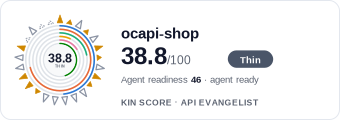
ocapi-shop has a Kin Score of 38.8 out of 100 (thin) and an Agent Readiness score of 45.5 (agent-ready), scored by API Evangelist on 2026-11-21.
Calls without X-API-Key need no key. Calls with it need a paid plan — get a key.
Get an API key
Free tier, no form to fill in. Signing in shares your email address with us — we
store it to create your key and to recognise you if you sign in with another
provider. By signing up you are subscribing to the APIs.io and API Evangelist
newsletters — you can unsubscribe from any issue. See our
Privacy Policy and Terms.
 Kin Score
How this is scored →
 It updates itself when the score changes. Paste this where you link to your API docs: