Lightning Web Components
Lightning Web Components (LWC) is Salesforce's MIT-licensed, open-source JavaScript UI framework, built directly on native web standards — custom elements, shadow DOM and ES modules — rather than on a proprietary component abstraction. It compiles components to native custom elements, renders in the browser and on the server, and is the component model for the Salesforce Platform as well as a standalone framework for any web app. LWC is distributed exclusively through npm: there is no hosted API, no API key, no pricing and no rate limit. Its contract surface is a JavaScript API — LightningElement, the @api, @track and @wire decorators, lifecycle hooks and wire adapters — accompanied by a published 109-code compiler diagnostic registry, a semver versioning and breaking-change policy, and a lightning-* base component library of 91 consumer-facing components.
Lightning Web Components is listed with 1 API on the APIs.io network. Tagged areas include Frontend, JavaScript, Lightning Web Components, Salesforce, and Web Components.
Lightning Web Components’ developer surface includes documentation, getting-started guide, code examples, changelog, CLI, sandbox, API reference, and 27 more developer resources.
Kin Score
 Kin Score
How this is scored →
Kin Score
How this is scored →scored 2026-10-23 · rubric v0.25.0
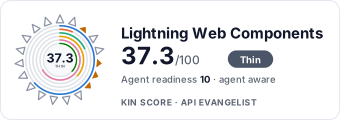 It updates itself when the score changes. Paste this where you link to your API docs:
<a href="https://apis.io/providers/lightning-web-components/"><img src="https://apis.io/badge/lightning-web-components/card.svg" alt="Lightning Web Components on APIs.io — Kin Score by API Evangelist"></a>Other styles, a README pill and a shields.io endpoint are on the badge page.
APIs 1
Individual APIs this provider publishes, each with its own machine-readable definition.
Lightning Web Components Runtime API
Core JavaScript APIs for building Lightning Web Components including decorators, wire service, and component lifecycle methods.
MCP Servers 1
Model Context Protocol servers that expose these APIs to AI agents.
Pricing Plans 1
Published pricing tiers and plan structures.
Rate Limits 1
Documented rate limits and quota policies.
Lightning Web Components Rate Limits
RATE LIMITSFinOps 1
Cost, billing, and metering signals for API financial operations.
Security Posture 3
Authentication, domain security, vulnerability disclosure, and trust-center signals.
Resources
Get Started 3
Portal, sign-up, and the first successful call
Documentation 2
Reference material describing how the API behaves
Agent Surfaces 2
MCP servers, agent skills, and machine-readable catalogs
Design & Contract 5
Pagination, idempotency, versioning, errors, and events
Build 6
SDKs, sample code, and the tooling you integrate with
Access & Security 5
Authentication, authorization, and security posture
Operate 4
Status, limits, changes, and where to get help
Commercial 5
Pricing, plans, and the legal terms of use
Company 2
The organization behind the API
Source (apis.yml)
Work with this as data
Every provider here is available over the APIs.io API and to AI agents over MCP.