fetcher-sh
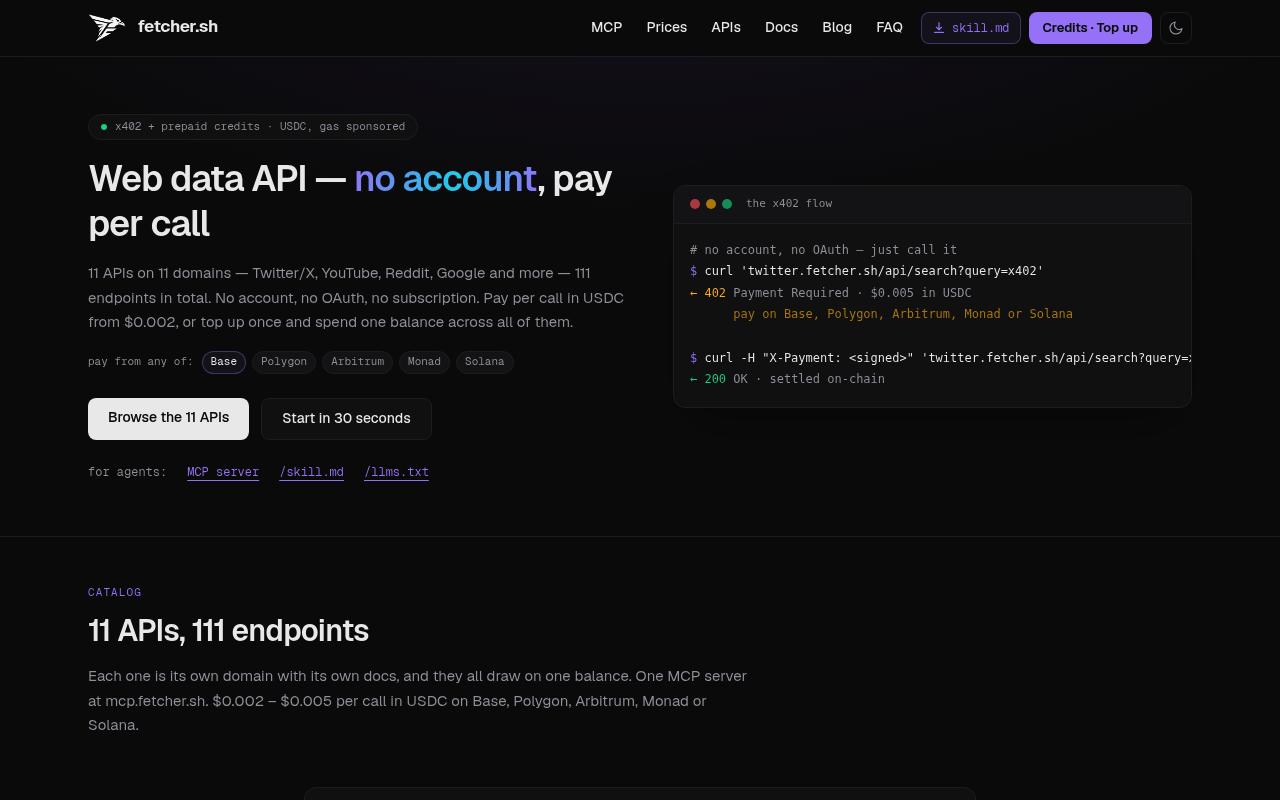
fetcher.sh provides a unified web‑data API that aggregates public data from eleven major platforms—including Twitter, YouTube, TikTok, Instagram, Reddit, Google Search, Google Maps, Google News, Google Play, App Store, and Yelp—into a single, no‑account, pay‑per‑call interface. Users can retrieve up to 111 endpoints across these services without OAuth or subscription, paying only per request in USDC (≈ $0.002–$0.005). The service is built on an MCP server architecture, offers transparent pricing, and publishes full OpenAPI 3.1 specifications. Documentation, pricing, and a blog are openly available.
fetcher-sh publishes 11 API contracts indexed on the APIs.io network, including App Store API, Google Maps API, Google News API, and 8 more. Tagged areas include Company, Web Data, API Aggregation, No Auth, and Pay-per-call.
The fetcher-sh catalog on APIs.io includes 1 JSON-LD context and 1 Spectral governance ruleset.
fetcher-sh’s developer surface includes CLI, documentation, API reference, engineering blog, pricing, getting-started guide, and 18 more developer resources.
Kin Score
 Kin Score
How this is scored →
scored 2026-11-13 · rubric v0.28.0
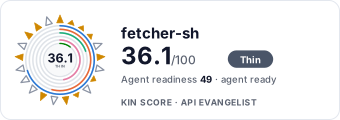 It updates itself when the score changes. Paste this where you link to your API docs:
<a href="https://apis.io/providers/fetcher-sh/"><img src="https://apis.io/badge/fetcher-sh/card.svg" alt="fetcher-sh on APIs.io — Kin Score by API Evangelist"></a>Other styles, a README pill and a shields.io endpoint are on the badge page.
- Request/Response Examples +7 pts — share of operations carrying request/response examples; else an Examples / Code Samples link Ask about this →
- Registration Without a Human +6 pts — a `registration_endpoint` in the served RFC 8414 / OIDC discovery document Ask about this →
- Delegated User Identity +6 pts — a served discovery document listing authorization_code in grant_types_supported (served), else an oauth2 authorizationCode flow or openIdConnect declared in an OpenAPI (documented) Ask about this →
- Typed Event Surface +6 pts — AsyncAPI document, OR webhooks/callbacks objects in the as-published OpenAPI, OR common[].type includes Webhooks Ask about this →
- Distinct Operations +3 pts — share of operations whose summary is unique within its document after light normalisation; na without two summarised operations Ask about this →
- Consent & Bot Identity +3 pts — common[].type includes AIPREF, ContentSignal, WebBotAuth, or HTTPMessageSignatures Ask about this →
- Access Clarity scores 8.5 — up to +18.3 composite points Ask about this →
- Operational Transparency scores 0.0 — up to +13.0 composite points Ask about this →
- Contract Quality scores 54.2 — up to +11.5 composite points Ask about this →
Standards implemented 4
Standards this provider implements or carries. De facto ones are profiled and measured by the API Commons; formal ones come from the standards directory and are linked by the provider's own tags. The evidence column says how each claim was established — not that it was made.
APIs 11
Individual APIs this provider publishes, each with its own machine-readable definition.
fetcher-sh App Store API
Apple App Store app and bundle lookups, reviews, similar apps, and developer catalogs.
fetcher-sh Google Maps API
Place search, place details, and reviews.
fetcher-sh Google News API
Headlines by section (world, business, technology, ...), keyword search, topics, and article URL decoding.
fetcher-sh Google Play API
App search, app details, reviews, permissions, data safety, and developer catalogs.
fetcher-sh Google Search API
Programmatic Google web search results as clean JSON.
fetcher-sh Instagram API
Profiles, posts, reels, stories, followers, hashtags, locations, and comment threads.
fetcher-sh Reddit API
Search posts, subreddits, and users; pull hot/new/top/best feeds, comment trees, and user history.
fetcher-sh Tik Tok API
Search posts, resolve users by handle, and pull followers, hashtags, music, comments, and replies.
fetcher-sh Twitter / X API
Search tweets, resolve profiles by handle or ID, and pull timelines, replies, followers, lists, and trends.
fetcher-sh Yelp API
Business search by query and location, place details, and reviews.
fetcher-sh YouTube API
Search videos, channels, and playlists; fetch video details, comments, shorts, live streams, and trending.
Scroll for all 11
MCP Servers 1
Model Context Protocol servers that expose these APIs to AI agents.
Agent Skills 1
Packaged agent skills for driving this provider's APIs from an AI assistant.
get-twitter-handle
AGENT SKILLfetcher-sh API pricing
Pricing Plans 1
Published pricing tiers and plan structures.
Rate Limits 1
Documented rate limits and quota policies.
fetcher-sh Rate Limits
RATE LIMITSSemantic Vocabularies 1
JSON-LD contexts and semantic vocabularies used across these APIs.
Fetcher Sh Context
JSON-LDSpectral Rules 1
Spectral governance rulesets for linting and validating these APIs. Counts are the severity each rule declares, not results of running them.
fetcher-sh API Rules
SPECTRALJSON Schema 1
Standalone JSON Schema definitions for this provider's data models.
Envelope
JSON SCHEMASecurity Posture 2
Authentication, domain security, vulnerability disclosure, and trust-center signals.
Scopes 1
OAuth scopes governing access to this provider's APIs.
Agentic Access (API Evangelist recommendations) 1
Recommended x-agentic-access execution contracts for AI agents.
Resources
Get Started 1
Portal, sign-up, and the first successful call
Documentation 2
Reference material describing how the API behaves
Agent Surfaces 5
MCP servers, agent skills, and machine-readable catalogs
Design & Contract 6
Pagination, idempotency, versioning, errors, and events
Build 3
SDKs, sample code, and the tooling you integrate with
Access & Security 1
Authentication, authorization, and security posture
Commercial 1
Pricing, plans, and the legal terms of use
Company 2
The organization behind the API
Other 3
Properties that don't map to a standard resource type
Source (apis.yml)
fetcher-sh API — frequently asked questions
Does fetcher-sh have an API?
Yes. APIs.io lists 11 APIs from fetcher-sh, including fetcher-sh App Store API, fetcher-sh Google Maps API and fetcher-sh Google News API, and 8 more.
Is there an OpenAPI specification for the fetcher-sh API?
Yes. APIs.io indexes 11 OpenAPI specifications for fetcher-sh, each linked for download from this page.
How do I authenticate with the fetcher-sh API?
fetcher-sh documents its authentication (0 schemes). The details are profiled on APIs.io as fetcher-sh Authentication.
Does fetcher-sh have an MCP server?
Yes. APIs.io lists 1 MCP server for fetcher-sh: Remote MCP server at appstore.fetcher.sh.
Is the fetcher-sh API ready for AI agents?
fetcher-sh has a Kin Score of 36.8 out of 100 (thin) and an Agent Readiness score of 56.1 (agent-native), scored by API Evangelist on 2026-11-13.
Work with this as data
Every provider here is available over the APIs.io API and to AI agents over MCP.