EvoLink
EvoLink provides a model access layer for AI teams, enabling production‑grade integration of large language models and other AI services. It offers unified authentication, usage tracking, rate‑limit management, and tools for monitoring model performance, helping developers ship AI‑powered applications quickly and securely. EvoLink positions itself as an API reseller that abstracts provider differences, delivering consistent endpoints and SDKs for popular models.
EvoLink is listed with 2 APIs on the APIs.io network. Tagged areas include AI Model API, Production AI, Unified API, Multi‑Model Access, and Video Generation.
The EvoLink catalog on APIs.io includes 1 JSON-LD context and 1 Spectral governance ruleset.
EvoLink’s developer surface includes CLI, changelog, authentication, signup flow, pricing, engineering blog, documentation, and 17 more developer resources.
Kin Score
 Kin Score
How this is scored →
scored 2026-11-13 · rubric v0.28.0
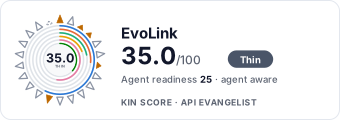 It updates itself when the score changes. Paste this where you link to your API docs:
<a href="https://apis.io/providers/evolink-ai/"><img src="https://apis.io/badge/evolink-ai/card.svg" alt="EvoLink on APIs.io — Kin Score by API Evangelist"></a>Other styles, a README pill and a shields.io endpoint are on the badge page.
- Agentic Access Contract +10 pts — agentic_access artifact present (x-agentic-access), graded by author Ask about this →
- Idempotency +9 pts — OpenAPI mutating operations declare an idempotency key — a header, a request-body property, or a named de-duplication token whose own description says so (verified); else common[].type matches /idempoten/i (documented) Ask about this →
- Stable Error Semantics +8 pts — OpenAPI $refs a shared error schema across 4xx/5xx responses (verified), else common[].type includes ErrorCatalog / ErrorCodes / DeclineCodes Ask about this →
- Rate-Limit Signaling +7 pts — OpenAPI responses document X-RateLimit-* / RateLimit headers (verified), else a rate_limits artifact or RateLimits link (documented) Ask about this →
- Registration Without a Human +6 pts — a `registration_endpoint` in the served RFC 8414 / OIDC discovery document Ask about this →
- Delegated User Identity +6 pts — a served discovery document listing authorization_code in grant_types_supported (served), else an oauth2 authorizationCode flow or openIdConnect declared in an OpenAPI (documented) Ask about this →
- Contract Quality scores 26.2 — up to +18.5 composite points Ask about this →
- Access Clarity scores 36.2 — up to +12.8 composite points Ask about this →
- Operational Transparency scores 19.0 — up to +10.5 composite points Ask about this →
Standards implemented 2
Standards this provider implements or carries. De facto ones are profiled and measured by the API Commons; formal ones come from the standards directory and are linked by the provider's own tags. The evidence column says how each claim was established — not that it was made.
APIs 2
Individual APIs this provider publishes, each with its own machine-readable definition.
EvoLink API
Unified AI model access API providing endpoints for text, image, and video generation across multiple providers.
EvoLink API
EvoLink API as documented publicly: 19 operations. Contract generated from the documentation by API Evangelist (2026-11-07); not the provider's own document.
EvoLink API pricing
Pricing Plans 1
Published pricing tiers and plan structures.
Semantic Vocabularies 1
JSON-LD contexts and semantic vocabularies used across these APIs.
Evolink Ai Context
JSON-LDSpectral Rules 1
Spectral governance rulesets for linting and validating these APIs. Counts are the severity each rule declares, not results of running them.
EvoLink API Rules
SPECTRALJSON Schema 5
Standalone JSON Schema definitions for this provider's data models.
GetApiV1FilesUploadBase64Response
JSON SCHEMAGetV1MessagesResponse
JSON SCHEMAPostApiV1FilesUploadBase64Response
JSON SCHEMAPostV1DecisionsResponse
JSON SCHEMAPostV1MessagesResponse
JSON SCHEMASecurity Posture 2
Authentication, domain security, vulnerability disclosure, and trust-center signals.
Resources
Get Started 3
Portal, sign-up, and the first successful call
Documentation 1
Reference material describing how the API behaves
Agent Surfaces 1
MCP servers, agent skills, and machine-readable catalogs
Design & Contract 5
Pagination, idempotency, versioning, errors, and events
Build 2
SDKs, sample code, and the tooling you integrate with
Access & Security 2
Authentication, authorization, and security posture
Operate 2
Status, limits, changes, and where to get help
Commercial 3
Pricing, plans, and the legal terms of use
Company 2
The organization behind the API
Other 3
Properties that don't map to a standard resource type
Source (apis.yml)
EvoLink API — frequently asked questions
Does EvoLink have an API?
Yes. APIs.io lists 2 APIs from EvoLink, including EvoLink API and EvoLink API.
Is there an OpenAPI specification for the EvoLink API?
Yes. APIs.io indexes 1 OpenAPI specification for EvoLink, each linked for download from this page.
How do I authenticate with the EvoLink API?
EvoLink uses bearer-token authentication (1 scheme). The details are profiled on APIs.io as EvoLink Authentication.
Is the EvoLink API ready for AI agents?
EvoLink has a Kin Score of 35.0 out of 100 (thin) and an Agent Readiness score of 25.4 (agent-aware), scored by API Evangelist on 2026-11-13.
Work with this as data
Every provider here is available over the APIs.io API and to AI agents over MCP.