
Corma
Corma is a SaaS license and access governance platform for modern IT teams that automates SaaS discovery, access reviews, provisioning, and deprovisioning. Recognized in the 2025 Gartner Magic Quadrant for SaaS Management Platforms, Corma helps organizations centralize all applications in one place, identify shadow IT, and reduce software spend by 10 to 15 percent. Corma offers extensive native integrations with identity providers (Microsoft Entra ID, Okta, Google Workspace), HR platforms (Workday, BambooHR, Personio), financial tools (Spendesk, Qonto, Pennylane, Agicap), and productivity and business tools (Slack, Notion, Salesforce, HubSpot, Zendesk). A public developer API is not currently published.
Corma is profiled on the APIs.io network. Tagged areas include Access Governance, Cost Optimization, Deprovisioning, Identity and Access Management, and License Management.
Corma’s developer surface includes documentation, pricing, engineering blog, signup flow, getting-started guide, support, changelog, and 7 more developer resources.
Kin Score
 Kin Score
How this is scored →
scored 2026-10-23 · rubric v0.25.0
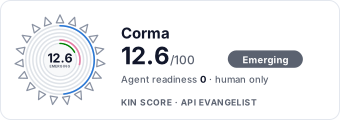 It updates itself when the score changes. Paste this where you link to your API docs:
<a href="https://apis.io/providers/corma/"><img src="https://apis.io/badge/corma/card.svg" alt="Corma on APIs.io — Kin Score by API Evangelist"></a>Other styles, a README pill and a shields.io endpoint are on the badge page.
Markets this provider is in provisional
The Kin Score Market layer reads a provider inside its market: its position, and how deep its integrations go. Depth is only comparable within a position. Provisional and unweighted: not part of the Kin Score or agent readiness.
| Market | Position | Depth | Registered MCP server | Declares compatibility |
|---|---|---|---|---|
| Zoom App Marketplace and Partner Ecosystem (builders and partners on Zoom) | undeclared | - | - | - |
Registered MCP server and declares compatibility are report only — not weighted. Undeclared means we found nothing we can read, so there is no number: we never infer integrations.
Standards implemented 1
Standards this provider implements or carries. De facto ones are profiled and measured by the API Commons; formal ones come from the standards directory and are linked by the provider's own tags. The evidence column says how each claim was established — not that it was made.
Security Posture 1
Authentication, domain security, vulnerability disclosure, and trust-center signals.
Resources
Get Started 3
Portal, sign-up, and the first successful call
Documentation 1
Reference material describing how the API behaves
Access & Security 1
Authentication, authorization, and security posture
Operate 2
Status, limits, changes, and where to get help
Commercial 3
Pricing, plans, and the legal terms of use
Company 4
The organization behind the API
Source (apis.yml)
Work with this as data
Every provider here is available over the APIs.io API and to AI agents over MCP.