Candid
Candid (formed from the 2019 merger of Foundation Center and GuideStar) helps social sector organizations advance their missions by sharing information, breaking down barriers, and improving giving. Candid maintains the most comprehensive set of data on U.S. nonprofits, foundations, grants, and philanthropy, and exposes that data through a family of developer APIs — Essentials, Premier, Charity Check, Demographics, Grants, News, Taxonomy, Eligibility, and PDF/Bulk variants — available through the Candid Developer Portal.
Candid publishes 9 API contracts indexed on the APIs.io network, including Lookup API, Essentials API, and 7 more. Tagged areas include Charities, Donations, Non-Profit, Philanthropy, and Foundations.
The Candid catalog on APIs.io includes 1 Spectral governance ruleset.
Candid’s developer surface includes engineering blog, authentication, support, and 16 more developer resources.
What this lets a business do 1
Business capabilities this provider's published APIs can perform, derived from its own contracts. Browse all capabilities →
Kin Score
 Kin Score
How this is scored →
scored 2026-11-06 · rubric v0.27.0
 It updates itself when the score changes. Paste this where you link to your API docs:
<a href="https://apis.io/providers/candid/"><img src="https://apis.io/badge/candid/card.svg" alt="Candid on APIs.io — Kin Score by API Evangelist"></a>Other styles, a README pill and a shields.io endpoint are on the badge page.
- Idempotency +9 pts — OpenAPI mutating operations declare an idempotency key — a header, a request-body property, or a named de-duplication token whose own description says so (verified); else common[].type matches /idempoten/i (documented)
- A2A Agent Card +8 pts — a2a/
-a2a.yml manifest, graded on conformance.grade against A2A 1.0.0 - Typed Event Surface +6 pts — AsyncAPI document, OR webhooks/callbacks objects in the as-published OpenAPI, OR common[].type includes Webhooks
- Documented Reversibility +6 pts — a reversal operation in the contract, graded up when a window is documented too
- Pagination +5 pts — share of collection GETs (an array, or one wrapped in data/items/results ...) that declare a page/limit/offset/cursor parameter, a Link header or a next/cursor field; na with no collection GETs
- Agent Skills +5 pts — skills artifact present, graded by who authored it
- Access Clarity scores 18.4 — up to +16.3 composite points
- Developer Ergonomics scores 38.1 — up to +12.4 composite points
- Operational Transparency scores 10.5 — up to +11.6 composite points
Markets this provider is in provisional
The Kin Score Market layer reads a provider inside its market: its position, and how deep its integrations go. Depth is only comparable within a position. Provisional and unweighted: not part of the Kin Score or agent readiness.
| Market | Position | Depth | Registered MCP server | Declares compatibility |
|---|---|---|---|---|
| Nonprofit and Fundraising | undeclared | - | - | - |
Registered MCP server and declares compatibility are report only — not weighted. Undeclared means we found nothing we can read, so there is no number: we never infer integrations.
Standards implemented 4
Standards this provider implements or carries. De facto ones are profiled and measured by the API Commons; formal ones come from the standards directory and are linked by the provider's own tags. The evidence column says how each claim was established — not that it was made.
APIs 9
Individual APIs this provider publishes, each with its own machine-readable definition.
Candid Premier API
Deep nonprofit profile data. Returns comprehensive records for a given organization including financials, programs, leadership, board, grants received and awarded, operating det...
Candid Charity Check API
Real-time nonprofit verification and compliance screening used for due diligence, donation compliance, and tax-deductibility checks. Returns IRS 501(c)(3) status, revocation his...
Candid Demographics API
Structured demographic data voluntarily provided by nonprofits about their staff, board, and populations served. Enables funders and platforms to analyze equity, diversity, and ...
Candid Grants API
Access to Candid's global grants dataset — summary statistics, funders, recipients, and individual transaction records. Useful for philanthropic benchmarking, funder research, a...
Candid News API
Search and retrieve philanthropic news content from Candid's curated news database covering funders, grantees, sector trends, and policy. Supports customizable parameters for da...
Candid Taxonomy API
Returns Candid's philanthropic classification system (subject, population, support-strategy, and geographic area taxonomies) so integrators can consistently tag and query nonpro...
Candid Nonprofit Eligibility API
Evaluates whether a given nonprofit is eligible to receive a grant or donation based on configurable rules — IRS status, country, OFAC, custom program criteria — to automate gra...
Candid Lookup API
Operations for retrieving lookup values and filter metadata.
Candid Essentials API
The Essentials API from Candid — 4 operation(s) for essentials.
Scroll for all 9
Open Collections 3
Open, tool-agnostic API collections (OpenAPI-derived and Bruno).
Candid Essentials API
OPEN COLLECTIONCandid Essentials Lookup API
OPEN COLLECTIONCandid Essentials Lookup Search API
OPEN COLLECTIONMCP Servers 1
Model Context Protocol servers that expose these APIs to AI agents.
Candid API pricing
Not yet checked against Candid's own pricing page. Compiled by API Evangelist on 2026-05-04; confirm before you rely on a figure. A free plan or tier is listed.
| Plan | Price |
|---|---|
| Free freemium | Free |
| Professional paid | Free |
| Enterprise enterprise | — |
Plan details, limits and sources →
Rate limits
- Free Tier Default: 10 requests per minute
- Free Tier Monthly Quota: 1000 requests per month
- Professional Tier Default: 100 requests per minute
Compiled by API Evangelist, not yet checked against Candid's documentation. All 5 limits →
Pricing Plans 1
Published pricing tiers and plan structures.
Candid Plans Pricing
PLANSRate Limits 1
Documented rate limits and quota policies.
Candid Rate Limits
RATE LIMITSService Levels 1
Uptime the provider promises or reports, as SLA4OAI. Read from its own pages; APIs.io runs no monitors.
Candid
SLAFinOps 1
Cost, billing, and metering signals for API financial operations.
Candid Finops
FINOPSSpectral Rules 1
Spectral governance rulesets for linting and validating these APIs.
Candid API Rules
SPECTRALSecurity Posture 2
Authentication, domain security, vulnerability disclosure, and trust-center signals.
Agentic Access 1
Recommended x-agentic-access execution contracts for AI agents.
Resources
Get Started 2
Portal, sign-up, and the first successful call
Agent Surfaces 2
MCP servers, agent skills, and machine-readable catalogs
Build 1
SDKs, sample code, and the tooling you integrate with
Access & Security 2
Authentication, authorization, and security posture
Operate 2
Status, limits, changes, and where to get help
Commercial 5
Pricing, plans, and the legal terms of use
Company 3
The organization behind the API
Other 2
Properties that don't map to a standard resource type
Source (apis.yml)
Candid API — frequently asked questions
Does Candid have an API?
Yes. APIs.io lists 9 APIs from Candid, including Candid Premier API, Candid Charity Check API and Candid Demographics API, and 6 more.
Is there an OpenAPI specification for the Candid API?
Yes. APIs.io indexes 2 OpenAPI specifications for Candid, each linked for download from this page.
How do I authenticate with the Candid API?
Candid documents its authentication (apiKey · 1 scheme). The details are profiled on APIs.io as Candid Authentication.
How much does the Candid API cost?
APIs.io lists 3 pricing plans for Candid, with each plan's price, limits and inclusions under Pricing on this page.
Does Candid have an MCP server?
Yes. APIs.io lists 1 MCP server for Candid: Remote MCP server at mcp.candid.org over HTTP.
Is the Candid API ready for AI agents?
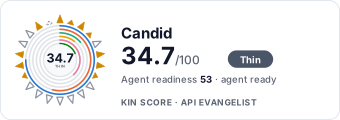
Candid has a Kin Score of 34.7 out of 100 (thin) and an Agent Readiness score of 52.6 (agent-ready), scored by API Evangelist on 2026-11-06.
Work with this as data
Every provider here is available over the APIs.io API and to AI agents over MCP.