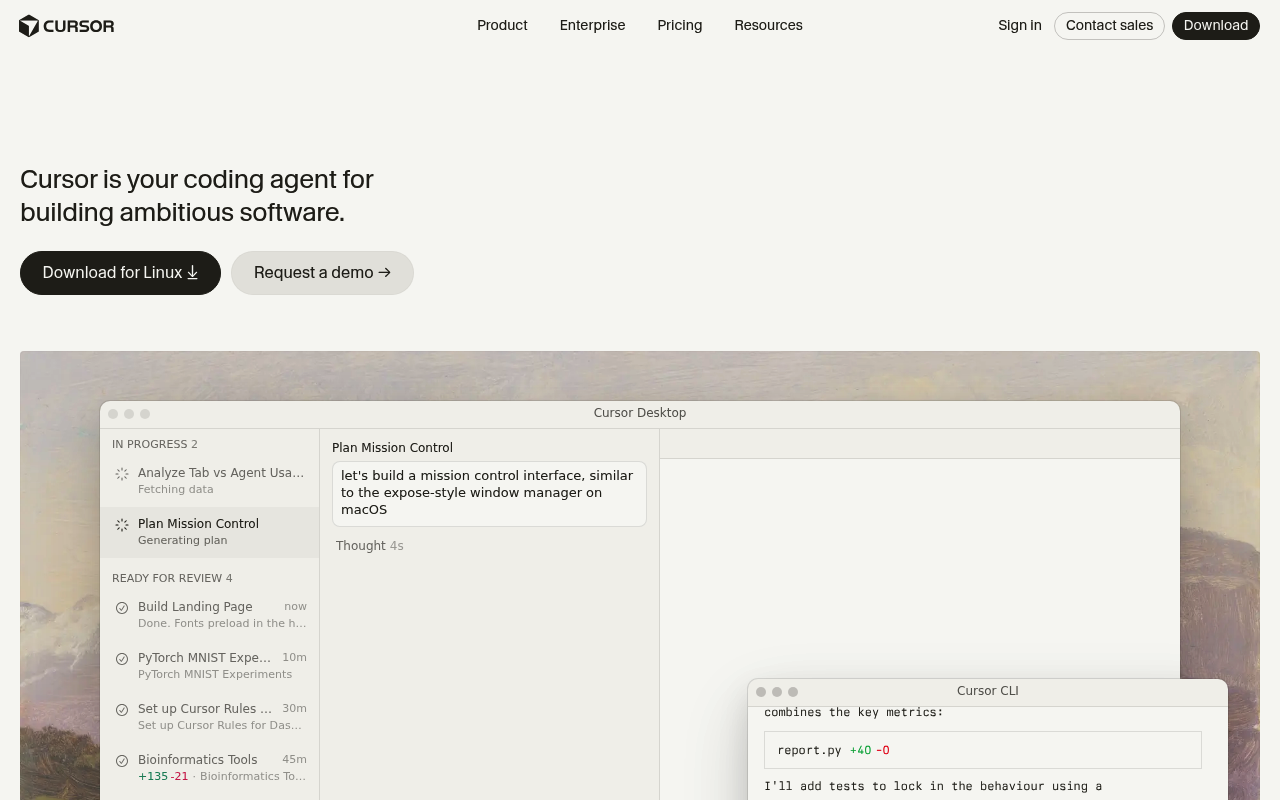
.cursorrules website screenshot

.cursorrules

.cursorrules is a project-level configuration file used by the Cursor AI code editor to define custom rules, coding conventions, and behavioral instructions that shape how the editor's AI assistant generates and edits code. The file is placed in the root of a repository and is read automatically by Cursor when the project is opened, giving teams a way to enforce architectural patterns, style guides, framework conventions, and tooling preferences across all AI-generated code. The format is intentionally flexible - rules are typically written in plain Markdown or natural language and may include sections describing project structure, technology stack, naming conventions, testing requirements, and out-of-scope behaviors. Cursor has since extended the concept with .cursor/rules/ directories of multiple scoped rule files, but the original .cursorrules file remains widely used and supported.

.cursorrules is profiled on the APIs.io network. Tagged areas include AI Agents, AI Copilot, Coding Standards, Configuration, and Cursor.

0 APIs
AI AgentsAI CopilotCoding StandardsConfigurationCursorDeveloper WorkflowLLMPrompt EngineeringRulesStandard

Resources

Documentation 2

Reference material describing how the API behaves

Agent Surfaces 1

MCP servers, agent skills, and machine-readable catalogs

Design & Contract 2

Pagination, idempotency, versioning, errors, and events

Operate 1

Status, limits, changes, and where to get help

Company 1

The organization behind the API

Source (apis.yml)

apis.yml Raw ↑
aid: cursorrules
name: .cursorrules
x-type: convention
description: .cursorrules is a project-level configuration file used by the Cursor AI code editor to define custom rules,
  coding conventions, and behavioral instructions that shape how the editor's AI assistant generates and edits code. The file
  is placed in the root of a repository and is read automatically by Cursor when the project is opened, giving teams a way
  to enforce architectural patterns, style guides, framework conventions, and tooling preferences across all AI-generated
  code. The format is intentionally flexible - rules are typically written in plain Markdown or natural language and may include
  sections describing project structure, technology stack, naming conventions, testing requirements, and out-of-scope behaviors.
  Cursor has since extended the concept with .cursor/rules/ directories of multiple scoped rule files, but the original .cursorrules
  file remains widely used and supported.
url: https://raw.githubusercontent.com/api-evangelist/cursorrules/refs/heads/main/apis.yml
deliveryModel:
  model: unknown
  open_source: false
  commercial: false
  callable_host: false
  label: Delivery model not determined — needs a product licence on record
  confidence: low
  source:
  - none
  generated: '2026-08-28'
  method: derived
accessModel:
  pricing: unknown
  onboarding: unknown
  trial: false
  try_now: false
  public: false
  label: Unknown
  confidence: low
  source: []
  generated: '2026-07-22'
  method: derived
image: https://kinlane-images.s3.amazonaws.com/shared/apis-json/icons/cursorrules.png
tags:
- AI Agents
- AI Copilot
- Coding Standards
- Configuration
- Cursor
- Developer Workflow
- LLM
- Prompt Engineering
- Rules
- Standard
created: '2025-01-01'
modified: '2026-04-28'
specificationVersion: '0.23'
apis: []
integrations:
- name: Publish Plugins
maintainers:
- FN: Kin Lane
  email: kin@apievangelist.com
common:
- type: Website
  url: https://www.cursor.com/
- type: Cursor Documentation
  url: https://cursor.com/docs
- type: Rules Documentation
  url: https://cursor.com/docs/context/rules
- type: Awesome CursorRules
  url: https://github.com/PatrickJS/awesome-cursorrules
- type: CursorRules Directory
  url: https://cursor.directory
- type: Cursor Forum
  url: https://forum.cursor.com
- type: Integrations
  url: https://cursor.com/marketplace
- type: LlmsText
  url: https://cursor.com/llms.txt

Work with this as data

Every provider here is available over the APIs.io API and to AI agents over MCP.

MCP server

One button, every client — Claude, Cursor, VS Code and the rest.

https://apis.io/mcp

Tools for providers

9 MCP tools reach this
  • find_providersBrowse and filter every provider in the catalog.
  • get_provider_artifactsEvery artifact this provider publishes, grouped by type.
  • get_provider_operationsEvery operation across all of their OpenAPIs — one call instead of parsing every spec.
  • get_provider_toolsEvery MCP tool they ship, with the operation each wraps.
  • get_provider_evidenceHow each part of their score was established. Free — the basis for a claim should not sit behind it.
  • get_provider_ratingPRO — composite, band, trend and facet scores.
  • apis_io_searchSTART HERE — APIs, providers and tags for one query, each with its total.
  • resolveTurn a domain, URL or GitHub org into the provider it belongs to.
  • find_cohortsEvery scored population of providers in the catalog.
All 92 tools →

Call it yourself

curl for this page
This provider
curl "https://apis.io/api/v1/providers/cursorrules"
All providers
curl "https://apis.io/api/v1/providers?limit=25"
Every operation they expose
curl "https://apis.io/api/v1/providers/cursorrules/operations?limit=25"
How their score was established
curl "https://apis.io/api/v1/providers/cursorrules/evidence"

Discovery needs no key. Ratings and market analysis are Pro.

Get an API key

Free tier, no form to fill in. Signing in shares your email address with us — we store it to create your key and to recognise you if you sign in with another provider. See our Privacy Policy and Terms.

A second provider on the same verified email joins the account you already have.