Paragon
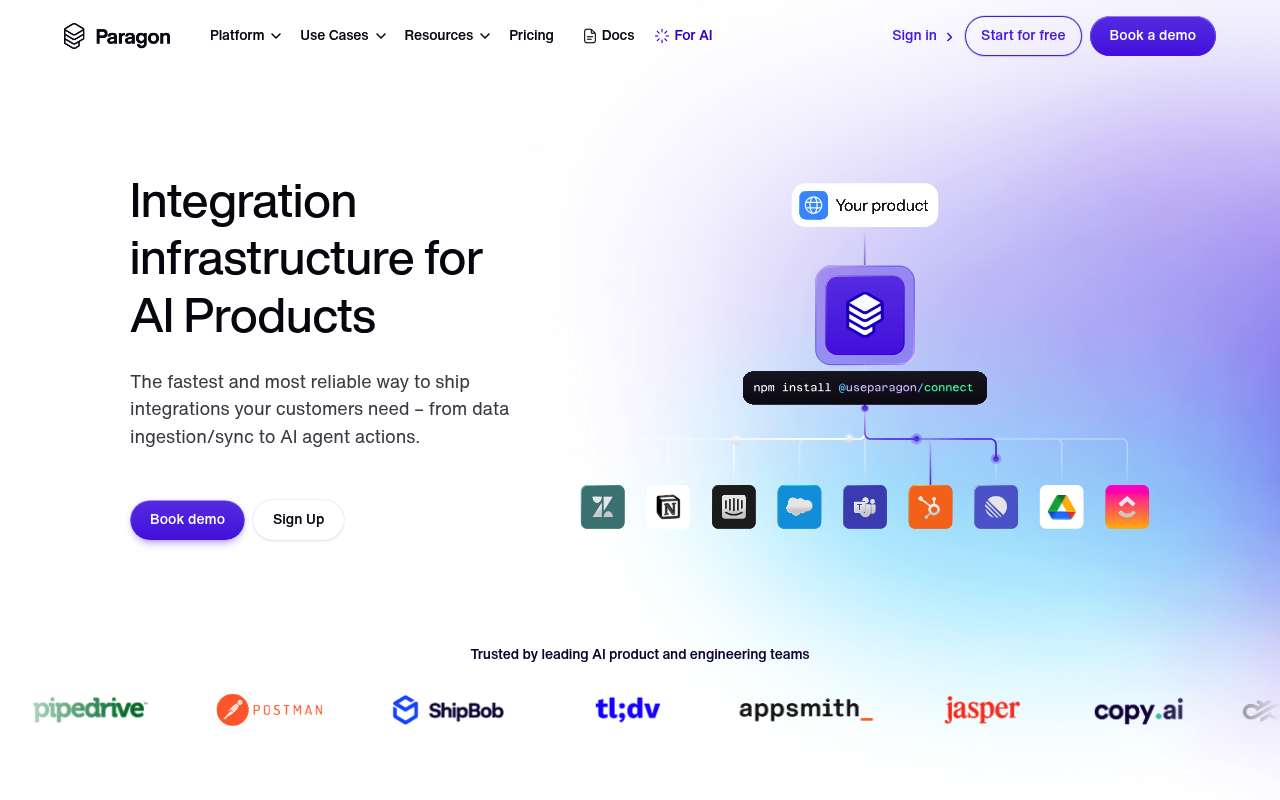
Paragon is an embedded iPaaS that lets SaaS companies build native, in-app integrations for their customers. Developers configure integrations, Managed Sync pipelines, Workflows, and ActionKit tools in Paragon, then embed them behind a Connect Portal so each of their end customers (Connected Users) can authenticate their own third-party accounts. Requests are made on behalf of Connected Users using a Paragon User Token - an RS256-signed JWT - across a REST Connect/SDK API (api.useparagon.com), a Workflows API, an ActionKit tool-calling API for AI agents (actionkit.useparagon.com), and a Proxy API (proxy.useparagon.com) that forwards requests to third-party providers. Paragon is a B2B, contact-sales product.
Paragon publishes 4 APIs on the APIs.io network, including ActionKit API, Connect API, Proxy API, and 1 more. Tagged areas include Embedded iPaaS, Integration, Embedded Integrations, Native Integrations, and Workflow-Automation.
Paragon’s developer surface includes authentication, documentation, and 7 more developer resources.
Kin Score
 Kin Score
How this is scored →
Kin Score
How this is scored →scored 2026-08-21 · rubric v0.12.0
APIs 4
Individual APIs this provider publishes, each with its own machine-readable definition.
Paragon ActionKit API
List and run third-party tools (actions) for AI agents.
Paragon Connect API
Project and integration metadata, Connected User, and credentials.
Paragon Proxy API
Forward requests to third-party providers on behalf of a Connected User.
Paragon Workflows API
Enable, disable, and trigger Workflows and send App Events.
Open Collections 6
Open, tool-agnostic API collections (OpenAPI-derived and Bruno).
API Collection
OPEN COLLECTIONParagon ActionKit API
OPEN COLLECTIONParagon ActionKit Connect API
OPEN COLLECTIONParagon ActionKit Proxy API
OPEN COLLECTIONParagon ActionKit Workflows API
OPEN COLLECTIONParagon API
OPEN COLLECTIONPricing Plans 1
Published pricing tiers and plan structures.
Rate Limits 1
Documented rate limits and quota policies.
Paragon Api Rate Limits
RATE LIMITSFinOps 1
Cost, billing, and metering signals for API financial operations.
Paragon Api Finops
FINOPSSecurity Posture 2
Authentication, domain security, vulnerability disclosure, and trust-center signals.
Agentic Access 1
Recommended x-agentic-access execution contracts for AI agents.
Resources
Documentation 1
Reference material describing how the API behaves
Agent Surfaces 1
MCP servers, agent skills, and machine-readable catalogs
Access & Security 2
Authentication, authorization, and security posture
Operate 1
Status, limits, changes, and where to get help
Commercial 2
Pricing, plans, and the legal terms of use
Company 2
The organization behind the API
Source (apis.yml)
Work with this as data
Every provider here is available over the APIs.io API and to AI agents over MCP.
MCP server
One button, every client — Claude, Cursor, VS Code and the rest.
https://apis.io/mcp
Tools for providers
9 MCP tools reach this
find_providersBrowse and filter every provider in the catalog.get_provider_artifactsEvery artifact this provider publishes, grouped by type.get_provider_operationsEvery operation across all of their OpenAPIs — one call instead of parsing every spec.get_provider_toolsEvery MCP tool they ship, with the operation each wraps.get_provider_evidenceHow each part of their score was established. Free — the basis for a claim should not sit behind it.get_provider_ratingPRO — composite, band, trend and facet scores.apis_io_searchSTART HERE — APIs, providers and tags for one query, each with its total.resolveTurn a domain, URL or GitHub org into the provider it belongs to.find_cohortsEvery scored population of providers in the catalog.
Call it yourself
curl for this page
curl "https://apis.io/api/v1/providers/paragon-api"curl "https://apis.io/api/v1/providers?limit=25"curl "https://apis.io/api/v1/providers/paragon-api/operations?limit=25"curl "https://apis.io/api/v1/providers/paragon-api/evidence"Discovery needs no key. Ratings and market analysis are Pro.