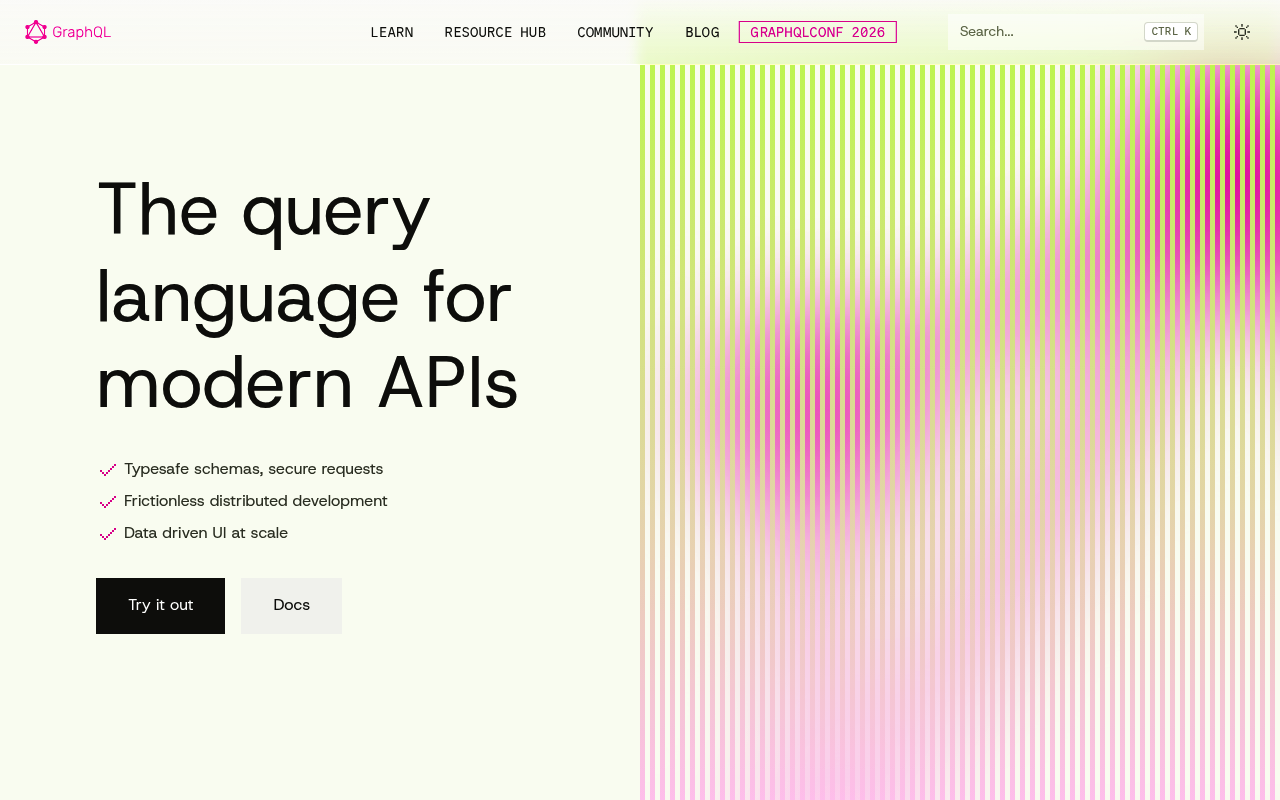
GraphQL website screenshot

GraphQL

GraphQL is a query language for APIs and a runtime for fulfilling those queries with existing data. Developed by Facebook in 2012 and open-sourced in 2015, GraphQL provides a complete and understandable description of the data in an API, gives clients the power to ask for exactly what they need, and enables powerful developer tools. It is maintained by the GraphQL Foundation under the Linux Foundation.

GraphQL is profiled on the APIs.io network. Tagged areas include Data Fetching, GraphQL, Query Language, and Specification.

The GraphQL catalog on APIs.io includes 1 JSON-LD context and 1 Spectral governance ruleset.

GraphQL’s developer surface includes developer portal, documentation, getting-started guide, engineering blog, and 8 more developer resources.

0 APIs
Data FetchingGraphQLQuery LanguageSpecification

Markets this provider is in provisional

The Kin Score Market layer reads a provider inside its market: its position, and how deep its integrations go. Depth is only comparable within a position. Provisional and unweighted: not part of the Kin Score or agent readiness.

MarketPositionDepthRegistered MCP serverDeclares compatibility
IDE Extension Marketplaces (JetBrains, VS Code, Open VSX, Docker Verified Publishers, PyPI orgs) builds-on 34.5 (thin) - -

Registered MCP server and declares compatibility are report only — not weighted. Undeclared means we found nothing we can read, so there is no number: we never infer integrations.

Semantic Vocabularies 1

JSON-LD contexts and semantic vocabularies used across these APIs.

Graphql Context

0 classes · 22 properties

JSON-LD

Spectral Rules 1

Spectral governance rulesets for linting and validating these APIs.

GraphQL — jsonschema rules

6 rules · 4 warnings 2 info

SPECTRAL

JSON Schema 4

Standalone JSON Schema definitions for this provider's data models.

GraphQL Error

4 properties

JSON SCHEMA

GraphQL Introspection Response

1 properties

JSON SCHEMA

GraphQL Request

4 properties

JSON SCHEMA

GraphQL Response

3 properties

JSON SCHEMA

Security Posture 1

Authentication, domain security, vulnerability disclosure, and trust-center signals.

Graphql Domain Security

TLSv1.3 · HSTS

SECURITY

Resources

Get Started 2

Portal, sign-up, and the first successful call

Documentation 5

Reference material describing how the API behaves

Design & Contract 1

Pagination, idempotency, versioning, errors, and events

Build 1

SDKs, sample code, and the tooling you integrate with

Access & Security 1

Authentication, authorization, and security posture

Company 2

The organization behind the API

Source (apis.yml)

apis.yml Raw ↑
aid: graphql
name: GraphQL
description: GraphQL is a query language for APIs and a runtime for fulfilling those queries with existing data. Developed
  by Facebook in 2012 and open-sourced in 2015, GraphQL provides a complete and understandable description of the data in
  an API, gives clients the power to ask for exactly what they need, and enables powerful developer tools. It is maintained
  by the GraphQL Foundation under the Linux Foundation.
deliveryModel:
  model: unknown
  open_source: false
  commercial: false
  callable_host: false
  label: Delivery model not determined — needs a product licence on record
  confidence: low
  source:
  - none
  generated: '2026-08-28'
  method: derived
accessModel:
  pricing: unknown
  onboarding: unknown
  trial: false
  try_now: false
  public: false
  label: Unknown
  confidence: low
  source:
  - security
  generated: '2026-11-06'
  method: derived
image: https://kinlane-images.s3.amazonaws.com/shared/apis-json/icons/graphql.png
url: https://graphql.org/
created: '2025-01-01'
modified: '2026-03-16'
specificationVersion: '0.23'
type: Index
x-docs-platform: nextra
x-docs-platform-confidence: medium
x-docs-platform-checked: 2026-10-03
tags:
- Data Fetching
- GraphQL
- Query Language
- Specification
apis: []
common:
- type: Website
  url: https://www.graphql.org/
- type: DomainSecurity
  url: security/graphql-domain-security.yml
- type: GitHubOrganization
  url: https://github.com/graphql
- type: Portal
  url: https://graphql.org/
- type: Documentation
  url: https://graphql.org/learn/
- type: GettingStarted
  url: https://graphql.org/learn/
- type: Blog
  url: https://graphql.org/blog/
- type: JSONSchema
  url: json-schema/graphql-request.json
- type: JSONSchema
  url: json-schema/graphql-response.json
- type: JSONSchema
  url: json-schema/graphql-error.json
- type: JSONSchema
  url: json-schema/graphql-introspection.json
- type: JSONLDContext
  url: json-ld/graphql-context.jsonld
maintainers:
- FN: Kin Lane
  email: kin@apievangelist.com
x-type: standard

Work with this as data

Every provider here is available over the APIs.io API and to AI agents over MCP.

MCP server

One button, every client — Claude, Cursor, VS Code and the rest.

https://apis.io/mcp

Tools for providers

9 MCP tools reach this
  • find_providersBrowse and filter every provider in the catalog.
  • get_provider_artifactsEvery artifact this provider publishes, grouped by type.
  • get_provider_operationsEvery operation across all of their OpenAPIs — one call instead of parsing every spec.
  • get_provider_toolsEvery MCP tool they ship, with the operation each wraps.
  • get_provider_evidenceHow each part of their score was established. Free — the basis for a claim should not sit behind it.
  • get_provider_ratingPRO — composite, band, trend and facet scores.
  • apis_io_searchSTART HERE — APIs, providers and tags for one query, each with its total.
  • resolveTurn a domain, URL or GitHub org into the provider it belongs to.
  • find_cohortsEvery scored population of providers in the catalog.
All 92 tools →

Call it yourself

curl for this page
This provider
curl "https://apis.io/api/v1/providers/graphql"
All providers
curl "https://apis.io/api/v1/providers?limit=25"
Every operation they expose
curl "https://apis.io/api/v1/providers/graphql/operations?limit=25"
How their score was established
curl "https://apis.io/api/v1/providers/graphql/evidence"

Calls without X-API-Key need no key. Calls with it need a paid plan — get a key.

Get an API key

Free tier, no form to fill in. Signing in shares your email address with us — we store it to create your key and to recognise you if you sign in with another provider. See our Privacy Policy and Terms.

A second provider on the same verified email joins the account you already have.