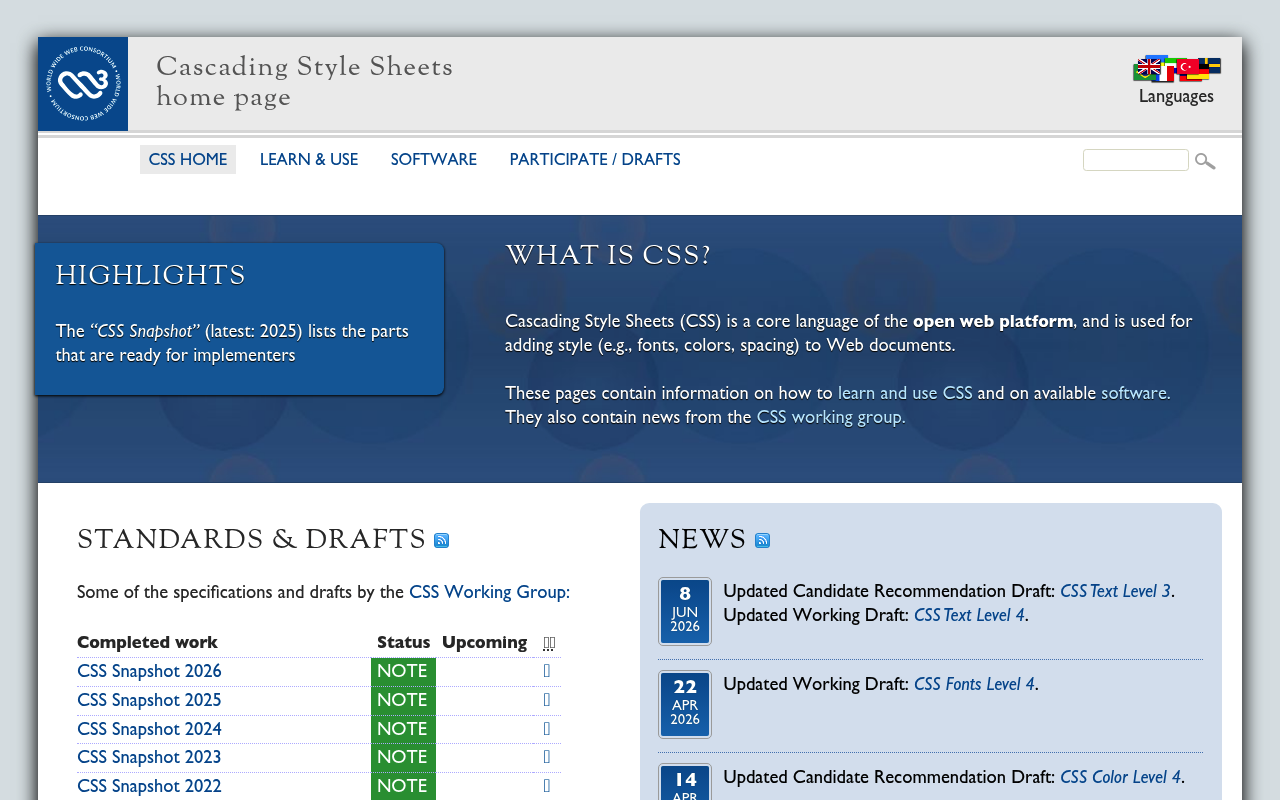
CSS (Cascading Style Sheets) website screenshot

CSS (Cascading Style Sheets)

Cascading Style Sheets (CSS) is a W3C web standard for describing the presentation of documents written in HTML and XML, including layout, colors, typography, and animations. CSS is a foundational web technology defined by the W3C CSS Working Group and is implemented natively by every major web browser. The CSS Object Model (CSSOM) and CSS Houdini extensibility APIs expose CSS to JavaScript at runtime.

CSS (Cascading Style Sheets) is profiled on the APIs.io network. Tagged areas include CSS, Web Standards, W3C, Styling, and Browser.

CSS (Cascading Style Sheets)’s developer surface includes documentation and 9 more developer resources.

8.9/100 minimal ▬ flat Agent 0/100 human only Full breakdown ↓
scored 2026-08-10 · rubric v0.9.1
0 APIs
CSSWeb StandardsW3CStylingBrowser

Kin Score

Kin Score Kin Score How this is scored →
scored 2026-08-10 · rubric v0.9.1
Composite quality — 8.9/100 · minimal
Contract Quality 0.0 / 25
Developer Ergonomics 3.9 / 20
Commercial Clarity 0.0 / 20
Operational Transparency 0.0 / 13
Governance 0.0 / 12
Discoverability 5.0 / 10
Agent readiness — 0/100 · human only
Machine-Readable Contract 0 / 18
Agentic Access Contract 0 / 10
MCP Server 0 / 12
Machine-Readable Auth 0 / 10
Idempotency 0 / 9
Stable Error Semantics 0 / 8
Request/Response Examples 0 / 7
Rate-Limit Signaling 0 / 7
Typed Event Surface 0 / 6
Agent Skills 0 / 5
Well-Known Catalog 0 / 4
Consent & Bot Identity 0 / 3
A2A Agent Card 0 / 8
Dry-Run / Simulate Mode 0 / 4
Improve this rating by publishing the missing artifacts — every area above can be raised, and the full rubric is at apis.io/rating/. This rating is computed from github.com/api-evangelist/css: open an issue to ask a question, or submit a pull request to add artifacts. Want it done for you? Prioritized profiling — $2,500 →

Security Posture 1

Authentication, domain security, vulnerability disclosure, and trust-center signals.

Css Domain Security

TLSv1.3 · HSTS · DMARC

SECURITY

Resources

Documentation 5

Reference material describing how the API behaves

Build 2

SDKs, sample code, and the tooling you integrate with

Access & Security 1

Authentication, authorization, and security posture

Operate 1

Status, limits, changes, and where to get help

Company 1

The organization behind the API

Source (apis.yml)

apis.yml Raw ↑
aid: css
accessModel:
  pricing: unknown
  onboarding: unknown
  trial: false
  try_now: false
  public: false
  label: Unknown
  confidence: low
  source: []
  generated: '2026-07-22'
  method: derived
image: https://kinlane-images.s3.amazonaws.com/shared/apis-json/icons/css.png
url: https://raw.githubusercontent.com/api-evangelist/css/refs/heads/main/apis.yml
kind: standard
name: CSS (Cascading Style Sheets)
description: Cascading Style Sheets (CSS) is a W3C web standard for describing the presentation of documents written in HTML
  and XML, including layout, colors, typography, and animations. CSS is a foundational web technology defined by the W3C CSS
  Working Group and is implemented natively by every major web browser. The CSS Object Model (CSSOM) and CSS Houdini extensibility
  APIs expose CSS to JavaScript at runtime.
tags:
- CSS
- Web Standards
- W3C
- Styling
- Browser
specificationVersion: '0.19'
created: '2025-01-01'
modified: '2026-04-28'
apis: []
features:
- name: Cascading and Inheritance
  description: Cascade, specificity, and inheritance rules combine author, user, and UA stylesheets.
- name: Selectors
  description: Selectors Level 3/4 match elements by tag, class, id, attribute, structure, and state.
- name: Box Model and Layout
  description: Block, inline, flex (Flexbox), and grid layout systems for composing pages.
- name: Responsive Design
  description: Media Queries Level 3/4 enable layouts that adapt to viewport, capability, and user preferences.
- name: Color and Typography
  description: CSS Color Levels 3-5 and CSS Fonts Level 3-4 define color spaces, gradients, and font features.
- name: Animation and Transitions
  description: Keyframe animations, transitions, and motion paths driven entirely from stylesheets.
- name: CSSOM
  description: The CSS Object Model exposes CSS rules and computed styles to JavaScript via DOM APIs.
- name: CSS Houdini
  description: Low-level browser extensibility APIs (Paint, Layout, Properties and Values, Animation Worklet) for custom CSS
    behaviors.
useCases:
- name: Web Page Styling
  description: Authors style HTML documents using stylesheets shipped with their site.
- name: Responsive and Adaptive UI
  description: Apps adapt presentation to device, viewport, and user preferences (dark mode, reduced motion).
- name: Component Libraries
  description: Design systems publish CSS-based components consumed by many applications.
- name: Web Animations
  description: Marketing sites and apps animate UI states purely with CSS.
- name: Browser Polyfills
  description: Houdini Paint and Layout worklets polyfill new CSS features in older browsers.
- name: Accessibility
  description: Authors honor user preferences (prefers-reduced-motion, prefers-contrast) via media features.
common:
- type: DomainSecurity
  url: security/css-domain-security.yml
- url: https://www.w3.org/Style/CSS/
  name: CSS at W3C
  type: Website
- url: https://www.w3.org/TR/?tag=css
  name: CSS Specifications (W3C TR)
  type: Specification
- url: https://www.w3.org/Style/CSS/current-work
  name: CSS Current Work
  type: Documentation
- url: https://www.w3.org/groups/wg/css/
  name: CSS Working Group
  type: Community
- url: https://github.com/w3c/csswg-drafts
  name: CSSWG Drafts (GitHub)
  type: GitHubRepository
- url: https://github.com/w3c/css-houdini-drafts
  name: CSS Houdini Drafts (GitHub)
  type: GitHubRepository
- url: https://www.w3.org/TR/CSS22/
  name: CSS 2.2 Specification
  type: Specification
- url: https://drafts.csswg.org/
  name: CSS Editor's Drafts
  type: Specification
- url: https://developer.mozilla.org/en-US/docs/Web/CSS
  name: MDN CSS Reference
  type: Reference
maintainers:
- FN: Kin Lane
  email: kin@apievangelist.com