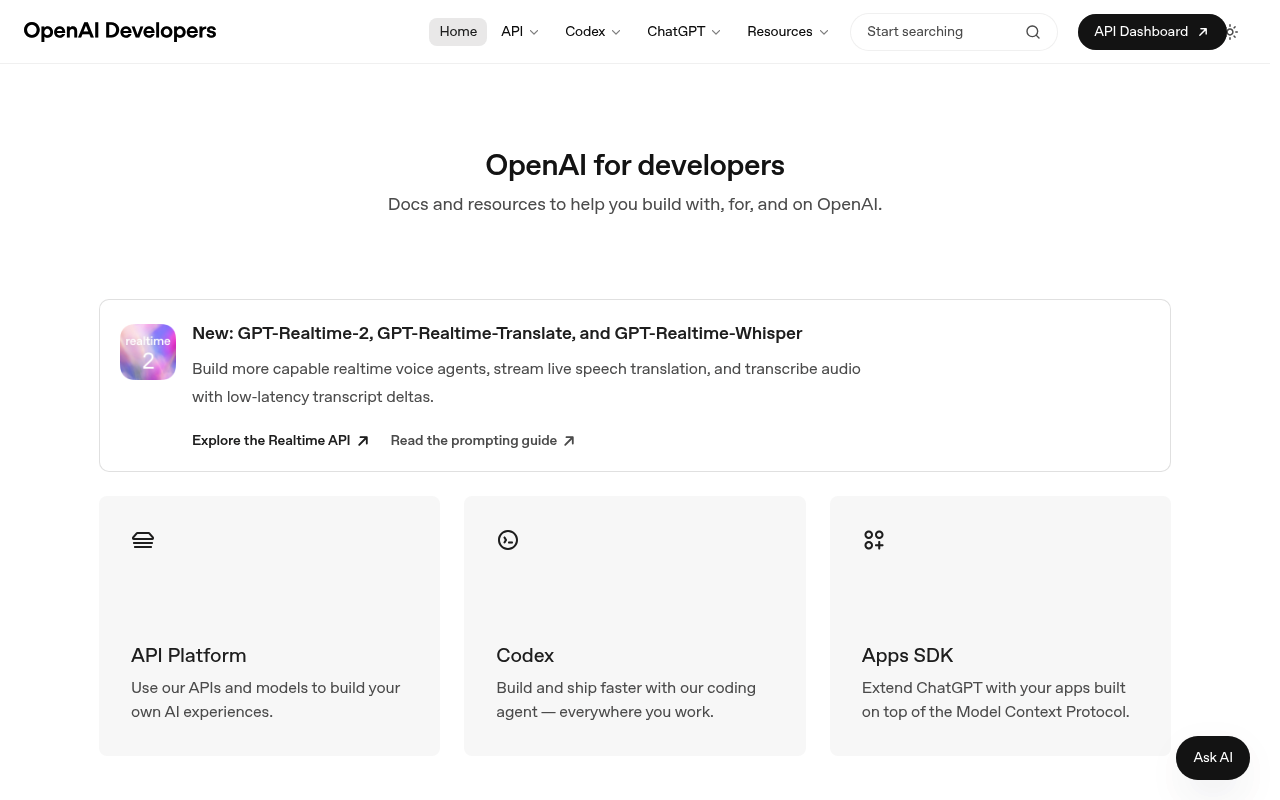
CODEX.md is a project-level Markdown memory file that the OpenAI Codex CLI loads to bootstrap an AI coding agent with persistent project instructions, coding conventions, build and test commands, and team conventions. The OpenAI Codex CLI now standardizes on AGENTS.md as the canonical filename, with CODEX.md and codex.md historically used and still recognized as fallback configuration filenames. Files are discovered through a three-tier hierarchy spanning the user's home directory, the Git repository root, and the current working directory, with closer files overriding earlier guidance when concatenated into the model prompt.
CODEX.md is profiled on the APIs.io network. Tagged areas include AI Agents, AI Copilot, Coding Standards, Configuration, and Developer Workflow.
CODEX.md’s developer surface includes engineering blog, documentation, GitHub presence, and 4 more developer resources.
aid: codex-md
url: https://raw.githubusercontent.com/api-evangelist/codex-md/refs/heads/main/apis.yml
name: CODEX.md
x-type: convention
tags:
- AI Agents
- AI Copilot
- Coding Standards
- Configuration
- Developer Workflow
- Memory
- OpenAI Codex
kind: standard
deliveryModel:
  model: unknown
  license_evidence:
    not_product:
    - openai/codex
  open_source: unknown
  commercial: false
  callable_host: false
  label: Delivery model not determined — needs a product licence on record
  confidence: low
  source:
  - repository-not-product
  generated: '2026-09-25'
  method: derived
accessModel:
  pricing: unknown
  onboarding: unknown
  trial: false
  try_now: false
  public: false
  label: Unknown
  confidence: low
  source: []
  generated: '2026-11-13'
  method: derived
image: https://kinlane-images.s3.amazonaws.com/shared/apis-json/icons/codex-md.png
access: 3rd-Party
created: '2025-01-01'
modified: '2026-10-06'
position: Consuming
description: CODEX.md is a project-level Markdown memory file that the OpenAI Codex CLI loads to bootstrap an AI coding agent
  with persistent project instructions, coding conventions, build and test commands, and team conventions. The OpenAI Codex
  CLI now standardizes on AGENTS.md as the canonical filename, with CODEX.md and codex.md historically used and still recognized
  as fallback configuration filenames. Files are discovered through a three-tier hierarchy spanning the user's home directory,
  the Git repository root, and the current working directory, with closer files overriding earlier guidance when concatenated
  into the model prompt.
apis: []
common:
- url: https://openai.com/news/
  type: Blog
- url: https://openai.com/news/rss.xml
  type: BlogRSS
- type: Website
  url: https://www.openai.com/
- type: Specification
  url: https://developers.openai.com/codex/guides/agents-md
- type: Documentation
  url: https://developers.openai.com/codex/cli
- type: GitHub
  url: https://github.com/openai/codex
- type: Landing Page
  url: https://developers.openai.com/codex
x-features:
- Markdown-based freeform instruction format with no mandated schema
- Loaded automatically by Codex CLI before any task execution
- Three-tier discovery (home directory, Git repo root, current directory)
- Override file convention (AGENTS.override.md / CODEX.override.md)
- Concatenated merge order with closer files taking precedence
- Equivalent role to CLAUDE.md (Claude Code) and .cursorrules (Cursor)
- Designed to encode build commands, test commands, lint rules, and conventions
- Agentic memory primitive for persistent project context across CLI sessions
x-use-cases:
- Pin a repository to specific package managers, formatters, and linters
- Document non-obvious build, test, or migration commands for the agent
- Establish project-wide coding standards (naming, error handling, imports)
- Capture team norms (PR descriptions, commit style, branch naming)
- Restrict the agent from touching protected files or directories
- Bridge organizational knowledge into AI-assisted development sessions
maintainers:
- FN: Kin Lane
  email: kin@apievangelist.com
specificationVersion: '0.23'
Calls without X-API-Key need no key. Calls with it need a paid plan — get a key.
Get an API key
Free tier, no form to fill in. Signing in shares your email address with us — we
store it to create your key and to recognise you if you sign in with another
provider. See our Privacy Policy and
Terms.