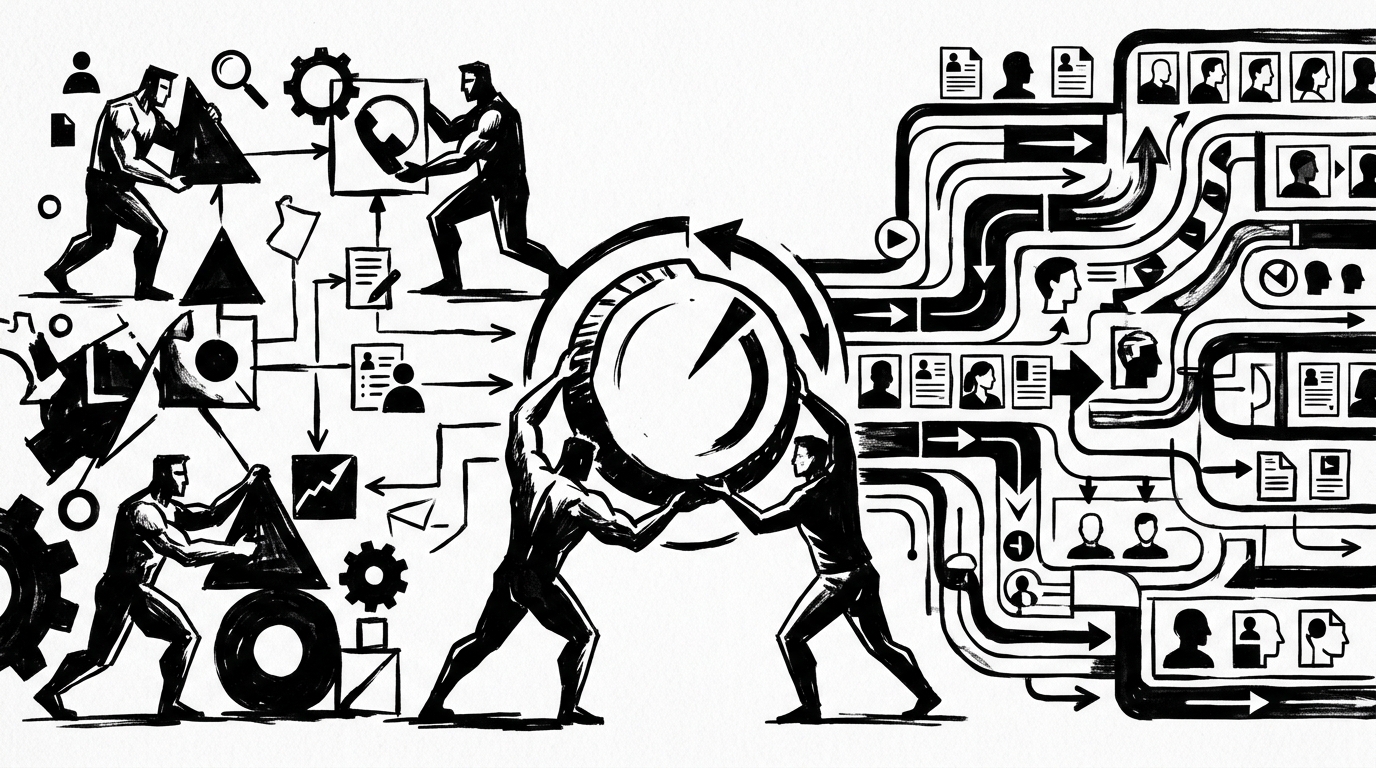
Zapier’s customer story on Blue Castle Agency follows a recruitment firm for real estate and property management that gave its sourcing to Claude, connected to its existing tools through Zapier MCP. Several times a day Claude picks active jobs from the applicant tracking system, reads the success profiles and segment notes, and builds candidate lists; a second Claude pass checks them later. CEO Curtis Key’s point is about inputs, not models: “It all comes down to context. The technology is all there.”
The numbers are a customer’s estimates in a vendor’s case study, and they should be read that way. Key says human-sourced candidates are approved 78 to 83 percent of the time and Claude’s about 94 percent; he estimates the sourcing and quality-control automations save 240+ hours a week, and a separate submission process another 4+ hours per recruiter. Sourcing output is “up about four times.” None of this is independently measured. What survives is the architecture, and the most useful part is the last section. Repeatable steps are moving into scheduled Zaps, one at 2 a.m. on weekdays building prep sheets, so that Claude keeps the judgment calls and the deterministic work stops costing model time. That is the right split, and it is rarer in case studies than the headline numbers.
The catalog has both halves of that split. Zapier has 13 API pages. Zapier MCP and the Zapier AI Actions API are how Claude reaches the tracking system, the sourcing tools and the sheets without a custom integration for each, which is the story’s central claim. The Zapier Zaps API is where the repeatable steps are going. The agentic access profile records 27 operations, five of them acting.
The measurement is the strongest of today’s providers. Zapier holds a Kin Score of 67.4, exemplar, with developer ergonomics at 74.4 and contract quality at 71.5; contract governance at 28.0 is the one weak facet. Agent Readiness is 66.0, agent-ready, with thirteen dimensions lit, including the MCP server, error semantics, agent skills, a well-known catalog and delegated identity. The unlit ones matter for exactly this workload: idempotency, reversibility and dry-run mode. A sourcing run that fires several times a day, with a second pass checking the first, is the case where a retried call must not act twice. The story says Blue Castle can “just turn the knob.” The contracts do not yet say what happens when the knob turns the same call twice.