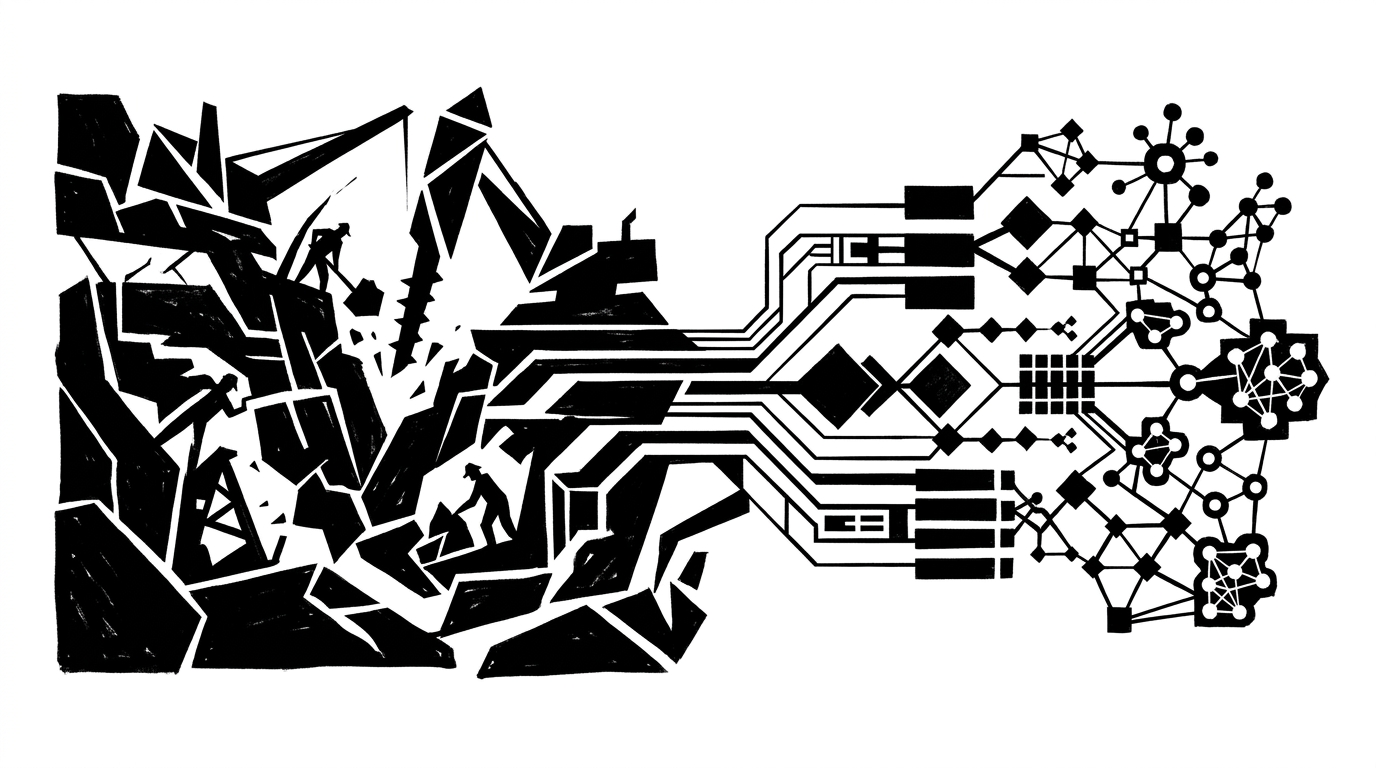
The Mining vertical on apis.io lists 96 providers and 91 API rows. Not one of those providers scores strong or exemplar. 64 are minimal, 22 emerging, 7 thin and 3 developing. Those three developing providers are a price-reporting agency, an equipment maker and a federal land bureau. The companies that actually dig the ore are mostly absent from the API layer, and the industry’s demand graph shows the size of that gap.
Who actually ships
These counts come from the rows on the industry page. I used the rows and not the header, which is known to drift.
| Band | Provider | Score | API rows |
|---|---|---|---|
| Market intelligence | Benchmark Minerals | 49.2 | 14 |
| Equipment | Caterpillar | 45.2 | 3 |
| Public land and minerals | Bureau of Land Management | 40.3 | 13 |
| Site surveying | Propeller Aero | 27.6 | 7 |
| Producers | Cleveland-Cliffs | 29.2 | 1 |
| Producers | United States Steel | 27.4 | 4 |
Benchmark Minerals has the deepest surface: anodes, cathodes, black mass, cobalt, electrolyte and more, split into lithium-ion supply-chain price APIs of two or three operations each. The BLM is close behind with 13 API rows over 700 million acres of subsurface mineral estate. The producers trail both.
Three patterns in the rows
The demand is in the companies with no APIs. The industry demand graph ranks Newmont first among adopters at 185. Newmont scores 1.1 with 0 APIs. BHP is 11.1, Rio Tinto 13.3, Alcoa 15.5, and Freeport-McMoRan 3.4, all with zero APIs. These companies show up in API Evangelist research as consumers of integration. None of them publishes a surface of its own.
Tag membership pulls in crypto. The vertical is built from tags, and “mining” also matches proof-of-work: Monero (8 API rows), Minerstat, Tari, Bitmain and Celsius are all members. That is a defect in how we compute membership, not anything the providers did. A metals buyer browsing this page has to skip past hash-rate tools.
The useful APIs sit beside the mine. Drone surveying from Propeller Aero, Percepto and Aaravun, Caterpillar’s equipment telematics, and Descartes Labs’ geospatial imagery (6 rows) are where machine-readable mining data actually lives. The operational data starts at the haul truck. It does not start at the miner’s front door.
Where to start
For commodity prices, use Benchmark Minerals. For land and claims, the BLM. For site operations, Caterpillar and Propeller. For the miners themselves, there is not yet anything to integrate with.
Takeaway
What would move this vertical is one major producer publishing even a single contract for ESG disclosures, production reporting, or supplier onboarding. Our side of the fix is to separate crypto mining from the metals vertical. Until both happen, mining on apis.io is mostly a story about its suppliers.
Browse the vertical at apis.io/industries/mining/.