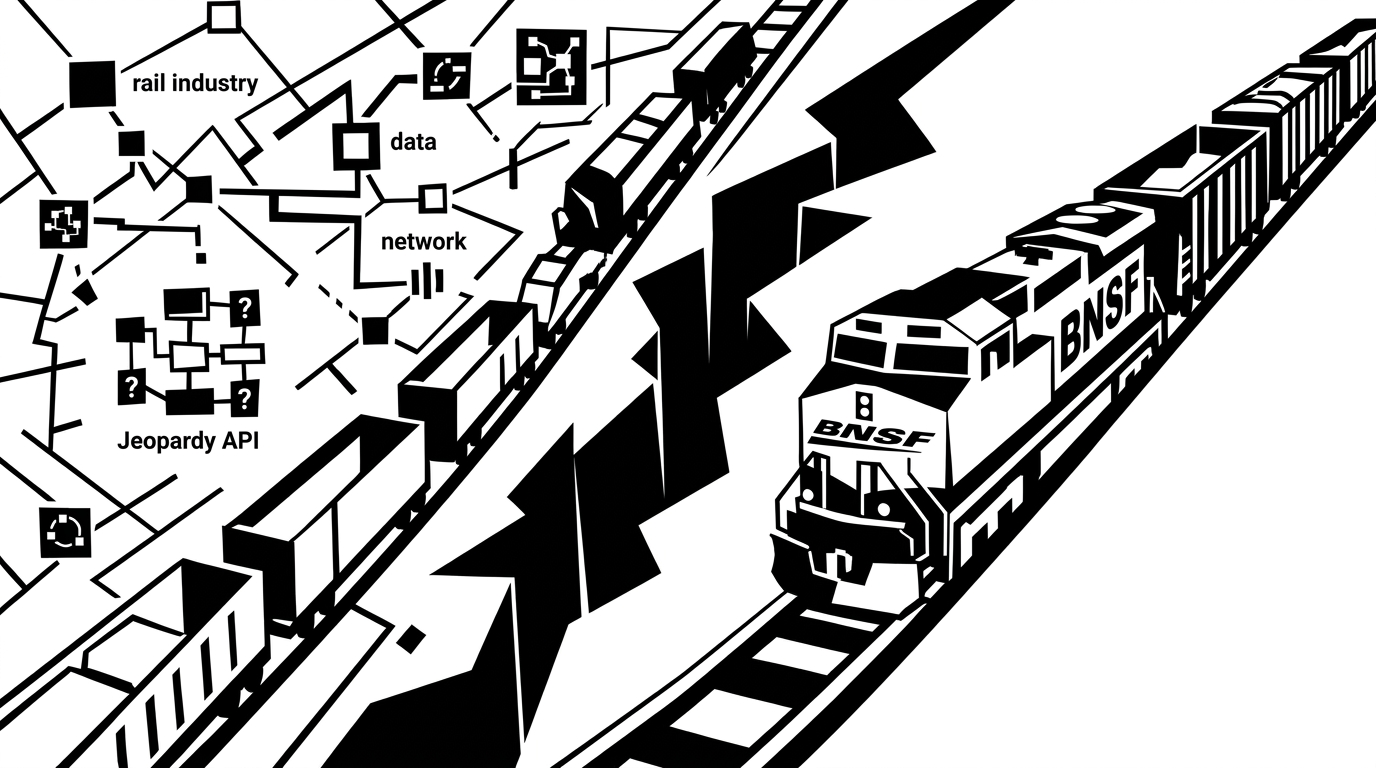
The Rail industry page describes itself as “companies operating freight railroad networks.” It lists 29 providers publishing 157 APIs. The top three members by score are American Express Global Business Travel at 49.2, the U.S. Department of Transportation at 49.0 and the OpenTravel Alliance at 45.6. None of them runs a train.
Membership is computed from provider tags, and the tag is “Rail.” The word does a lot of unintended work. jService, a Ruby on Rails trivia API serving Jeopardy! questions, is a member at 28.9. So is Kamal, the 37signals deployment tool, and so is NPP Australia, which runs payment rails. Meanwhile BNSF is not on the list. It scores 49.1, developing, with agent readiness at 30.0, which is more than double any other Class I railroad we hold. Its tags say “Railroad” and “Trains” and never “Rail.”
What the vertical actually holds
With the false positives set aside, the real rail providers fall into four groups:
| Band | Provider | Kin Score |
|---|---|---|
| Class I freight | BNSF (not a member) | 49.1 developing |
| Class I freight | Norfolk Southern | 20.8 emerging |
| Class I freight | Union Pacific | 20.5 emerging |
| Class I freight | Canadian National | 8.6 minimal |
| Class I freight | CSX | 6.2 minimal |
| Rail software and data | Cedarai | 39.0 thin |
| Rail software and data | Railinc | 14.5 emerging |
| Passenger and ticketing | Trainline | 25.5 emerging |
| Passenger and ticketing | VIA Rail Canada | 22.9 emerging |
| Passenger and ticketing | Amtrak | 18.8 emerging |
| Equipment | Greenbrier | 24.8 emerging |
Three patterns
The railroads trail the software built for them. Cedarai’s ARMS External API covers railcar inventory and history, work orders, invoices and quotes, and Cedarai outscores four of the five Class I carriers on this list. Rail tooling has taken on the job of publishing a developer surface, while most of the railroads themselves have not.
Demand is real even where supply is thin. The industry’s own demand signal ranks Canadian National first among adopters, with a score of 46, ahead of Union Pacific at 36 and CSX at 21. Yet CN scores 8.6 and CSX 6.2 on the public surface, and CSX publishes no APIs at all. The signal finds API work inside these railroads, but almost none of it is published. Rail ranks 50th of 50 industries on adoption.
Passenger rail is all one shape. Amtrak, VIA Rail and Trainline each hold a single API. The value sits in GTFS feeds and booking distribution through agents, and none of the three clears 26.
Where to start
If you are building a rail integration, start with BNSF, whose carload, intermodal, automotive and trains APIs cover the shipment lifecycle, and Cedarai for railcar management. Use Union Pacific as the second carrier, since its 8 APIs are the most of any Class I railroad on the page.
Takeaway
Freight rail is one of the thinnest verticals on the network, and a tag-matched page makes it look busier than it is. The fix on our side is simple: an alias for “Railroad” and an exclusion list for Rails and payment rails. On the railroads’ side, nothing changes until a Class I carrier publishes a contract a shipper’s software can read. Browse the vertical at apis.io/industries/rail/.