An index and topic collection covering webhook delivery, ingestion, transformation, retry, and inspection APIs. Webhooks are the dominant HTTP pattern for asynchronous, event-driven integration between SaaS platforms — providers POST events to consumer endpoints, and consumers must reliably receive, verify, persist, and process those deliveries. This collection includes purpose-built webhook gateways like Hookdeck and ngrok, webhook inspection tools like Beeceptor and Webhook.site, durable event platforms like Inngest and Trigger.dev, automation hubs that expose webhook triggers (Zapier, n8n, Make, Pipedream, IFTTT, Integrately), cloud event buses (Amazon EventBridge, SNS, SQS, Azure Event Grid), and major webhook-emitting providers (Stripe, GitHub, Shopify, Twilio, SendGrid, Slack) whose webhook surfaces define the practices the rest of the ecosystem builds on.
Webhooks is profiled on the APIs.io network. Tagged areas include Webhook, Event Delivery, Webhook Gateway, Webhook Inspection, and Async Events.
The Webhooks catalog on APIs.io includes 1 JSON-LD context.
Webhooks’ developer surface includes developer portal and 1 more developer resources.
Regulatory Posture applies to this provider. Its tags matched the
Horizontal (data, software, accessibility, platform) regime, so
Regulatory Posture carries 15 points of the composite.
If this regime is wrong for your business, say so on your
provider repo — the
applicability map is public and we will correct it.
Create-or-Update Ergonomics could not be measured. We hold no machine-readable contract for
this provider to read, so there is nothing to measure a write surface against. Excluded rather than scored zero:
never-measured and measured-empty are different facts. Publishing an OpenAPI is what makes this facet — and
several others — scorable at all.
The six quality facets above are damped to 85 points between them,
because the conditional facet above carries the other
15. That is why each facet's contribution is shown against a damped
maximum: raising a quality facet moves the composite by 85% of its nominal
weight, not 100%. The full arithmetic is at apis.io/rating/.
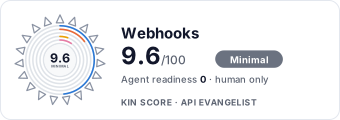
Show this score on your site.
It updates itself when the score changes. Paste this where you link to your API docs:
<a href="https://apis.io/providers/webhooks/"><img src="https://apis.io/badge/webhooks/card.svg" alt="Webhooks on APIs.io — Kin Score by API Evangelist"></a>
Other styles, a README pill and a shields.io endpoint are on the badge page.
Improve this rating by publishing the missing artifacts — every area above can be raised, and the full rubric is at apis.io/rating/. Every facet and dimension name above is a link: it opens that measurement's own page — what it means, the exact checks that feed it, how the whole catalog distributes on it, and the providers at the top of it. This rating is computed from github.com/api-evangelist/webhooks: open an issue to ask a question, or submit a pull request to add artifacts.
Submit an artifact on GitHub — free →Manage your own listing — the Influence plan, $499/mo →
Webhook platforms reliably deliver event payloads from producer APIs to consumer endpoints, with automatic retries, exponential backoff, and dead-letter queues to handle transie...
Signature Verification and Security
Webhook providers sign payloads with HMAC-SHA256, Ed25519, or asymmetric keys so consumers can verify authenticity, prevent replay attacks, and reject forged requests.
Webhook Inspection and Debugging
Tools like Beeceptor, Webhook.site, and ngrok give developers public URLs for local endpoints and human-readable logs of inbound webhook traffic for debugging and replay.
Webhook Gateways and Fan-Out
Gateway platforms like Hookdeck and Convoy sit between producers and consumers to centralize signing, filtering, transformation, fan-out to multiple destinations, and observabil...
Event Filtering and Transformation
Webhook platforms let teams filter events by type or payload content, transform JSON payloads inline, and route the result to specific consumer endpoints or queues.
Local Tunneling for Development
Tunneling tools like ngrok and smee.io expose localhost endpoints to public URLs so developers can receive and debug real webhook traffic during local development.
Durable Event Workflows
Platforms like Inngest and Trigger.dev treat webhook deliveries as the entry point to durable, retryable, multi-step workflows with built-in scheduling, queues, and step-level r...
E-commerce and SaaS applications subscribe to Stripe webhook events (invoice.paid, customer.subscription.updated) to keep billing state in sync with Stripe and trigger fulfillment.
GitHub CI/CD Automation
Engineering teams use GitHub webhook events (push, pull_request, release) to trigger CI/CD pipelines, ChatOps notifications, and security scanning workflows.
Shopify Order Fan-Out
Merchants use webhook gateways to fan out Shopify order events to fulfillment, accounting, marketing, and analytics consumers with per-destination retry isolation.
Local Webhook Development with Tunnels
Developers use ngrok or smee.io to receive production-style webhook traffic on localhost during integration development, replaying captured requests to iterate on consumer logic.
Webhook Observability and Replay
Operations teams use webhook gateways and inspection tools to monitor delivery success rates, alert on consumer failures, and replay missed or failed deliveries from history.
No-Code Webhook Automation
Business users use Zapier, Make, n8n, IFTTT, and Pipedream to wire webhook events from one SaaS app into actions in another without writing code.
Event-Driven Cloud Fan-Out
Cloud teams use Amazon EventBridge, SNS, and SQS to fan webhook deliveries out to multiple subscribers (Lambdas, queues, HTTP endpoints) with at-least-once delivery guarantees.
Pre-built integrations with other platforms and tools.
Hookdeck
Webhook gateway that ingests, verifies, persists, filters, transforms, and reliably delivers webhook events with retry, replay, and observability.
ngrok
Secure tunneling and ingress platform widely used by developers to expose local webhook endpoints to public URLs for development and debugging.
Beeceptor
Webhook inspection and mocking platform providing instant public endpoints to capture, inspect, and mock inbound HTTP and webhook traffic.
Inngest
Durable event-driven platform that receives webhook events and runs them through retryable, multi-step workflow functions with built-in queues and scheduling.
Trigger.dev
Developer-first background jobs and workflows platform with first-class webhook triggers, retries, and long-running execution.
Stripe
Payments platform whose webhook event model (signed payloads, idempotency, replayable history) defines best practice for the broader webhook ecosystem.
GitHub
Source control platform emitting webhook events for repository, issue, pull request, release, and CI/CD activity used to drive automation across the developer ecosystem.
Amazon EventBridge
Serverless event bus that ingests events from AWS services, SaaS partners, and custom applications, and fans them out to targets including webhook-style HTTP endpoints.
aid: webhooks
name: Webhooks
description: An index and topic collection covering webhook delivery, ingestion, transformation, retry, and inspection APIs.
Webhooks are the dominant HTTP pattern for asynchronous, event-driven integration between SaaS platforms — providers POST
events to consumer endpoints, and consumers must reliably receive, verify, persist, and process those deliveries. This collection
includes purpose-built webhook gateways like Hookdeck and ngrok, webhook inspection tools like Beeceptor and Webhook.site,
durable event platforms like Inngest and Trigger.dev, automation hubs that expose webhook triggers (Zapier, n8n, Make, Pipedream,
IFTTT, Integrately), cloud event buses (Amazon EventBridge, SNS, SQS, Azure Event Grid), and major webhook-emitting providers
(Stripe, GitHub, Shopify, Twilio, SendGrid, Slack) whose webhook surfaces define the practices the rest of the ecosystem
builds on.
type: Index
image: https://kinlane-images.s3.amazonaws.com/shared/apis-json/apis-json-logo.jpg
tags:
- Webhook
- Event Delivery
- Webhook Gateway
- Webhook Inspection
- Async Events
tags_raw:
- Webhooks
- Event Delivery
- Webhook Gateway
- Webhook Inspection
- Async Events
url: https://raw.githubusercontent.com/api-evangelist/webhooks/refs/heads/main/apis.yml
created: '2026-05-19'
modified: '2026-05-19'
specificationVersion: '0.19'
apis: []
network:
- name: Amazon EventBridge
url: https://raw.githubusercontent.com/api-evangelist/amazon-eventbridge/refs/heads/main/apis.yml
- name: Amazon SNS
url: https://raw.githubusercontent.com/api-evangelist/amazon-sns/refs/heads/main/apis.yml
- name: Amazon SQS
url: https://raw.githubusercontent.com/api-evangelist/amazon-sqs/refs/heads/main/apis.yml
- name: Azure Event Grid
url: https://raw.githubusercontent.com/api-evangelist/azure-event-grid/refs/heads/main/apis.yml
- name: Beeceptor
url: https://raw.githubusercontent.com/api-evangelist/beeceptor/refs/heads/main/apis.yml
- name: Cloudflare
url: https://raw.githubusercontent.com/api-evangelist/cloudflare/refs/heads/main/apis.yml
- name: GitHub
url: https://raw.githubusercontent.com/api-evangelist/github/refs/heads/main/apis.yml
- name: Hookdeck
url: https://raw.githubusercontent.com/api-evangelist/hookdeck/refs/heads/main/apis.yml
- name: IFTTT
url: https://raw.githubusercontent.com/api-evangelist/ifttt/refs/heads/main/apis.yml
- name: Inngest
url: https://raw.githubusercontent.com/api-evangelist/inngest/refs/heads/main/apis.yml
- name: Integrately
url: https://raw.githubusercontent.com/api-evangelist/integrately/refs/heads/main/apis.yml
- name: Make
url: https://raw.githubusercontent.com/api-evangelist/make/refs/heads/main/apis.yml
- name: n8n
url: https://raw.githubusercontent.com/api-evangelist/n8n/refs/heads/main/apis.yml
- name: ngrok
url: https://raw.githubusercontent.com/api-evangelist/ngrok/refs/heads/main/apis.yml
- name: Pipedream
url: https://raw.githubusercontent.com/api-evangelist/pipedream/refs/heads/main/apis.yml
- name: Postman
url: https://raw.githubusercontent.com/api-evangelist/postman/refs/heads/main/apis.yml
- name: Relay
url: https://raw.githubusercontent.com/api-evangelist/relay-app/refs/heads/main/apis.yml
- name: SendGrid
url: https://raw.githubusercontent.com/api-evangelist/sendgrid/refs/heads/main/apis.yml
- name: Shopify
url: https://raw.githubusercontent.com/api-evangelist/shopify/refs/heads/main/apis.yml
- name: Slack
url: https://raw.githubusercontent.com/api-evangelist/slack/refs/heads/main/apis.yml
- name: Splunk
url: https://raw.githubusercontent.com/api-evangelist/splunk/refs/heads/main/apis.yml
- name: Stripe
url: https://raw.githubusercontent.com/api-evangelist/stripe/refs/heads/main/apis.yml
- name: Tray.io
url: https://raw.githubusercontent.com/api-evangelist/tray-io/refs/heads/main/apis.yml
- name: Trigger.dev
url: https://raw.githubusercontent.com/api-evangelist/trigger-dev/refs/heads/main/apis.yml
- name: Twilio
url: https://raw.githubusercontent.com/api-evangelist/twilio/refs/heads/main/apis.yml
- name: Workato
url: https://raw.githubusercontent.com/api-evangelist/workato/refs/heads/main/apis.yml
- name: Zapier
url: https://raw.githubusercontent.com/api-evangelist/zapier/refs/heads/main/apis.yml
common:
- type: Portal
url: https://apievangelist.com
- type: GitHubOrganization
url: https://github.com/api-evangelist
- type: Features
data:
- name: Webhook Delivery and Retries
description: Webhook platforms reliably deliver event payloads from producer APIs to consumer endpoints, with automatic
retries, exponential backoff, and dead-letter queues to handle transient consumer failures.
- name: Signature Verification and Security
description: Webhook providers sign payloads with HMAC-SHA256, Ed25519, or asymmetric keys so consumers can verify authenticity,
prevent replay attacks, and reject forged requests.
- name: Webhook Inspection and Debugging
description: Tools like Beeceptor, Webhook.site, and ngrok give developers public URLs for local endpoints and human-readable
logs of inbound webhook traffic for debugging and replay.
- name: Webhook Gateways and Fan-Out
description: Gateway platforms like Hookdeck and Convoy sit between producers and consumers to centralize signing, filtering,
transformation, fan-out to multiple destinations, and observability.
- name: Event Filtering and Transformation
description: Webhook platforms let teams filter events by type or payload content, transform JSON payloads inline, and
route the result to specific consumer endpoints or queues.
- name: Local Tunneling for Development
description: Tunneling tools like ngrok and smee.io expose localhost endpoints to public URLs so developers can receive
and debug real webhook traffic during local development.
- name: Durable Event Workflows
description: Platforms like Inngest and Trigger.dev treat webhook deliveries as the entry point to durable, retryable,
multi-step workflows with built-in scheduling, queues, and step-level retries.
- type: UseCases
data:
- name: Receiving Stripe Payment Events
description: E-commerce and SaaS applications subscribe to Stripe webhook events (invoice.paid, customer.subscription.updated)
to keep billing state in sync with Stripe and trigger fulfillment.
- name: GitHub CI/CD Automation
description: Engineering teams use GitHub webhook events (push, pull_request, release) to trigger CI/CD pipelines, ChatOps
notifications, and security scanning workflows.
- name: Shopify Order Fan-Out
description: Merchants use webhook gateways to fan out Shopify order events to fulfillment, accounting, marketing, and
analytics consumers with per-destination retry isolation.
- name: Local Webhook Development with Tunnels
description: Developers use ngrok or smee.io to receive production-style webhook traffic on localhost during integration
development, replaying captured requests to iterate on consumer logic.
- name: Webhook Observability and Replay
description: Operations teams use webhook gateways and inspection tools to monitor delivery success rates, alert on consumer
failures, and replay missed or failed deliveries from history.
- name: No-Code Webhook Automation
description: Business users use Zapier, Make, n8n, IFTTT, and Pipedream to wire webhook events from one SaaS app into
actions in another without writing code.
- name: Event-Driven Cloud Fan-Out
description: Cloud teams use Amazon EventBridge, SNS, and SQS to fan webhook deliveries out to multiple subscribers (Lambdas,
queues, HTTP endpoints) with at-least-once delivery guarantees.
- type: Integrations
data:
- name: Hookdeck
description: Webhook gateway that ingests, verifies, persists, filters, transforms, and reliably delivers webhook events
with retry, replay, and observability.
- name: ngrok
description: Secure tunneling and ingress platform widely used by developers to expose local webhook endpoints to public
URLs for development and debugging.
- name: Beeceptor
description: Webhook inspection and mocking platform providing instant public endpoints to capture, inspect, and mock
inbound HTTP and webhook traffic.
- name: Inngest
description: Durable event-driven platform that receives webhook events and runs them through retryable, multi-step workflow
functions with built-in queues and scheduling.
- name: Trigger.dev
description: Developer-first background jobs and workflows platform with first-class webhook triggers, retries, and long-running
execution.
- name: Stripe
description: Payments platform whose webhook event model (signed payloads, idempotency, replayable history) defines best
practice for the broader webhook ecosystem.
- name: GitHub
description: Source control platform emitting webhook events for repository, issue, pull request, release, and CI/CD activity
used to drive automation across the developer ecosystem.
- name: Amazon EventBridge
description: Serverless event bus that ingests events from AWS services, SaaS partners, and custom applications, and fans
them out to targets including webhook-style HTTP endpoints.
maintainers:
- FN: Kin Lane
email: kin@apievangelist.com
humanURL: https://apievangelist.com
Discovery needs no key. Ratings and market analysis are Pro.
Get an API key
Free tier, no form to fill in. Signing in shares your email address with us — we
store it to create your key and to recognise you if you sign in with another
provider. See our Privacy Policy and
Terms.