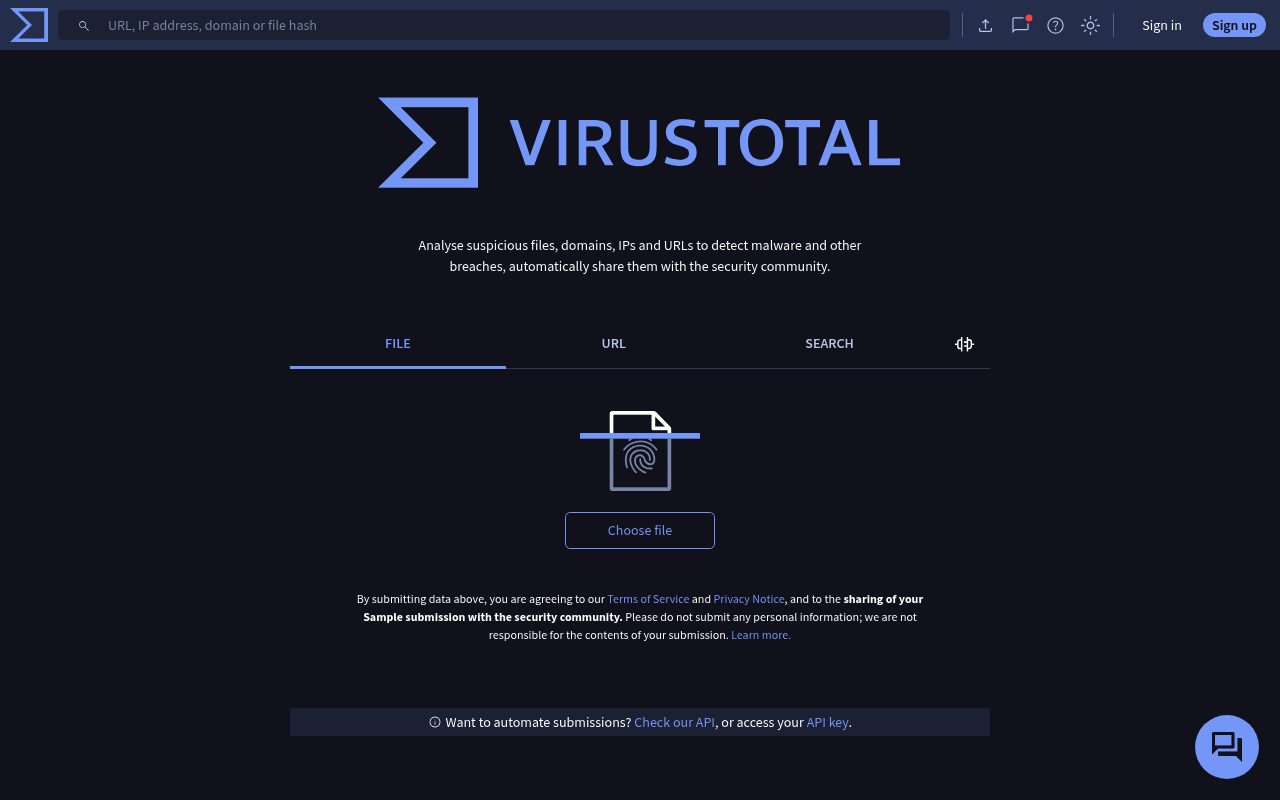
VirusTotal website screenshot

VirusTotal

VirusTotal — the Google-owned (since 2012) threat intelligence platform that aggregates anti-malware engines and URL scanners to analyse files, URLs, IP addresses, and domains. The v3 API surfaces seven major areas: Access Control, IoC Feeds, IoC Investigation, Private Scanning, Threat Graphs, Threat Landscape & Vulnerability Intelligence, and YARA Hunting (Livehunt, Retrohunt, IoC Stream). Now also branded "Google Threat Intelligence" (GTI) for Enterprise customers, integrating Mandiant intelligence, Digital Threat Monitoring (DTM), and Attack Surface Management (ASM).

9 APIs 0 Features
Anti-MalwareThreat IntelligenceSecurityFile AnalysisURL AnalysisYARAIoCSandboxMITRE ATT&CKGoogle Cloud

APIs

VirusTotal API v3 - Access Control

Manage users, groups, service accounts, API quotas, and overall account usage. The control plane that wraps every other VirusTotal API surface.

VirusTotal API v3 - IoC Feeds

Per-minute and hourly intelligence feed batches for files, URLs, domains, IP addresses, and sandbox analyses. Premium tier required. The bulk pipeline behind SIEM / SOAR / data-...

VirusTotal API v3 - IoC Investigation

Investigate files, URLs, IP addresses, and domains. Submit and analyse samples, retrieve verdicts, traverse the relationships graph, fetch sandbox behaviour, post comments and v...

VirusTotal API v3 - Private Scanning

Submit files and URLs for analysis without sharing the artefact with the VirusTotal community. Mirrors the public scanning surface (Files / URLs / Analyses / Behaviours / Zip Fi...

VirusTotal API v3 - Threat Graphs

Create, share, edit, and search Threat Graphs — visualisations of how IoCs and threats relate. Includes the editor / viewer ACL surface for collaboration.

VirusTotal API v3 - Threat Landscape & Vulnerability Intelligence

Threat Landscape — Collections, Threat Actors, Malware & Tools, Campaigns, Reports, Vulnerabilities, and the curated IoC catalogue. Premium tier; this is where Mandiant-curated ...

VirusTotal API v3 - YARA Hunting (Livehunt, Retrohunt, IoC Stream)

Livehunt (real-time YARA matching on incoming corpus), Retrohunt (historical YARA scans), the IoC Stream, and crowdsourced YARA rules. The hunting and notification surface. Prem...

Google Threat Intelligence - Attack Surface Management (ASM)

Enterprise add-on (formerly Mandiant Advantage ASM). Discovers and monitors an organisation's external attack surface, scoring exposures and prioritising remediation.

Google Threat Intelligence - Digital Threat Monitoring (DTM)

Enterprise add-on (formerly Mandiant Advantage DTM). Monitors the open, deep, and dark web for credential leaks, brand abuse, and adversary chatter referencing the customer.

Collections

Pricing Plans

Virustotal Plans Pricing

3 plans

PLANS

Rate Limits

Virustotal Rate Limits

10 limits

RATE LIMITS

FinOps

Semantic Vocabularies

Virustotal Context

30 classes · 156 properties

JSON-LD

API Governance Rules

VirusTotal API Rules

40 rules · 15 errors 19 warnings 6 info

SPECTRAL

JSON Structure

Virustotal Analysis Object Structure

5 properties

JSON STRUCTURE

Virustotal Attack Tactic Object Structure

5 properties

JSON STRUCTURE

Virustotal Attack Technique Object Structure

5 properties

JSON STRUCTURE

Virustotal Collection Object Structure

5 properties

JSON STRUCTURE

Virustotal Comment Object Structure

5 properties

JSON STRUCTURE

Virustotal Domain Object Structure

5 properties

JSON STRUCTURE

Virustotal File Behaviour Object Structure

5 properties

JSON STRUCTURE

Virustotal File Object Structure

5 properties

JSON STRUCTURE

Virustotal Graph Object Structure

5 properties

JSON STRUCTURE

Virustotal Group Object Structure

5 properties

JSON STRUCTURE

Virustotal Ip Address Object Structure

5 properties

JSON STRUCTURE

Virustotal Livehunt Ruleset Object Structure

5 properties

JSON STRUCTURE

Virustotal Retrohunt Job Object Structure

5 properties

JSON STRUCTURE

Virustotal Url Object Structure

5 properties

JSON STRUCTURE

Virustotal User Object Structure

5 properties

JSON STRUCTURE

Virustotal Vote Object Structure

5 properties

JSON STRUCTURE

Virustotal Yara Rule Object Structure

5 properties

JSON STRUCTURE

Example Payloads

Resources

🔗
Website
Website
🔗
Documentation
Documentation
🔗
APIReference
APIReference
👥
GitHubOrganization
GitHubOrganization
📰
Blog
Blog
🔗
PublicAPIsListing
PublicAPIsListing
🔗
GTI API v3 — Full Spec (official, upstream)
OpenAPI
🔗
GTI ASM — Attack Surface Management
OpenAPI
🔗
GTI DTM — Digital Threat Monitoring
OpenAPI
📦
Python SDK (vt-py)
SDKs
📦
Go SDK (vt-go)
SDKs
📦
Graph API Python (vt-graph-api)
SDKs
🔗
vt-cli — Official VirusTotal Command Line Interface (Go)
CLI
🔧
MCP Server (BurtTheCoder/mcp-virustotal — community)
Tools
🔧
MCP Server (alephnan/MCP-VirusTotal — community)
Tools
🔧
MCP Server (barvhaim/virustotal-mcp-server — community, Python)
Tools
🔧
YARA (the pattern matching swiss knife)
Tools
🔧
YARA-X (Rust rewrite of YARA)
Tools
🔧
yara-python (Python interface for YARA)
Tools
🔧
yara-x-benchmarks
Tools
🔧
go-yara (Go bindings for YARA)
Tools
🔧
protoc-gen-yara (YARA modules from protobufs)
Tools
🔧
CAPEv2 (Malware Configuration And Payload Extraction)
Tools
🔧
vt-ida-plugin (Official VirusTotal plugin for IDA Pro)
Tools
🔧
vt-windows-event-stream
Tools
🔧
qt-virustotal-uploader (Qt desktop uploader)
Tools
🎓
GTI Developer Kit (example integration code)
Tutorials
🔗
Plans
Plans
🔗
RateLimits
RateLimits
🔗
FinOps
FinOps
🔗
SpectralRuleset
SpectralRuleset
🔗
Vocabulary
Vocabulary
🔗
JSONLDContext
JSONLDContext

Sources

Raw ↑
opencollection: 1.0.0
info:
  name: VirusTotal API v3 - YARA Hunting (Livehunt, Retrohunt, IoC Stream)
  version: '3.0'
request:
  auth:
    type: apikey
    key: x-apikey
    value: '{{x-apikey}}'
    placement: header
items:
- info:
    name: YARA Hunting - IoC Stream
    type: folder
  items:
  - info:
      name: VirusTotal Get Objects from the IoC Stream
      type: http
    http:
      method: GET
      url: https://www.virustotal.com/api/v3/ioc_stream
      params:
      - name: limit
        value: ''
        type: query
        description: Number of objects to retrieve (max 40)
      - name: descriptors_only
        value: ''
        type: query
        description: The response returns only objects descriptors instead of whole VT objects
      - name: filter
        value: ''
        type: query
        description: Filter string
      - name: cursor
        value: ''
        type: query
        description: Continuation cursor
      - name: order
        value: ''
        type: query
        description: Sort order
      auth:
        type: apikey
        key: x-apikey
        value: '{{x-apikey}}'
        placement: header
    docs: 'The IoC stream endpoint returns different types of objects (files, URLs, domains, IP addresses) coming from multiple
      origins (you can restrict the returned types by using the filters explained below). In addition, depending on the origin
      of the notification there will be different context attributes added to these objects.


      The possible context attributes in IoC Stream objects are:


      - `notification_id`: \<_string_> Always present. This string identifies the notification, and can be used to retri'
  - info:
      name: VirusTotal Delete Notifications from the IoC Stream
      type: http
    http:
      method: DELETE
      url: https://www.virustotal.com/api/v3/ioc_stream
      params:
      - name: filter
        value: ''
        type: query
        description: Filter string
      auth:
        type: apikey
        key: x-apikey
        value: '{{x-apikey}}'
        placement: header
    docs: 'Uses the same filters than the IoC Stream ([GET /ioc_stream](https://gtidocs.virustotal.com/reference/get-objects-from-the-ioc-stream))
      to delete all the matching notifications.

      '
  - info:
      name: VirusTotal Get an IoC Stream Notification
      type: http
    http:
      method: GET
      url: https://www.virustotal.com/api/v3/ioc_stream_notifications/:id
      params:
      - name: id
        value: ''
        type: path
        description: The ID of the IoC Stream notification
      auth:
        type: apikey
        key: x-apikey
        value: '{{x-apikey}}'
        placement: header
    docs: 'Returns an IoC Stream notification.

      '
  - info:
      name: VirusTotal Delete an IoC Stream Notification
      type: http
    http:
      method: DELETE
      url: https://www.virustotal.com/api/v3/ioc_stream_notifications/:id
      params:
      - name: id
        value: ''
        type: path
        description: The ID of the IoC Stream notification
      auth:
        type: apikey
        key: x-apikey
        value: '{{x-apikey}}'
        placement: header
    docs: 'Deletes an IoC Stream notification.

      '
- info:
    name: YARA Hunting - Livehunt
    type: folder
  items:
  - info:
      name: VirusTotal Retrieve File Objects for Livehunt Notifications
      type: http
    http:
      method: GET
      url: https://www.virustotal.com/api/v3/intelligence/hunting_notification_files
      params:
      - name: limit
        value: ''
        type: query
        description: Maximum number of notifications to retrieve
      - name: cursor
        value: ''
        type: query
        description: Continuation cursor
      - name: filter
        value: ''
        type: query
        description: String to search with in the hunting notification tags
      - name: count_limit
        value: ''
        type: query
        description: Maximum number of notifications counted (meta.count in the response) 10,000 max
      auth:
        type: apikey
        key: x-apikey
        value: '{{x-apikey}}'
        placement: header
    docs: "> ❗️ Important\n> \n> Hunting notifications files are no longer showed in the web interface. Use the [/api/v3/ioc_stream](https://gtidocs.virustotal.com/reference/get-objects-from-the-ioc-stream)\
      \ endpoint instead to retrieve objects from IoC-Stream notifications.\n\nEach file object returned, _in addition to\
      \ all the file details_, has a `context_attributes` property that contains information about the Google Threat Intelligence\
      \ Hunting Livehunt notification tied to the file, this is an example:\n\n```"
  - info:
      name: VirusTotal Get Livehunt Notifications
      type: http
    http:
      method: GET
      url: https://www.virustotal.com/api/v3/intelligence/hunting_notifications
      params:
      - name: limit
        value: ''
        type: query
        description: Maximum number of notifications to retrieve
      - name: filter
        value: ''
        type: query
        description: Return the notifications matching the given criteria only
      - name: cursor
        value: ''
        type: query
        description: Continuation cursor
      - name: count_limit
        value: ''
        type: query
        description: Maximum number of notifications counted (meta.count in the response) 10,000 max
      auth:
        type: apikey
        key: x-apikey
        value: '{{x-apikey}}'
        placement: header
    docs: "> ❗️ Important\n> \n> Hunting notifications are no longer showed in the web interface. Use the [/api/v3/ioc_stream](https://gtidocs.virustotal.com/reference/get-objects-from-the-ioc-stream)\
      \ endpoint (with `descriptors_only=true`) instead to retrieve IoC-Stream notifications.\n\n> \U0001F6A7 Retrieving matching\
      \ files rather than just notifications\n> \n> This API endpoint retrieves lists of hunting notification objects, but\
      \ you may be more interested in retrieving the actual file objects tied to those notifica"
  - info:
      name: VirusTotal Delete Livehunt Notifications
      type: http
    http:
      method: DELETE
      url: https://www.virustotal.com/api/v3/intelligence/hunting_notifications
      params:
      - name: tag
        value: ''
        type: query
        description: Delete notifications with the given tag
      auth:
        type: apikey
        key: x-apikey
        value: '{{x-apikey}}'
        placement: header
    docs: 'This endpoint deletes Google Threat Intelligence Hunting Livehunt notifications in bulk. If the `tag` parameter
      is specified all your notifications with the given tag will be deleted. If the `tag` parameter is not specified all
      your notifications will be deleted.

      '
  - info:
      name: VirusTotal Get a Livehunt Notification Object
      type: http
    http:
      method: GET
      url: https://www.virustotal.com/api/v3/intelligence/hunting_notifications/:id
      params:
      - name: id
        value: ''
        type: path
        description: Notification identifier
      auth:
        type: apikey
        key: x-apikey
        value: '{{x-apikey}}'
        placement: header
    docs: VirusTotal Get a Livehunt Notification Object
  - info:
      name: VirusTotal Delete a Livehunt Notification
      type: http
    http:
      method: DELETE
      url: https://www.virustotal.com/api/v3/intelligence/hunting_notifications/:id
      params:
      - name: id
        value: ''
        type: path
        description: Notification identifier
      auth:
        type: apikey
        key: x-apikey
        value: '{{x-apikey}}'
        placement: header
    docs: VirusTotal Delete a Livehunt Notification
  - info:
      name: VirusTotal Get Livehunt Rulesets
      type: http
    http:
      method: GET
      url: https://www.virustotal.com/api/v3/intelligence/hunting_rulesets
      params:
      - name: limit
        value: ''
        type: query
        description: Maximum number of rulesets to retrieve
      - name: filter
        value: ''
        type: query
        description: Return the rulesets matching the given criteria only
      - name: order
        value: ''
        type: query
        description: Sort order
      - name: cursor
        value: ''
        type: query
        description: Continuation cursor
      auth:
        type: apikey
        key: x-apikey
        value: '{{x-apikey}}'
        placement: header
    docs: This endpoint returns the Google Threat Intelligence Hunting Livehunt rulesets viewable by the user making the request.
      A ruleset is viewable by a user either if it was created by the user or if it was shared with him by someone else. This
      endpoint is equivalent to `GET /users/{user}/hunting_rulesets`, where `{user}` is the username of the user owning the
      API key. In fact, if you look carefully at the example response below you'll notice that the `self` and `next` links
      do not point to `/intelli
  - info:
      name: VirusTotal Create a New Livehunt Ruleset
      type: http
    http:
      method: POST
      url: https://www.virustotal.com/api/v3/intelligence/hunting_rulesets
      body:
        type: json
        data: '{}'
      auth:
        type: apikey
        key: x-apikey
        value: '{{x-apikey}}'
        placement: header
    docs: "This endpoint creates a new Google Threat Intelligence Hunting Livehunt ruleset. The request's body must have the\
      \ following structure:\n\n```json Example request\n{\n  \"data\": {\n    \"type\": \"hunting_ruleset\",\n    \"attributes\"\
      : {\n      \"name\": \"foobar\",\n      \"enabled\": true,\n      \"limit\": 100,\n      \"rules\": \"rule foobar {\
      \ strings: $ = \\\"foobar\\\" condition: all of them }\",\n      \"notification_emails\": [\"wcoyte@acme.com\", \"rrunner@acme.com\"\
      ],\n      \"match_object_type\": \"file\"\n    }\n  }\n}\n```\n\nUse th"
  - info:
      name: VirusTotal Remove All Livehunt Rulesets
      type: http
    http:
      method: DELETE
      url: https://www.virustotal.com/api/v3/intelligence/hunting_rulesets
      headers:
      - name: x-confirm-delete
        value: ''
      auth:
        type: apikey
        key: x-apikey
        value: '{{x-apikey}}'
        placement: header
    docs: 'This API call deletes all rulesets owned by the user and removes the user from the list of editors in rules shared
      with them. This operation is asynchronous: the handler launches a background job and returns immediately. This API endpoint
      returns a [Operation](https://gtidocs.virustotal.com/reference/operation-object) object.

      '
  - info:
      name: VirusTotal Get a Livehunt Ruleset
      type: http
    http:
      method: GET
      url: https://www.virustotal.com/api/v3/intelligence/hunting_rulesets/:id
      params:
      - name: id
        value: ''
        type: path
        description: Ruleset identifier
      auth:
        type: apikey
        key: x-apikey
        value: '{{x-apikey}}'
        placement: header
    docs: 'Returns a [Hunting Ruleset](https://gtidocs.virustotal.com/reference/hunting-ruleset-object) object.

      '
  - info:
      name: VirusTotal Update a Livehunt Ruleset
      type: http
    http:
      method: PATCH
      url: https://www.virustotal.com/api/v3/intelligence/hunting_rulesets/:id
      params:
      - name: id
        value: ''
        type: path
        description: Ruleset identifier
      body:
        type: json
        data: '{}'
      auth:
        type: apikey
        key: x-apikey
        value: '{{x-apikey}}'
        placement: header
    docs: "```json Example request\n{\n  \"data\": {\n    \"type\": \"hunting_ruleset\",\n    \"id\": \"{id}\",\n    \"attributes\"\
      : {\n      \"enabled\": true,\n      \"limit\": 10,\n      \"name\": \"bar\",\n      \"notification_emails\": [\"notifications@acme.com\"\
      ],\n      \"rules\": \"rule foo {condition: false}\"\n    }\n  }\n}\n```\n\nReturns the updated [Hunting Ruleset](https://gtidocs.virustotal.com/reference/hunting-ruleset-object)\
      \ object.\n"
  - info:
      name: VirusTotal Delete a Livehunt Ruleset
      type: http
    http:
      method: DELETE
      url: https://www.virustotal.com/api/v3/intelligence/hunting_rulesets/:id
      params:
      - name: id
        value: ''
        type: path
        description: Ruleset identifier
      auth:
        type: apikey
        key: x-apikey
        value: '{{x-apikey}}'
        placement: header
    docs: VirusTotal Delete a Livehunt Ruleset
  - info:
      name: VirusTotal Grant Livehunt Ruleset Edit Permissions for a User or Group
      type: http
    http:
      method: POST
      url: https://www.virustotal.com/api/v3/intelligence/hunting_rulesets/:id/relationships/editors
      params:
      - name: id
        value: ''
        type: path
        description: Ruleset identifier
      body:
        type: json
        data: '{}'
      auth:
        type: apikey
        key: x-apikey
        value: '{{x-apikey}}'
        placement: header
    docs: VirusTotal Grant Livehunt Ruleset Edit Permissions for a User or Group
  - info:
      name: VirusTotal Check if a User or Group is a Livehunt Ruleset Editor
      type: http
    http:
      method: GET
      url: https://www.virustotal.com/api/v3/intelligence/hunting_rulesets/:id/relationships/editors/:user_or_group_id
      params:
      - name: id
        value: ''
        type: path
        description: Ruleset identifier
      - name: user_or_group_id
        value: ''
        type: path
        description: User or group ID
      auth:
        type: apikey
        key: x-apikey
        value: '{{x-apikey}}'
        placement: header
    docs: "This endpoint returns true if the user has editing access to the Hunting ruleset.\n\n```json Response example\n\
      {\n    \"data\": true\n}\n```\n"
  - info:
      name: VirusTotal Revoke Livehunt Ruleset Edit Permission from a User or Group
      type: http
    http:
      method: DELETE
      url: https://www.virustotal.com/api/v3/intelligence/hunting_rulesets/:id/relationships/editors/:user_or_group_id
      params:
      - name: id
        value: ''
        type: path
        description: Ruleset identifier
      - name: user_or_group_id
        value: ''
        type: path
        description: User or group ID
      auth:
        type: apikey
        key: x-apikey
        value: '{{x-apikey}}'
        placement: header
    docs: VirusTotal Revoke Livehunt Ruleset Edit Permission from a User or Group
  - info:
      name: VirusTotal Transfer Livehunt Ruleset to Another User
      type: http
    http:
      method: POST
      url: https://www.virustotal.com/api/v3/intelligence/hunting_rulesets/:id/relationships/owner
      params:
      - name: id
        value: ''
        type: path
        description: Ruleset identifier
      body:
        type: json
        data: '{}'
      auth:
        type: apikey
        key: x-apikey
        value: '{{x-apikey}}'
        placement: header
    docs: 'Note: The new owner must be a member of the same group the ruleset was created with.

      '
  - info:
      name: VirusTotal Get Object Descriptors Related to a Livehunt Ruleset
      type: http
    http:
      method: GET
      url: https://www.virustotal.com/api/v3/intelligence/hunting_rulesets/:id/relationships/:relationship
      params:
      - name: id
        value: ''
        type: path
        description: Ruleset identifier
      - name: relationship
        value: ''
        type: path
        description: Relationship name (see [table](ref:hunting-ruleset-object#relationships))
      auth:
        type: apikey
        key: x-apikey
        value: '{{x-apikey}}'
        placement: header
    docs: 'Same as [/hunting_rulesets/{id}/{relationships}](https://gtidocs.virustotal.com/reference/get-hunting-ruleset-full-relationships)
      except it returns just the related object''s descriptor (and context attributes, if any) instead of returning all attributes.

      '
  - info:
      name: VirusTotal Get Objects Related to a Livehunt Ruleset
      type: http
    http:
      method: GET
      url: https://www.virustotal.com/api/v3/intelligence/hunting_rulesets/:id/:relationship
      params:
      - name: id
        value: ''
        type: path
        description: Ruleset identifier
      - name: relationship
        value: ''
        type: path
        description: Relationship name (see [table](ref:hunting-ruleset-object#relationships))
      auth:
        type: apikey
        key: x-apikey
        value: '{{x-apikey}}'
        placement: header
    docs: "Hunting Rulesets objects have relationships to other objects. As mentioned in the [Relationships](https://gtidocs.virustotal.com/reference/relationships)\
      \ section, those related objects can be retrieved by sending `GET` requests to the relationship URL. \n\nThe relationships\
      \ supported by Hunting Rulesets objects are documented in the [Hunting Rulesets](https://gtidocs.virustotal.com/reference/hunting-ruleset-object#relationships)\
      \ API object page.\n"
- info:
    name: YARA Hunting - Retrohunt
    type: folder
  items:
  - info:
      name: VirusTotal Get a List of Retrohunt Jobs
      type: http
    http:
      method: GET
      url: https://www.virustotal.com/api/v3/intelligence/retrohunt_jobs
      params:
      - name: limit
        value: ''
        type: query
        description: Maximum number jobs to retrieve
      - name: filter
        value: ''
        type: query
        description: Return the jobs matching the given criteria only
      - name: cursor
        value: ''
        type: query
        description: Continuation cursor
      auth:
        type: apikey
        key: x-apikey
        value: '{{x-apikey}}'
        placement: header
    docs: 'Returns a list of [Retrohunt Job](https://gtidocs.virustotal.com/reference/retrohunt-job-object) objects. Accepted
      filters are `status:(starting|running|aborting|aborted|finished)`.

      '
  - info:
      name: VirusTotal Create a New Retrohunt Job
      type: http
    http:
      method: POST
      url: https://www.virustotal.com/api/v3/intelligence/retrohunt_jobs
      body:
        type: json
        data: '{}'
      auth:
        type: apikey
        key: x-apikey
        value: '{{x-apikey}}'
        placement: header
    docs: "This endpoint creates a new Retrohunt job. The request's body must have the following structure:\n\n```json Example\
      \ request\n{\n  \"data\": {\n    \"type\": \"retrohunt_job\",\n    \"attributes\": {\n      \"rules\": \"rule foobar\
      \ { strings: $ = \\\"foobar\\\" condition: all of them }\",\n      \"notification_email\": \"notifications@acme.com\"\
      ,\n      \"corpus\": \"main\",\n      \"time_range\": {\n        \"start\": 1545145761,\n        \"end\": 1547737720\n\
      \      }\n    }\n  }\n}\n```\n\nThe `rules` attribute is required, but `notification_e"
  - info:
      name: VirusTotal Get a Retrohunt Job Object
      type: http
    http:
      method: GET
      url: https://www.virustotal.com/api/v3/intelligence/retrohunt_jobs/:id
      params:
      - name: id
        value: ''
        type: path
        description: Job identifier
      auth:
        type: apikey
        key: x-apikey
        value: '{{x-apikey}}'
        placement: header
    docs: 'Returns a [Retrohunt Job](https://gtidocs.virustotal.com/reference/retrohunt-job-object) object.

      '
  - info:
      name: VirusTotal Delete a Retrohunt Job
      type: http
    http:
      method: DELETE
      url: https://www.virustotal.com/api/v3/intelligence/retrohunt_jobs/:id
      params:
      - name: id
        value: ''
        type: path
        description: Job identifier
      auth:
        type: apikey
        key: x-apikey
        value: '{{x-apikey}}'
        placement: header
    docs: VirusTotal Delete a Retrohunt Job
  - info:
      name: VirusTotal Abort a Retrohunt Job
      type: http
    http:
      method: POST
      url: https://www.virustotal.com/api/v3/intelligence/retrohunt_jobs/:id/abort
      params:
      - name: id
        value: ''
        type: path
        description: Job identifier
      auth:
        type: apikey
        key: x-apikey
        value: '{{x-apikey}}'
        placement: header
    docs: VirusTotal Abort a Retrohunt Job
  - info:
      name: VirusTotal Retrieve Matches for a Retrohunt Job
      type: http
    http:
      method: GET
      url: https://www.virustotal.com/api/v3/intelligence/retrohunt_jobs/:id/matching_files
      params:
      - name: id
        value: ''
        type: path
        description: Job identifier
      - name: cursor
        value: ''
        type: query
        description: Continuation cursor
      - name: limit
        value: ''
        type: query
        description: Maximum number of matching files to retrieve
      auth:
        type: apikey
        key: x-apikey
        value: '{{x-apikey}}'
        placement: header
    docs: 'Retrohunt jobs are related to other objects. As mentioned in the [Relationships](https://gtidocs.virustotal.com/reference/relationships)
      section, those related objects can be retrieved by sending `GET` requests to the relationships URL.


      The supported relationships for Retrohunt jobs are described in the [Retrohunt Jobs](https://gtidocs.virustotal.com/reference/retrohunt-job-object)
      API object page.

      '
- info:
    name: YARA Hunting - Rules
    type: folder
  items:
  - info:
      name: VirusTotal List Crowdsourced YARA Rules
      type: http
    http:
      method: GET
      url: https://www.virustotal.com/api/v3/yara_rules
      params:
      - name: limit
        value: ''
        type: query
        description: Maximum number of rules to retrieve
      - name: filter
        value: ''
        type: query
        description: Return the rules matching the given criteria only
      - name: order
        value: ''
        type: query
        description: Sort order
      - name: cursor
        value: ''
        type: query
        description: Continuation cursor
      auth:
        type: apikey
        key: x-apikey
        value: '{{x-apikey}}'
        placement: header
    docs: "This endpoint lists the different Google Threat Intelligence's Crowdsourced YARA rules.\n\n```json Example response\n\
      {\n\t\"meta\": {\n\t\t\"cursor\": \"Ck8KDwoCbG0SCQjdvIy9kdv-AhI4ahFzfnZpcnVzdG90YWxjbG91ZHIjCxIIWWFyYVJ1bGUiFTAwM2UxYzUxZWZ8UEtfQVhBX2Z1bgwYACAB\"\
      \n\t},\n\t\"data\": [\n\t\t{\n\t\t\t\"attributes\": {\n\t\t\t\t\"name\": \"PK_AXA_fun\",\n\t\t\t\t\"tags\": [\n\t\t\t\
      \t\t\"AXA\"\n\t\t\t\t],\n\t\t\t\t\"matches\": 0,\n\t\t\t\t\"author\": \"Thomas Damonneville\",\n\t\t\t\t\"enabled\"\
      : true,\n\t\t\t\t\"rule\": \"rule PK_AXA_fun : AXA\\n{\\n    meta:\\n        description = \\\"Phis"
  - info:
      name: VirusTotal Get a Crowdsourced YARA Rule
      type: http
    http:
      method: GET
      url: https://www.virustotal.com/api/v3/yara_rules/:id
      params:
      - name: id
        value: ''
        type: path
        description: Rule identifier
      auth:
        type: apikey
        key: x-apikey
        value: '{{x-apikey}}'
        placement: header
    docs: 'Returns a [YARA rule](https://gtidocs.virustotal.com/reference/yara-rule-object) object.

      '
  - info:
      name: VirusTotal Get Objects Descriptors Related to a Crowdsourced YARA Rule
      type: http
    http:
      method: GET
      url: https://www.virustotal.com/api/v3/yara_rules/:id/relationships/:relationship
      params:
      - name: id
        value: ''
        type: path
        description: Rule identifier
      - name: relationship
        value: ''
        type: path
        description: Relationship name (see [table](ref:yara-rule-object#relationships))
      auth:
        type: apikey
        key: x-apikey
        value: '{{x-apikey}}'
        placement: header
    docs: 'Same as [/yara_rules/{id}/{relationships}](https://gtidocs.virustotal.com/reference/crowdsourced-yara-rule-relationship-endpoint)
      except it returns just the related object''s descriptor (and context attributes, if any) instead of returning all attributes.

      '
  - info:
      name: VirusTotal Get Objects Related to a Crowdsourced YARA Rule
      type: http
    http:
      method: GET
      url: https://www.virustotal.com/api/v3/yara_rules/:id/:relationship
      params:
      - name: id
        value: ''
        type: path
        description: Rule identifier
      - name: relationship
        value: ''
        type: path
        description: Relationship name (see [table](ref:yara-rule-object#relationships))
      auth:
        type: apikey
        key: x-apikey
        value: '{{x-apikey}}'
        placement: header
    docs: "YARA rule objects have relationships to other objects. As mentioned in the [Relationships](https://gtidocs.virustotal.com/reference/relationships)\
      \ section, those related objects can be retrieved by sending `GET` requests to the relationship URL. \n\nThe relationships\
      \ supported by YARA rule objects are documented in the [YARA Rules](https://gtidocs.virustotal.com/reference/yara-rule-object#relationships)\
      \ API object page.\n"
bundled: true