Protect AI
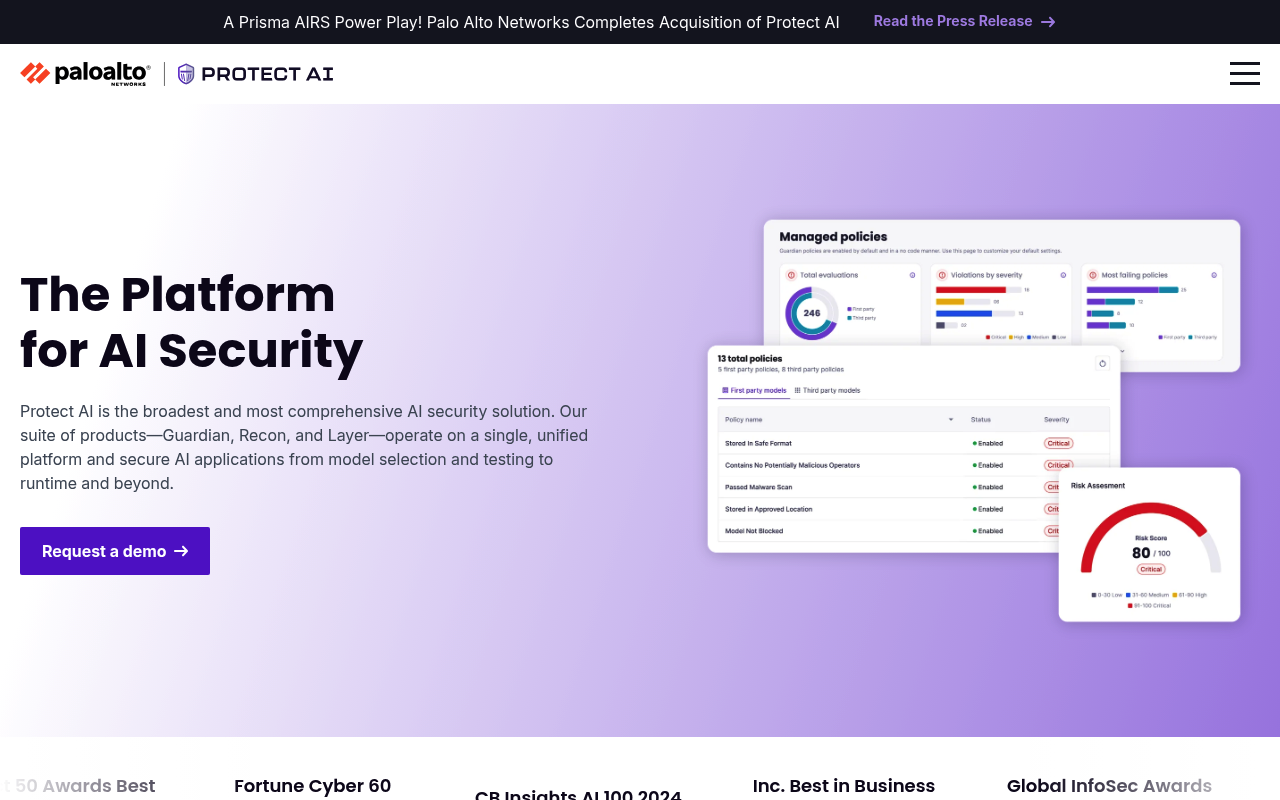
Protect AI is an AI/ML security company building defensive tooling and open-source security research for the model supply chain, large language model (LLM) applications, and runtime AI workloads. The commercial platform is anchored by three products — Guardian (AI model security and third-party model scanning across PyTorch, TensorFlow, ONNX, Keras, Pickle, GGUF, Safetensors, and 35+ formats with Hugging Face, SageMaker, MLflow, S3, Git, and Artifactory integrations), Recon (scalable AI red teaming with an attack library of 450+ known attacks against LLM applications mapped to OWASP LLM Top 10), and Layer (runtime AI security with 27 turnkey policies, eBPF and SDK collection, and DataDog/Splunk/Elastic/PagerDuty integration). Protect AI also stewards a portfolio of widely used open-source AI security projects on GitHub including LLM Guard (input/output scanner toolkit for prompt injection, PII, toxicity, secrets, and data leakage detection), ModelScan (model serialization attack scanner), Rebuff (prompt injection detector, archived May 2025), NB Defense (Jupyter notebook security), AI Exploits (real-world AI/ML vulnerability demonstrations), and Vulnhuntr (LLM-driven autonomous vulnerability discovery), plus the huntr bug bounty platform for AI/ML with over 17,000 security researchers. Protect AI was acquired by Palo Alto Networks in 2025 and is being integrated into the Prisma AIRS AI security platform. No public, programmatic developer API or OpenAPI specification is published for Guardian, Recon, or Layer at the time of this profile — integration is performed via product CLIs, SDKs, eBPF agents, and platform connectors documented behind Palo Alto Networks customer accounts.
Protect AI is profiled on the APIs.io network. Tagged areas include AI Security, ML Security, MLSecOps, AI Model Security, and AI Red Teaming.
Protect AI’s developer surface includes engineering blog, training material, documentation, YouTube channel, and 19 more developer resources.
Kin Score
 Kin Score
How this is scored →
Kin Score
How this is scored →scored 2026-08-20 · rubric v0.12.0
Security Posture 1
Authentication, domain security, vulnerability disclosure, and trust-center signals.
Resources
Documentation 2
Reference material describing how the API behaves
Build 1
SDKs, sample code, and the tooling you integrate with
Access & Security 2
Authentication, authorization, and security posture
Learn 2
Tutorials, courses, talks, and written guidance
Company 5
The organization behind the API
Other 11
Properties that don't map to a standard resource type
Scroll for all 11