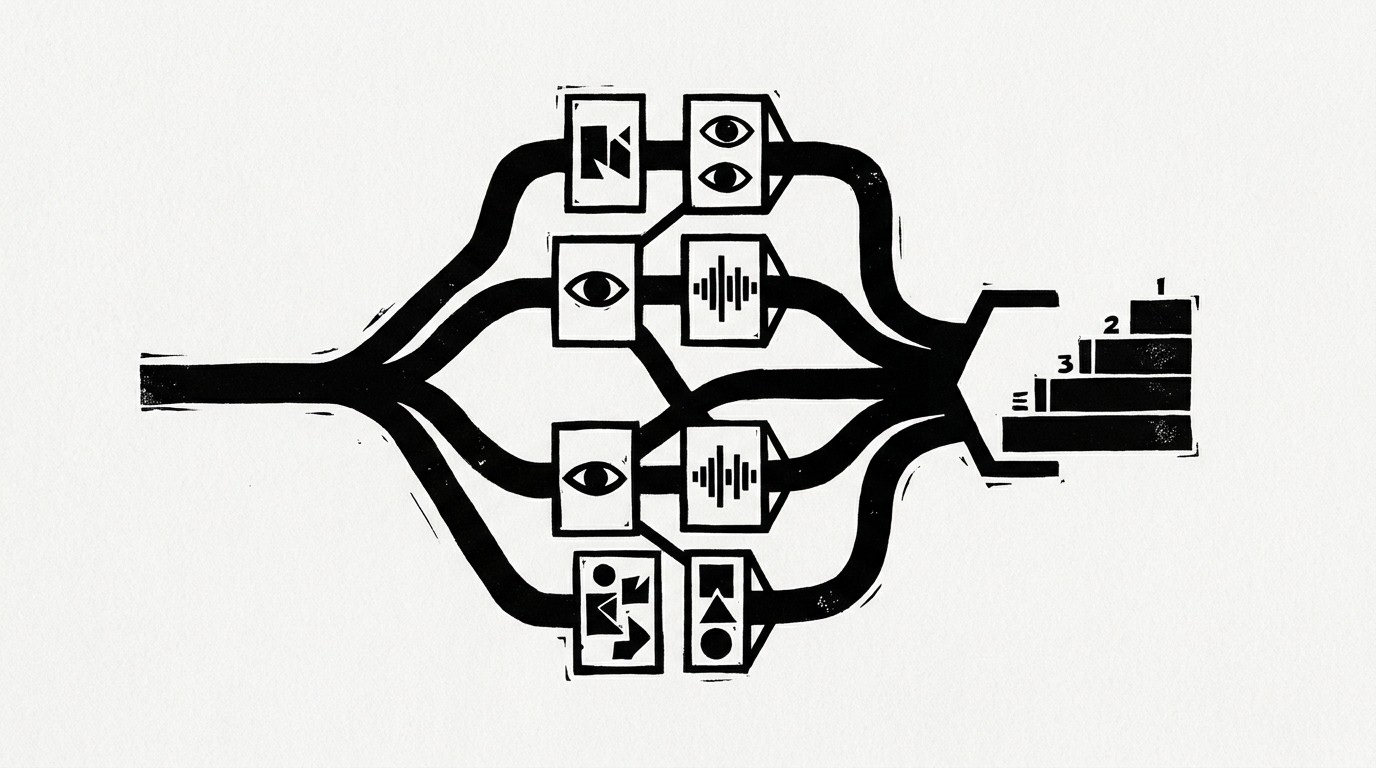
Google introduced the Gemini Decisions API, a new endpoint for closed-set decisions powered by a new model, Gemini Decision 1 (gemini-decision-1). You pass one multimodal input, text, images, audio, video or PDFs up to 256K tokens, with up to 1,000 independent questions, and the model scores your candidate options in a single forward pass instead of generating text. Three question types cover the ground: noul for yes/no, choice for 2 to 255 options, and score for an ordered rubric. Every answer carries a confidence from 0 to 1, “so your code can route ambiguous cases to a fallback or human reviewer.”
The numbers are Google’s: 150-250 ms end-to-end latency, $0.10 per 1M input tokens with zero output tokens billed, “nearly 5x cheaper” than Gemini 3.5 Flash-Lite across Google’s own benchmark suite, and up to 40% lower latency for Gemini Notebook, which uses it as a model router. Treat those as launch claims. What holds regardless is the shape of the pricing: the shared input is billed once per request no matter how many questions ride on it, and there is no output to bill. That turns routing, policy checks and grading from a generative call into a classifier you define by writing down the options.
The record for Google Gemini does not yet hold it. It carries 30 API pages, and the closest is the Gemini Interactions API, which matters twice here: the Decisions API takes the same Content block format as Interactions, and Interactions is what Google benchmarks it against. The Vertex AI Gemini API is where “support coming soon to Gemini in Google Cloud” will land. The agentic access profile counts 3 operations, which is thin for a provider with 30 API pages, and thinner now that one more has shipped.
On the rating, Google Gemini scores 64.4, strong, carried by access clarity (71.1), contract quality (70.2) and developer ergonomics (66.0), with contract governance at 43.6. Agent Readiness is 35.4, agent-ready, with an MCP server, rate-limit signals, error semantics and delegated identity lit. openapi_examples is unlit, and so is idempotency. For an endpoint built to sit in an agent’s control loop, where it is called before every tool selection and policy check, examples in the contract are how the next developer learns to write the questions. Google has shipped a decision primitive. The contract that tells an agent how to call it is the piece still missing from the record.