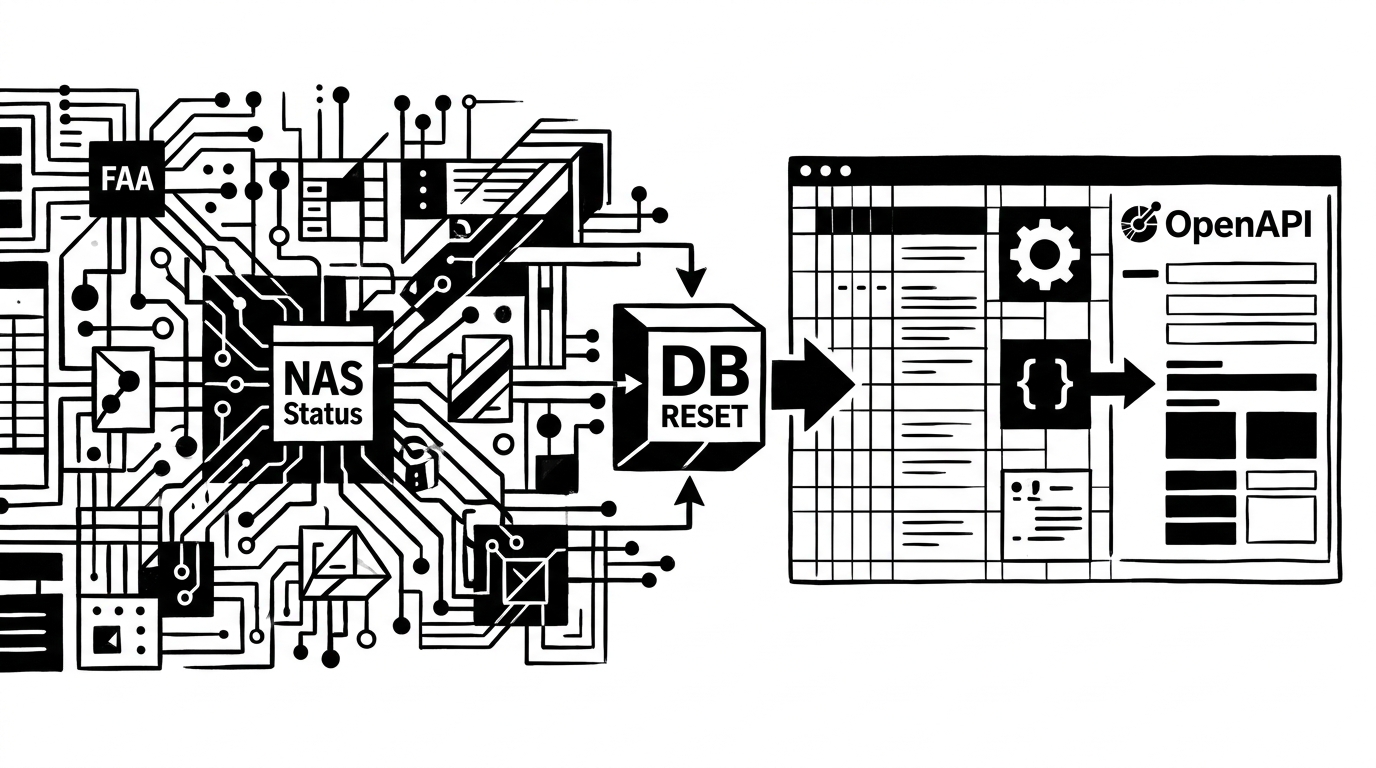
The Federal Aviation Administration has 41 APIs on the network, the most of any provider in air traffic. One of them is the Federal Aviation Administration Reset Db Controller API. It has one operation, GET /api/fixtures/reset-db, and its summary is “Reset db.” The FAA did not design this as a product. It is a test fixture, and it appears in the OpenAPI document that the FAA’s National Airspace System status site serves at nasstatus.faa.gov/v3/api-docs.
Where it came from
The provenance block on the contract records what happened. The source document was harvested from the FAA’s own published endpoint and verified by fetch. Then our refine-openapis stage split it by tag. The NAS Status application is a Spring service, and springdoc generates one tag per controller. Splitting by tag therefore turned each controller into its own API. Six one-operation APIs on the FAA page come from that one document:
| API page | Operation |
|---|---|
| Airport Status Information Controller | GET /api/airport-status-information |
| Airport Events Controller | GET /api/airport-events |
| ARTCC Boundary Controller | GET /api/artcc-boundaries |
| Operations Plan Controller | GET /api/operations-plan |
| Analytics Controller | POST /api/metric-log |
| Reset Db Controller | GET /api/fixtures/reset-db |
Three of these are useful public data. Airport status, airport events and the operations plan are what the NAS Status map shows. The fourth is a metrics logger for the site’s own frontend. The fifth resets a database.
Three things the contract shows
A fixture route is in a production document. Spring applications commonly ship a fixtures controller for test environments. This one is listed in the API description served by the production host. We have not called it and we will not. A GET route that resets state should not be in a public contract. The FAA should either remove it from the springdoc scan or gate it behind a profile that production never runs.
Method names leak into summaries. The ARTCC boundaries operation has the operationId getAirportEvent and the summary “Get airport event,” which is a controller method copied and never renamed. The airport events operation is getAirportEvent_1 because the name collided with it. Springdoc publishes whatever the code says.
Our base URL is wrong. All six pages declare https://external-api.faa.gov/notamapi/v1 as the base URL, which is the NOTAM API’s host. The contract’s own server is https://nasstatus.faa.gov. The NAS Status airport feed page already has the right host. These six inherited a provider default rather than reading their own spec.
What is ours to fix
Splitting a document by controller tag works well for a large, curated contract. Applied to a raw springdoc dump, it publishes fixtures and frontend telemetry as products. The fix belongs in the refine stage. It should not split out a tag whose only paths are /fixtures/ or internal telemetry, and the base URL should come from spec_server. The FAA page should list one NAS Status API with three operations, not six APIs.
Takeaway
A harvested contract is evidence of what a provider publishes. It does not mean every path in it is meant for you. The FAA’s real NAS Status surface is airport status, events and the operations plan. The provider page is at apis.io/providers/faa/.