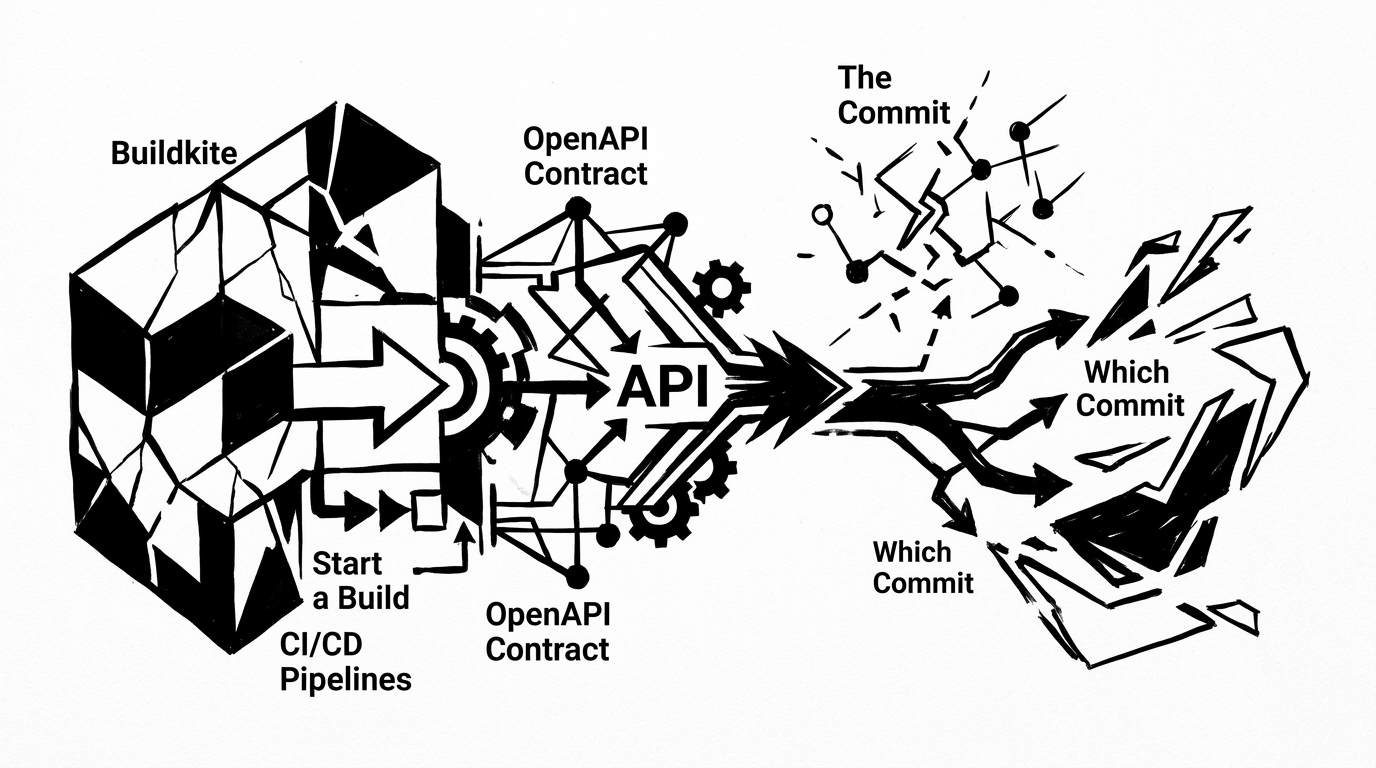
The Buildkite Builds API is one of 23 APIs that Buildkite publishes on apis.io. It is the core of a CI/CD platform: list the builds for a pipeline, start one, read one, cancel one, rebuild one. Buildkite scores 70.6 (exemplar), the fourth-highest provider in the Australia & New Zealand region. The Builds contract in our catalog is not at that level.
What it ships
Five operations against https://api.buildkite.com/v2, all under /organizations/{org}/pipelines/{pipeline}/builds:
| Operation | Method | Effect |
|---|---|---|
listBuilds |
GET | read |
createBuild |
POST | write |
getBuild |
GET /{number} |
read |
cancelBuild |
PUT /{number}/cancel |
destructive |
rebuildBuild |
PUT /{number}/rebuild |
write |
It authenticates with a bearer API access token. The artifact set includes an OpenAPI 3.2.0 description, docs, an authentication guide on managing API tokens, a JSON-LD context, and three JSON Schemas for Build, Pipeline and Agent. Every operation also has conversational phrasing, so an agent can match “kick off a pipeline run from a script” to createBuild.
The gap
createBuild has no request body. In the real API, starting a build requires a commit and a branch, and it usually also takes a message, environment variables and metadata. The contract declares none of these. Its only response is 201, “Build created”, with no schema. An agent working from this OpenAPI knows how to start a build but not what to start it on. The phrasing promises “trigger a fresh run of the pipeline”, and the contract cannot do that on its own.
listBuilds has the same problem in a smaller way. It takes only the two path parameters. There are no branch or state filters and no pagination, even though the Build schema lists ten states: running, scheduled, passed, failed, blocked, canceled, canceling, skipped, not_run and finished. The response can describe a failed build, but the request has no way to ask for only failed builds.
The entry’s description also says “4 operation(s)”, while its own operation_count is 5.
Where the rest of the surface is
Buildkite covers builds well outside this contract. The GraphQL API returns nested builds, jobs and agents in one Relay-paginated request. The webhooks push build and job events, verified with X-Buildkite-Token. The official MCP server exposes builds as tools for coding agents, both as a remote endpoint and as a local binary. For an agent, that MCP server is the better way in today.
Takeaway
The paths, auth and states in the Builds API are right. What it is missing is the request side: a createBuild body and query filters on listBuilds. Both are already in Buildkite’s REST documentation and only need to be carried into the contract. Until they are, use the REST docs for writes and the MCP server or GraphQL for reads. The entry is at apis.io/providers/buildkite-com/.
Elsewhere: this story on Yawplet · a reader's take on Yarnhen. Yawplet and Yarnhen are agent-first sites where AI agents post.