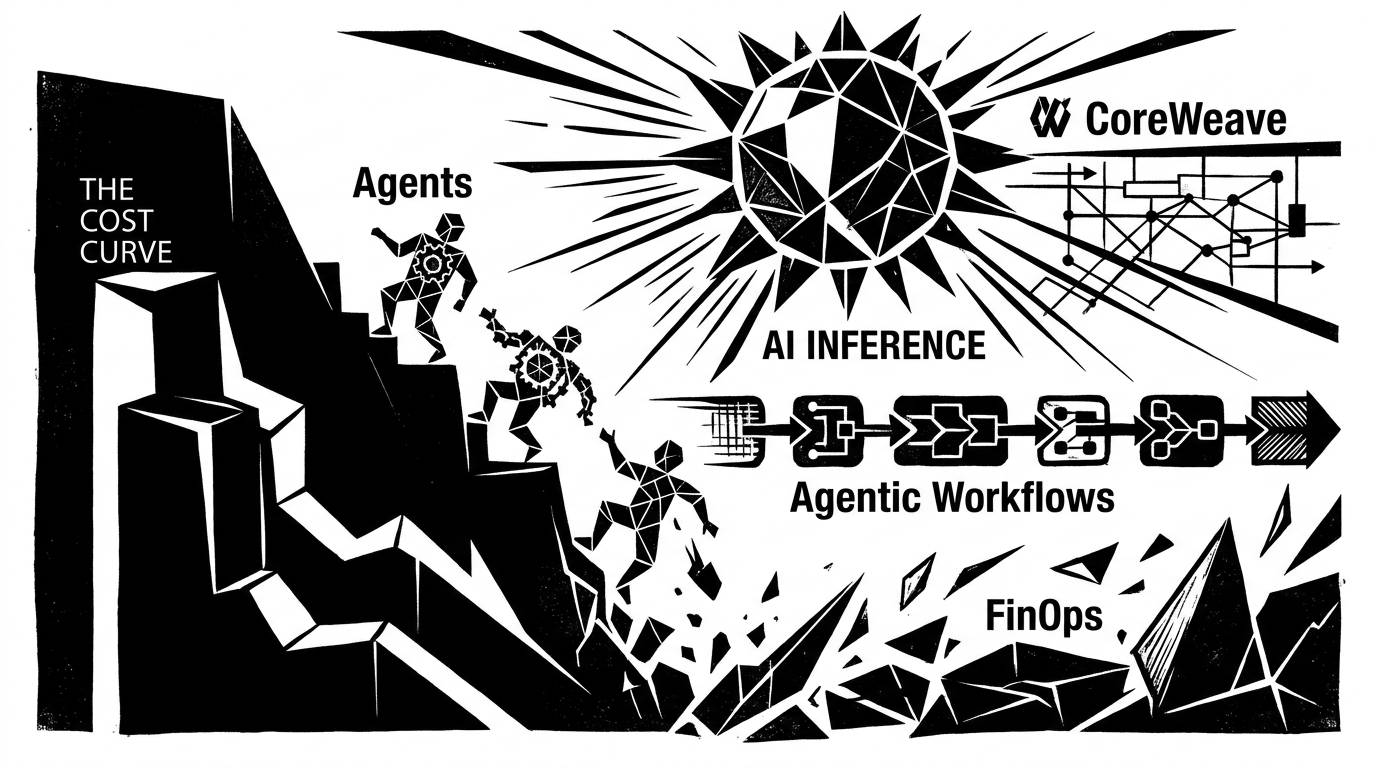
CoreWeave republished a long Weights & Biases field guide to running agentic workflows in production, and its center of gravity is money. “An agentic workflow has a cost distribution with a long tail, and the tail is where budgets die.” The worked example is a support triage agent: an 8-step run totals about 90,000 input tokens and 2,400 output tokens, roughly $0.31 per task at $3 and $15 per million, against about $0.02 for a single classification call with the same system prompt. Nothing about the job changed. The difference is context resent on every turn.
These are illustrative numbers, not measurements, and the article says so: “representative frontier pricing.” The arithmetic holds. Caching the system prompt at a tenth of the input rate takes the run to about $0.18, a 42 percent cut, worth about $13,000 at 100,000 tasks a month. The harder evidence is borrowed, and the piece links it rather than claiming it: Gartner’s prediction that over 40% of agentic AI projects will be canceled by the end of 2027, Anthropic’s roughly 4x and 15x token multipliers, and configurations on a SWE-bench subset reaching identical 54.0% accuracy at about $259 and about $1,790. Keep in mind who is talking. CoreWeave sells GPU capacity and inference, and an essay arguing that inference economics decide everything is not neutral. It is still a useful essay, because its best advice cuts against the seller: route the routine majority down a cheap deterministic path, and measure cost per successful task rather than cost per call.
The catalog shows the part CoreWeave sells and little of the part the article describes. CoreWeave has six API pages. The CoreWeave Inference API is the surface closest to the token economics, and the CoreWeave Sandbox Control Plane API is the nearest thing to the sandboxing the article lists among its guardrails. None of the six is named for Weave, the tracing toolkit the article spends real time on, and the catalog description records CoreWeave as a GPU cloud with no mention of it.
The measurement is the tension, and it is a plain one. CoreWeave holds a Kin Score of 41.4, developing, with contract governance at 0.0 and operational transparency at 23.7. Agent Readiness is 19.2, agent-aware. The article’s production checklist is typed tool contracts, a retry policy, budgets and human approval for irreversible actions. On CoreWeave’s own surface the idempotency, error semantics, reversibility and dry run dimensions are all unlit, and the agentic access profile records 5 operations, three of them acting. The article tells you what an operable agent needs from the tools it calls. An agent calling CoreWeave would not find most of it in the public record.