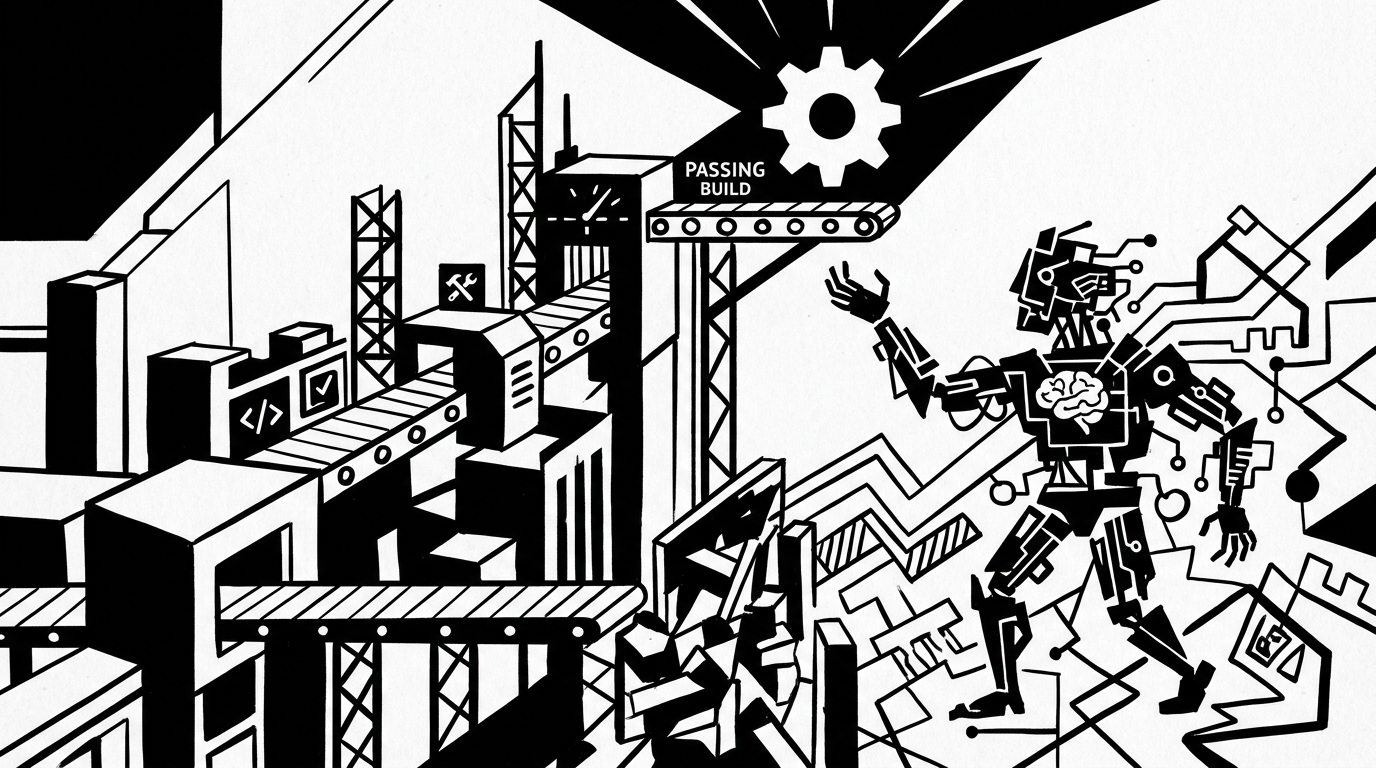
The Jenkins project has answered the prediction that agents make CI obsolete, and the answer is short. In Jenkins and AI Agents: The Trusted Engine for Faster Software Delivery, a long-time contributor writes that “generating a change is not the same as proving it works.” Agents are probabilistic, “the same instruction can lead to different code, different approaches, and different confidence levels,” while delivery depends on repeatable checks. Jenkins turns a proposed change into a controlled execution and gives the agent “something more useful than reassurance: evidence.”
There are no figures, and the argument is careful about its limits. “A successful build is not proof that software is flawless, and a green pipeline cannot validate every business requirement. But a passing build is a concrete, repeatable signal that a probabilistic system can’t provide simply by reasoning about its own code.” The practical advice follows from the volume agents create: parallel stages, caching and targeted tests so feedback arrives fast, with failFast to stop early and a deploy stage guarded by when { branch 'main' } so “agent branches never reach this stage.” On governance, the post names the risks of “the AI PR firehose,” a leaked credential, a weakened test, a change beyond the agent’s scope, and recommends scoped credentials, a secret manager, signed artifacts and keeping untrusted changes away from privileged environments. “Agent-generated pipeline changes deserve the same testing and review as application code.”
The catalog holds the surface an agent would drive. The Jenkins provider page lists 4 API pages, and the loop the post describes runs over the Jenkins Jobs API to trigger a build, the Jenkins Queue API to follow it, and the Jenkins Computer API for the isolated workers it runs on. The agentic access profile maps 8 operations, 2 of them acting. Spec presence, agentic access, the MCP server, auth clarity and the rate limit signal are lit on the Agent Readiness score.
The Kin Score is 36.6, thin band, with discoverability at 61.7 and developer ergonomics at 45.2 against access clarity at 26.3 and contract governance at 4.5. The Agent Readiness score is 23.2, agent-aware. Error semantics, idempotency and the event surface are unlit, and those three are the evidence channel the post is about. An agent that triggers a build needs to know, from the contract, what a failure looks like, whether a retried trigger starts a second build, and how to be told when the run finishes instead of polling. Jenkins is right that the pipeline is where an agent earns trust. The Remote Access API that hands the agent its evidence is still described more thinly than the pipeline it reports on.