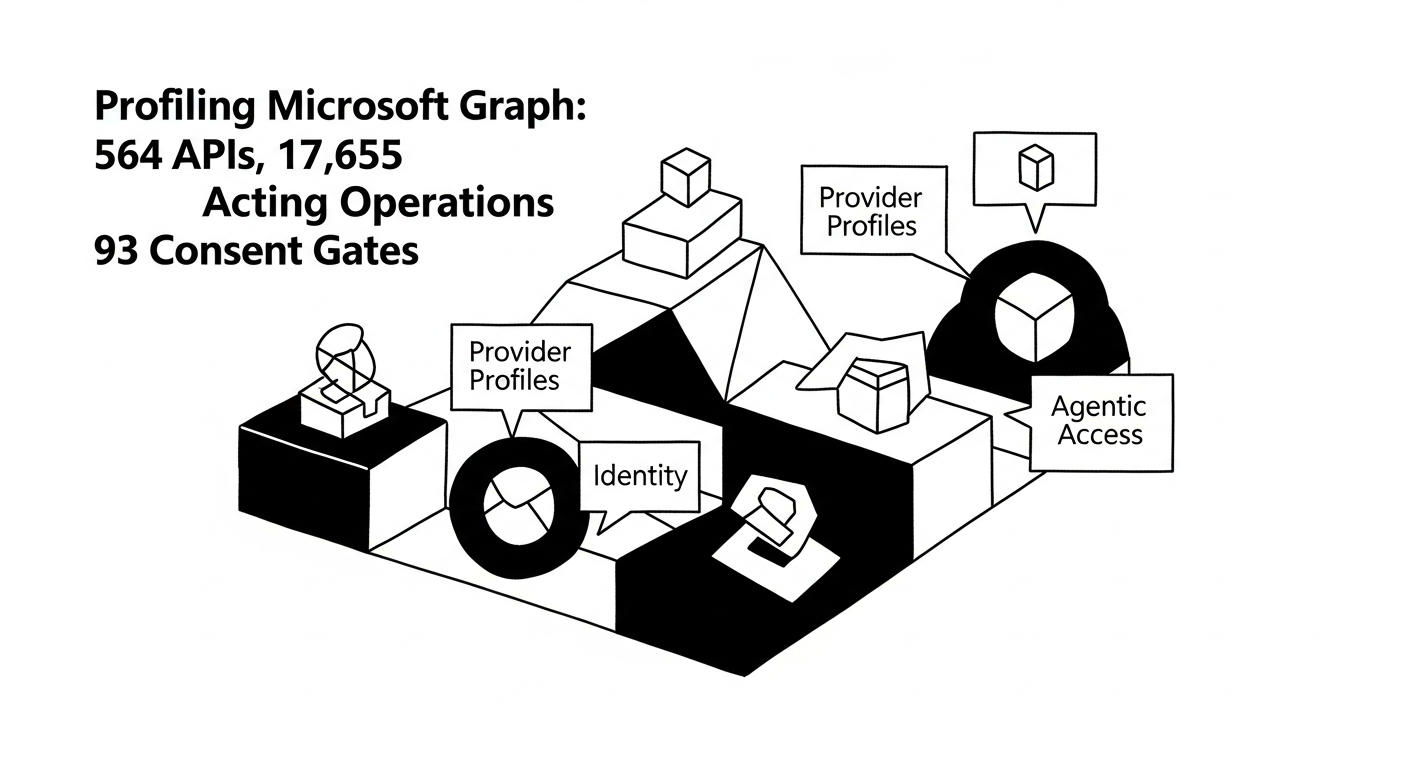
Microsoft Graph publishes 564 APIs on the network — the unified programmability model over Microsoft 365, Entra ID, Teams, OneDrive, SharePoint and the security services. It scores 67.9, an exemplar band, and every one of its 564 contracts is callable as published.
That last number is rarer than it sounds. A provider this size usually leaks placeholder hosts. Graph does not.
What is in the surface
The catalog carries all 564 OpenAPI specifications, one AsyncAPI describing Graph change notifications, one GraphQL schema, and two Spectral governance rulesets. Tagged areas run across Azure AD, Collaboration, Contacts, Documents, Email, Identity, Presentations, Productivity, Spreadsheets and Tasks.
The facet breakdown is lopsided in an interesting way:
| Facet | Score |
|---|---|
| Commercial clarity | 84.2 |
| Operational transparency | 78.9 |
| Discoverability | 68.5 |
| Contract quality | 67.6 |
| Developer ergonomics | 56.5 |
| Governance | 47.9 |
Microsoft is better at telling you what things cost and whether they are up than it is at telling you how the surface is governed. For a platform that a billion-plus seats depend on, governance at 47.9 is the number to sit with.
The number that matters
Graph’s agentic access profile is the largest in the catalog: 37,105 operations, of which 17,655 are acting — operations that change state rather than read it.
Human-in-the-loop: 93.
That is a half of one percent. Seventeen thousand ways for an agent to write, delete, send, provision or revoke something inside a tenant, and ninety-three places where the surface itself signals that a person should be asked first.
This is not a claim that Microsoft has no consent model. Entra ID, admin consent and scoped permissions are real and they are enforced. It is a narrower and more specific claim: at the level of the published contract, almost nothing distinguishes an operation an agent may take alone from one it may not. That distinction currently lives in documentation and in tenant policy, not in the machine-readable surface an agent actually reads.
Exemplar and not agent-ready
Graph scores 67.9 on the Kin Score and 38.7 on agent readiness. The gap is the whole story of this profile.
Spec presence, auth clarity, error semantics and rate-limit signalling are all there. What is not: no MCP server, no Agent Skills, no .well-known catalog, no agent card, no dry-run mode, no idempotency signalling, and no consent-identity dimension. Nine of fourteen readiness dimensions are absent.
An API can be exemplary for the developer it was designed for and still be unprepared for the consumer that showed up afterward. Graph is the clearest case in the catalog.
Takeaway
564 callable contracts, 100% of them resolvable, an exemplar composite, and the biggest acting surface anyone publishes — with 93 human-in-the-loop markers standing between agents and seventeen thousand state changes. The contract quality is not the problem here. The absence of a machine-readable answer to should you do this without asking is.
See the full profile at apis.io/providers/microsoft-graph/.